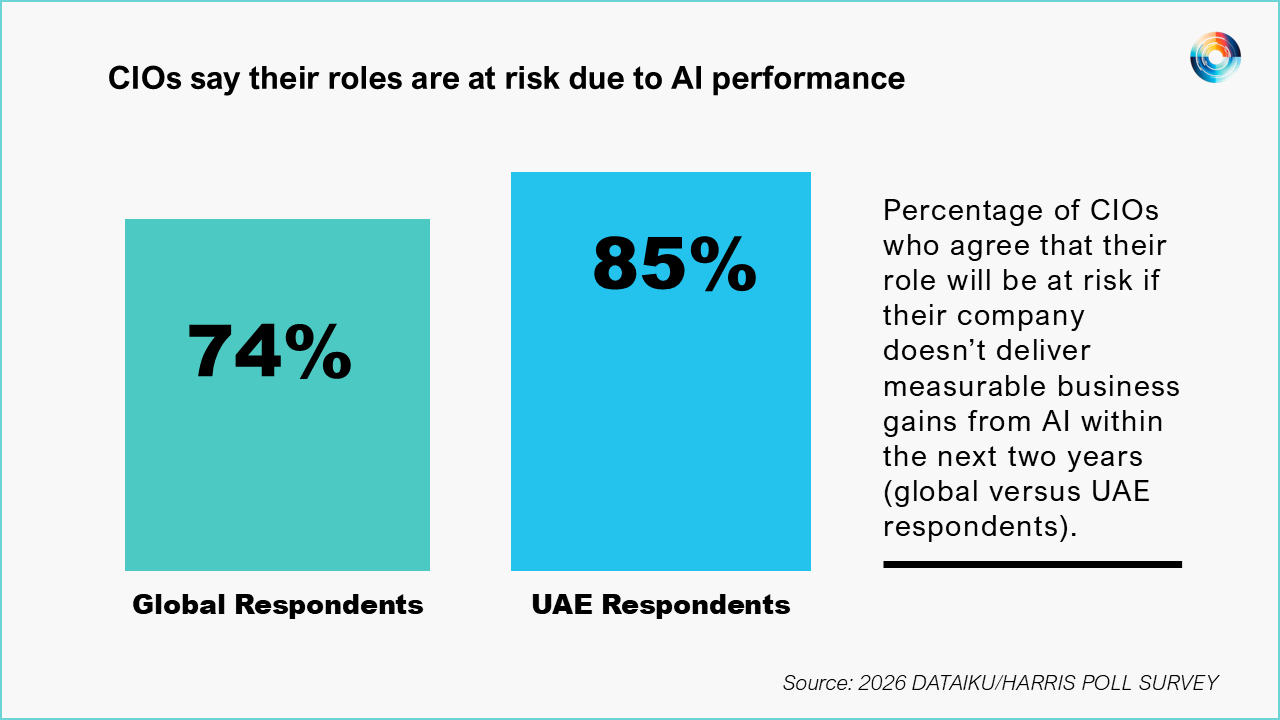
#UAE #survey – Eighty-five per cent of UAE chief information officers believe their role could be at risk if their organisation fails to deliver measurable business gains from artificial intelligence in the next one to two years, according to global research from US AI and analytics platform Dataiku conducted by Harris Poll surveying 600 CIOs across eight countries. Nearly all UAE CIOs (98%) say their professional reputation will be shaped by their success with AI—the highest globally—whilst 92 percent expect chief executive compensation to be directly linked to AI outcomes, signalling that accountability is cascading down from the boardroom.
Meanwhile, three-quarters of UAE CIOs say their organisation would face high financial distress if the “AI bubble” were to burst, whilst 65% report AI agents are embedded in business-critical workflows, demonstrating how mission-critical AI has become to enterprise success in the country.
SO WHAT? – The findings reveal CIOs are moving from experimentation into accountability faster than most organisations expected. Seventy-eight percent report that employees are creating AI agents and applications faster than IT teams can govern them whilst only one in five have complete oversight of all AI agents in use across the organisation. This dynamic leaves CIOs personally accountable for systems they may not fully control, increasing the importance of traceability, governance and visibility as the conversation shifts from “how fast can we deploy AI?” to “how confidently can we stand behind it?”
Here are some key points about the research:
US AI and analytics platform Dataiku has released a new research report “The 7 Career-Making AI Decisions for CIOs in 2026” based on a survey of 600 enterprise CIOs across eight countries conducted by Harris Poll.
UAE CIOs report 65% of organisations have AI agents embedded in business-critical workflows, whilst only 22% say they are frequently or almost always asked to justify AI outcomes they cannot fully explain—the lowest figure globally—suggesting strong level of internal trust in AI-driven decision-making.
However, the UAE ranks highest globally for concern that insufficient AI explainability could trigger a crisis eroding customer trust or brand credibility, with nearly two-thirds (63%) saying this outcome is very likely or certain, indicating confidence may mask growing exposure.
More than three-quarters (78%) of UAE CIOs say employees are creating AI agents and applications faster than IT teams can govern them, whilst only one in five report having complete oversight of all AI agents in use across the organisation.
Two-thirds (67%) of CIOs say their organisations always require human sign-off before AI systems take action in business-critical workflows, with the UAE ranking first globally for having formal, documented human-in-the-loop procedures.
Sixty-five per cent believe it is at least very likely, if not certain, that governments will introduce AI explainability requirements in 2026, reinforcing the belief that the next phase of AI advancement will be defined less by experimentation and more by defensibility.
Despite rising pressure, UAE CIOs remain the most confident globally that their current AI strategies will remain valid over the next year, suggesting that whilst stakes are high, many believe they are moving in the right direction provided they can maintain control as AI adoption accelerates.
[Written and edited with the assistance of AI]