

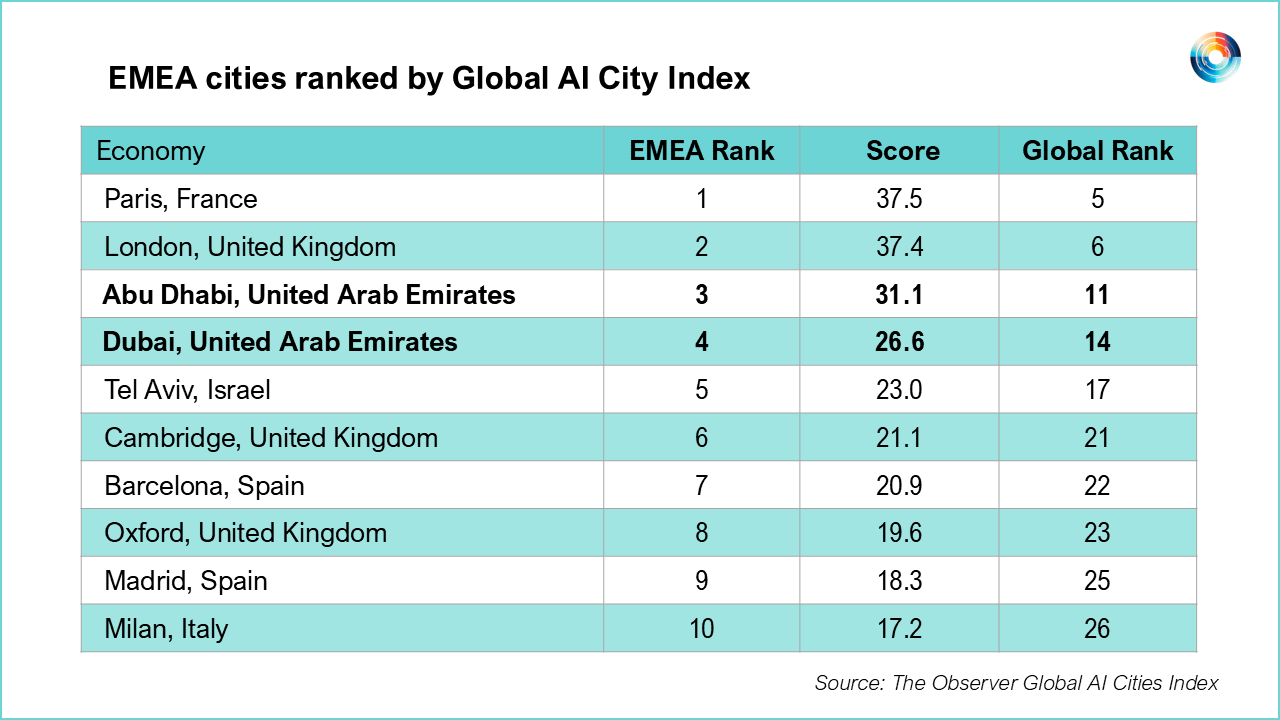
#UAE #GlobalCitiesIndex - UK magazine The Observer has published its first Global AI Cities Index, with Abu Dhabi and Dubai both ranking in the top five among Europe, Middle East and Africa cities. Abu Dhabi placed 11th globally out of 57 cities assessed, the highest ranking for any city in the region. Meanwhile, Dubai ranked 4th globally on the index’s Public Investment pillar, which measures government spending commitments to AI infrastructure, research and sector support. The index, commissioned by Abu Dhabi research universities Mohamed bin Zayed University of Artificial Intelligence (MBZUAI) and Khalifa University, scores cities across 50 indicators and seven pillars.
SO WHAT? - Two UAE cities placing in the EMEA top five, in a region dominated by European technology hubs, is a strong showing for a market of its size. Dubai’s 4th place finish globally on Public Investment stands out in particular, indicating government commitment (something few established tech hubs lead on). That’s consistent with overall UAE policy, where state investment is the driving force behind AI capacity building.
KEY POINTS:
The Observer’s Global AI Cities Index ranked 57 cities worldwide using 50 indicators across seven pillars, drawing on 20 data sources, commissioned by Mohamed bin Zayed University of Artificial Intelligence (MBZUAI) and Khalifa University.
The seven pillars of the new index are: Infrastructure, Operating Environment, Development, Research, Commercial Ecosystem, Private Investment and Public Investment.
Abu Dhabi and Dubai both ranked in the top five cities in the Europe, Middle East and Africa (EMEA) region, alongside Paris and London.
Abu Dhabi ranked 11th globally with an overall score of 31.1, the highest-placed city in the Middle East, ahead of Dubai in 14th place at 26.6.
Dubai ranked 4th globally on the index’s Public Investment pillar, with a score of 63.7, its strongest result across all seven measured categories.
Abu Dhabi also performed strongly on Public Investment, ranking 6th globally with a score of 36.2, and on Operating Environment, ranking 5th globally with a score of 77.9.
San Francisco Bay Area topped the overall global index with a score of 100, followed by New York (50.1), Seoul (48.1), Beijing (45.4) and Paris (37.5).
Riyadh ranked 11th in the EMEA region and 28th globally, with a score of 16.6, its strongest results coming in Private Investment (10th globally) and Public Investment (8th globally).
Both Abu Dhabi and Dubai scored comparatively low on Research and Commercial Ecosystem, the pillars covering AI research output and depth of local company activity.
ZOOM OUT - The UAE earned its strong showing on the new Global AI Cities Index by formulating strong policy choices stretching back nearly a decade. In October 2017, the UAE appointed the world's first Minister of State for Artificial Intelligence and launched the National Strategy for Artificial Intelligence 2031, among the earliest national AI strategies anywhere. Furthermore, the country has proved to be relentless in its implementation of its AI strategy. Earlier this year, the UAE created a new federal Artificial Intelligence and Data Authority reporting directly to Cabinet, renamed its Ministerial Development Council to give AI transformation executive authority at the highest level of government, and set a two-year deadline to deploy agentic AI across 50 percent of government sectors and services.
[Written and edited with the assistance of AI]
Source: The Observer, various
LINK
Global AI Cities Index (The Observer)
Read about other key indexes and reports:
UAE retains top world AI use ranking (Middle East AI News)
Gulf firms race ahead on AI, as skills fall behind (Middle East AI News)
Saudi Arabia, UAE AI spend surges, execution lags behind (Middle East AI News)
Falcon H1 tops new global sovereign AI index (Middle East AI News)
UAE ranks top in MENA on QS World Future Skills Index (Middle East AI News)