#MENA #AIeconomy - AI could unlock more than $1 trillion in economic and sustainability value across the Middle East and North Africa by 2030, according to the conclusions of World Economic Forum (WEF) research. The think tank released two new reports at its Annual Meeting of Global Future Leaders in Dubai, the first was developed with consultancy Bain & Company. A second, with Saudi Research and Media Group (SRMG), says new data centres in the region could connect to the grid in two to five years, against more than 10 in mature markets.
SO WHAT? - The $1 trillion figure is a modelled estimate that depends on AI being deployed at scale. However, the gap between ambition and practice appears to be a wide one. Fewer than six in ten sustainability leaders describe their AI use cases as piloting or scaled, even though 89 percent see high potential. The infrastructure report adds a second condition. MENA’s speed to the grid is a real advantage, but only if data centres can handle volatile AI loads without straining power and water systems.
KEY POINTS:
The World Economic Forum (WEF) published two reports at its Annual Meeting of Global Future Leaders in Dubai: Unlocking Value: AI for Resilient Growth in MENA, with Bain & Company, and Optimizing Hyperscale Data Centre Infrastructure in MENA, with Saudi Research and Media Group (SRMG).
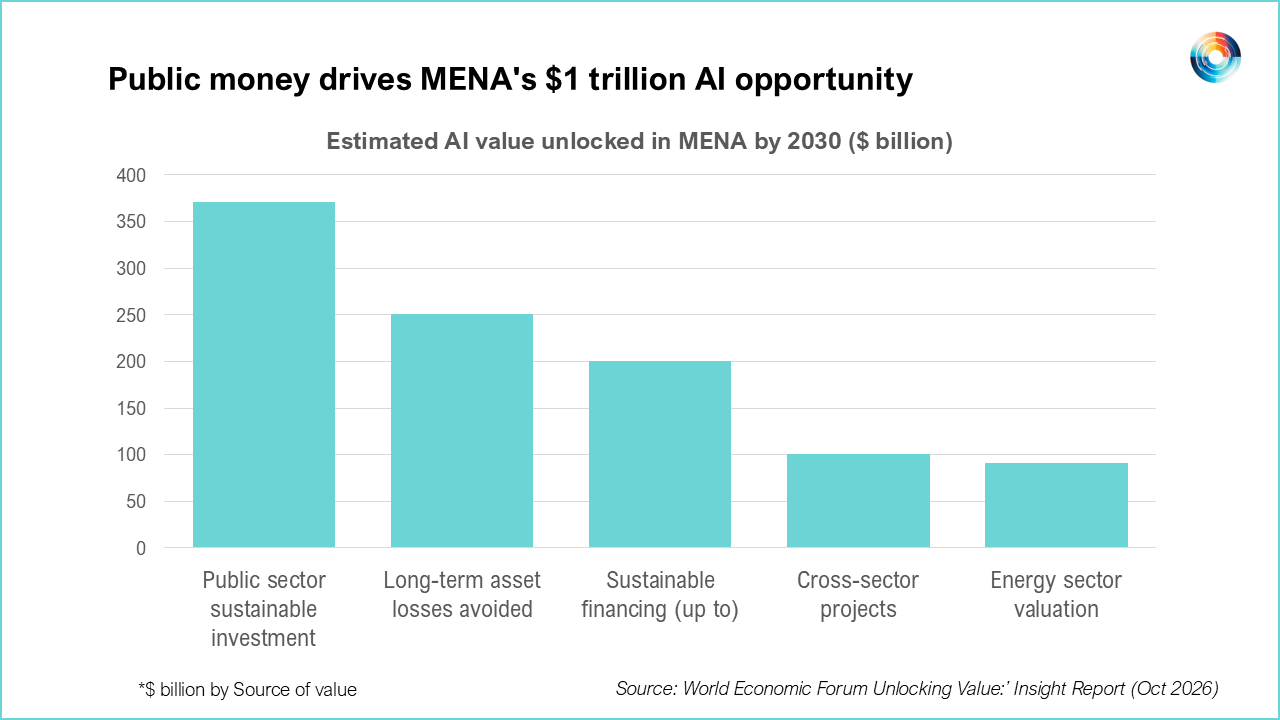
The first report estimates AI could unlock more than $1 trillion in economic and sustainability value across MENA by 2030, if deployed at scale.
The total includes up to $200 billion in sustainable financing through the financial sector and $370 billion in sustainable investment flows enabled by the public sector.
It also includes $250 billion in long-term asset losses avoided, $90 billion in added energy sector valuation and $100 billion in sustainable projects launched through cross-sector partnerships.
While 89% of sustainability leaders surveyed see high or very high potential for AI, only 40-55% describe their adoption of sustainable AI use cases as piloting or scaled, depending on the use case.
Five prototypes were built with First Abu Dhabi Bank, ADNOC, Bahrain’s Ministry of Sustainable Development and Saudi Arabia’s Ministry of Economy and Planning. They cover sustainable finance, climate hazard prediction, ESG intelligence, SME financing and cross-sector collaboration.
The infrastructure report treats AI infrastructure as a systems challenge needing integrated planning of energy, water and digital networks. Cooling can account for more than 40% of data centre electricity use globally, and regional heat makes it harder.
The report warns MENA’s grid advantage could erode if data centres can’t absorb volatile AI loads. It recommends smarter design, AI-driven operations, advanced cooling and updated regulation.
[Written and edited with the assistance of AI]
Source: WEF