

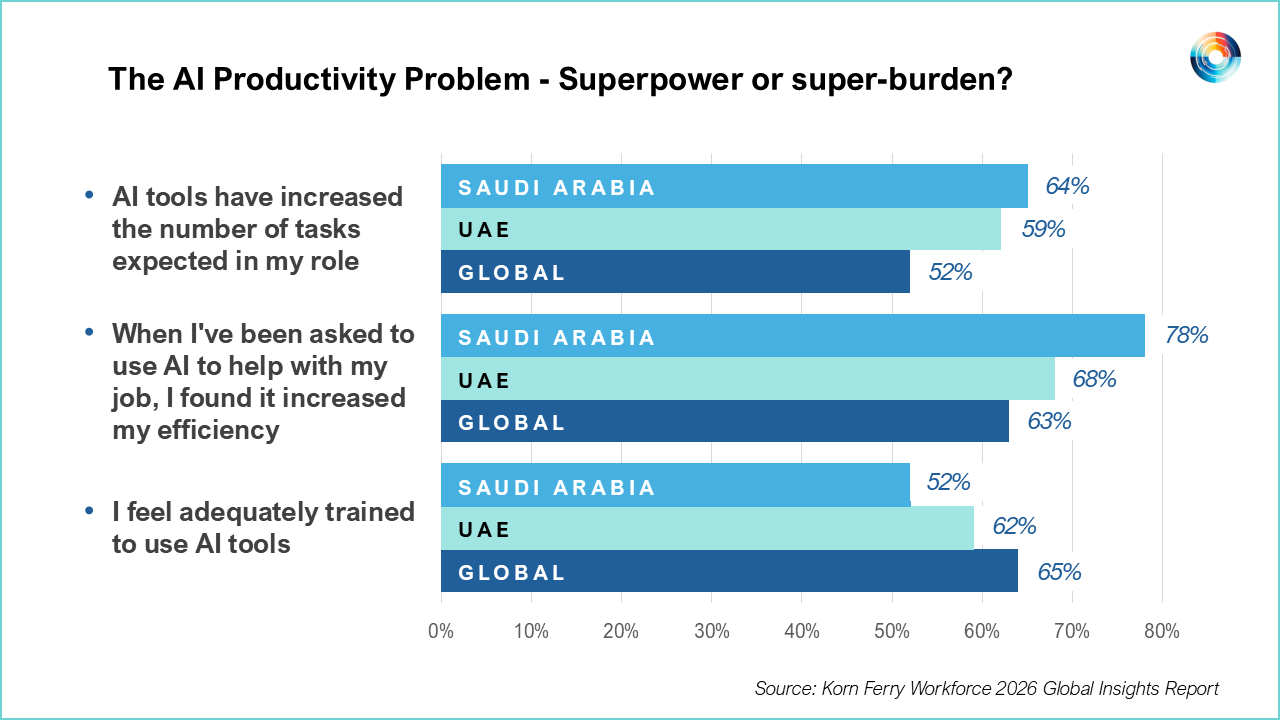
#GCC #workforce - Gulf employees report heavier workloads than their global peers, and AI is adding tasks to their roles. Global consulting firm Korn Ferry surveyed more than 16,000 professionals across 11 markets for its Workforce 2026 Global Insights Report. It found 70 percent of UAE and 71 percent of Saudi employees find that their workloads have grown significantly in two years, against 62 percent globally. AI tools have increased expected tasks for 59 percent of UAE and 64 percent of Saudi respondents. Globally, 79 percent of CEOs report AI efficiency gains, against 51 percent of individual contributors.
SO WHAT? - The Gulf’s AI push depends on the people asked to deliver it, and this survey suggests some of those are running out of capacity. Executives see efficiency gains, while staff see extra tasks and, for 65 percent in the UAE and 69 percent in Saudi Arabia, more than one job. Training isn’t the main gap: 62 percent of UAE and 65 percent of Saudi respondents feel adequately trained on AI tools, well above the 52 percent global figure. The problem is workload and role design, which no course fixes.
KEY POINTS:
Korn Ferry released its third annual Workforce 2026 Global Insights Report in September 2026, surveying more than 16,000 professionals from entry level to CEO across 11 markets, including Saudi Arabia and the UAE, Australia, Brazil, France, Germany, India, Japan, Singapore, the UK and the US.
Gulf employees manage heavier workloads, compared to global counterparts. 70% of UAE and 71% of Saudi respondents say their workload has increased significantly in two years, against 62% globally. Some 50% and 58% say they are too busy to deliver meaningful results, against 45% globally.
AI is expanding job scope. Some 59% of UAE and 64% of Saudi respondents say AI tools have increased the number of tasks expected in their role, against 52% globally.
Globally, 79% of CEOs report improved efficiencies from AI, against 51% of individual contributors. Among Gulf respondents asked to use AI, 68% in the UAE and 78% in Saudi Arabia say it increased their efficiency, against 63% globally.
Some 65% of UAE and 69% of Saudi respondents say they perform the responsibilities of more than one role, against 61% globally, as work from restructured or AI-replaced roles passes to remaining staff.
Gulf staff feel better prepared than most globally. 62% of UAE and 65% of Saudi respondents say they are adequately trained to use AI tools, against an average of 52% across the survey.
However, workforce motivation has fallen from 71% in 2024 to 61% in 2026. The report says employees now stay for pay, job security and fair treatment rather than the work itself.
Some 68% of UAE and 75% of Saudi respondents say existing processes and structures hold back their performance, against 64% globally. Some 57% and 63% say their organisation is poor at turning new ideas into real outcomes, against 52% globally.
Globally, 42% of organisations have cut management roles in the past year, and 55% of remaining managers say they are exhausted. Some 50% of UAE and 58% of Saudi respondents say they aren’t getting what they need from their manager, against 45% globally.
ZOOM OUT - The global picture is similar, but Gulf employees seem to be feeling more pain. Korn Ferry's survey of more than 16,000 professionals found 62 percent report significantly heavier workloads over two years, and 45 percent say they're too busy to deliver meaningful results. While 79 percent of CEOs report AI efficiency gains, only 51 percent of individual contributors do, and 52 percent say AI has added to their workload. Some 61% now perform more than one role, and motivation has slipped from 71 percent in 2024 to 61 percent. Management is thinner too: 42 percent of organisations cut manager roles last year, and 55 percent of remaining managers say they're exhausted.
[Written and edited with the assistance of AI]
Source: Korn Ferry
LINKS
Access the full report (Korn Ferry)
Read more about AI in the workforce:
UAE retains top world AI use ranking (Middle East AI News)
Gulf firms race ahead on AI, as skills fall behind (Middle East AI News)
UAE ranks top in MENA on QS World Future Skills Index (Middle East AI News)
45% of Saudi Internet users now use AI (Middle East AI News)
AI now features in 1 in 30 new Gulf jobs (Middle East AI News)