

#UAE #R&D – Researchers at New York UniversityAbu Dhabi have demonstrated that AI can independently rediscover fundamental principles of particle physics directly from experimental data, without any prior theoretical knowledge built into the system. Published in the peer-reviewed Journal of High Energy Physics, the study used particle discovery data from the 1950s and 1960s to show that relatively simple unsupervised machine learning techniques can uncover the same organising principles that took human scientists decades to identify. Developed by physicists in the 1960s and 1970s, the Standard Model theory classifies all known fundamental particles. The new study’s findings suggest AI could also be used to identify new particles and previously unrecognised patterns in physics data that human researchers may have missed.
SO WHAT? – The Standard Model is one of the greatest intellectual achievements in the history of science, built over decades through theoretical insight, experimental discovery and mathematical innovation. The fact that a relatively simple AI system, provided with only raw experimental data, can arrive at the same fundamental structures is a striking result. It could pave the way for AI to serve as a powerful tool for scanning vast bodies of experimental data for patterns that human researchers would not know to look for and, potentially, point to new physics beyond the Standard Model.
Here are some key points about the discovery:
A new study from New York UniversityAbu Dhabi — Rediscovering the Standard Model with AI — has been published in the peer-reviewed Journal of High Energy Physics, The research study demonstrates that AI can independently rediscover fundamental principles of particle physics directly from experimental data, without any prior theoretical knowledge built into the system.
NYU Abu Dhabi researchers including Aya Abdelhaq, Pellegrino Piantadosi and Fernando Quevedo applied unsupervised machine learning techniques, including dimensionality reduction and clustering algorithms, to experimental particle physics data from the 1950s and 1960s. The AI system was not provided with any prior theoretical knowledge of the mathematical tools used at the time.
The AI independently identified fundamental organising principles of the Standard Model (SM), including baryon number, isospin, strangeness, charm and bottom quantum numbers, conserved quantities that took human physicists years of theoretical and experimental work to establish.
The research used three unsupervised learning techniques: principal component analysis, t-distributed stochastic neighbour embedding, and clustering algorithms. The fact that these are relatively standard tools in machine learning, makes the depth of the physical structures they uncovered all the more significant.
The Standard Model is a quantum field theory developed between the 1960s and mid-1970s that classifies all known fundamental particles and describes three of the four fundamental forces (electromagnetic, weak, and strong interactions).
The NYU AD AI study also reproduced the Eightfold Way, a classification scheme developed by American theoretical physicist Murray Gell-Mann in the 1960. The theory groups particles into structured families based on their quantum numbers, and which ultimately led to the prediction and discovery of quarks.
Additionally, the AI identified Regge trajectories (patterns relating a particle’s mass to its spin that closely match experimental observations) purely from data analysis, without any instruction to look for such relationships.
The study mirrors a comparable result in chemistry, where unsupervised machine learning was previously used to rediscover the periodic table of elements from data on atomic environments and chemical compounds.
The research suggested a broader pattern of AI’s ability to reconstruct scientific knowledge from raw data across disciplines.
The NYU AD research team identifies several immediate next steps, including whether AI can recover quarks as the basic building blocks of hadrons and infer gauge symmetries from quantum field theory. Ultimately AI could go beyond reproducing known physics to identifying previously unrecognised patterns that might point toward new particles or hidden symmetries.
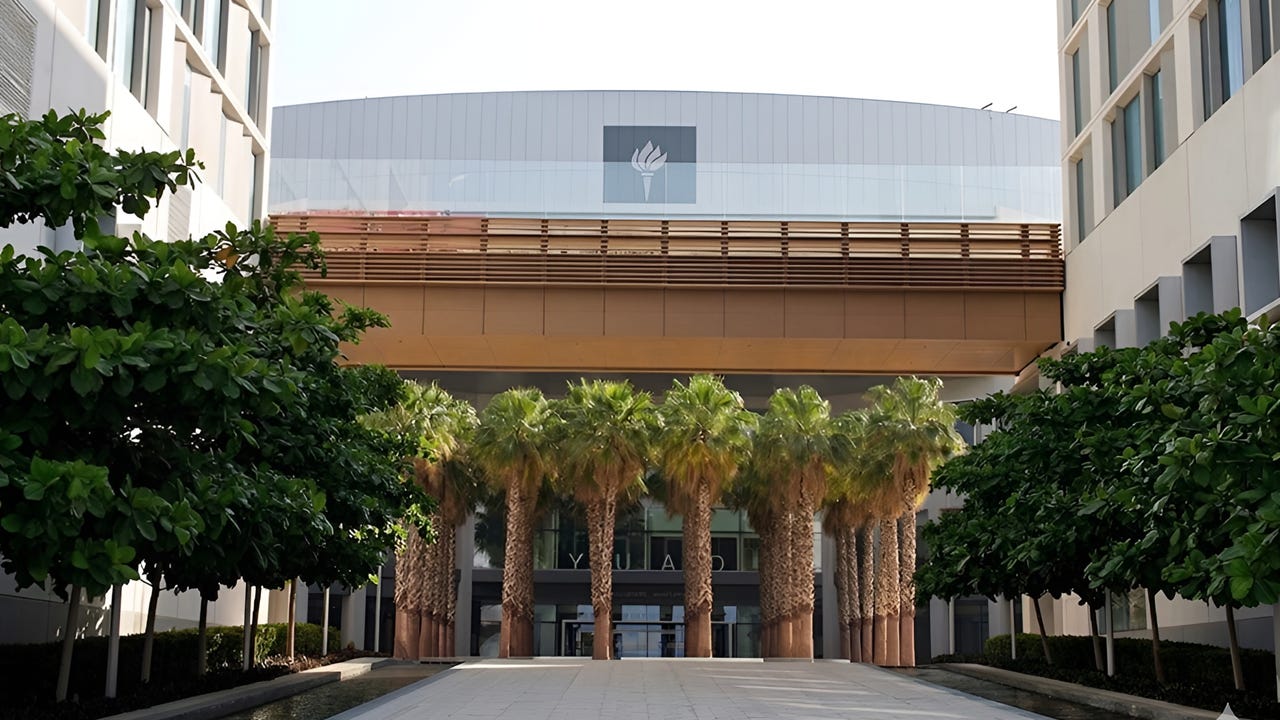
NYU Abu Dhabi is the highest globally ranked university in the UAE according to Times Higher Education, which places NYU among the world’s top 31 universities. The Abu Dhabi campus forms part of NYU’s global network alongside campuses in New York and Shanghai.
ZOOM OUT – The news of the study and research paper ‘Rediscovering the Standard Model with AI’ comes as the university operates under difficult circumstances. Due to associated Iran war risks, the university has temporarily closed its Abu Dhabi campus and is continuing classes remotely. NYU Abu Dhabi, which opened in 2010 and has approximately 2,200 students representing around 120 countries, stated that the temporary closure was taken out of an abundance of caution, with the safety of students, faculty and staff as the primary consideration. The research published in the Journal of High Energy Physics was conducted prior to the closure and reflects the university's ongoing commitment to advancing scientific research in Abu Dhabi.
[Written and edited with the assistance of AI]