

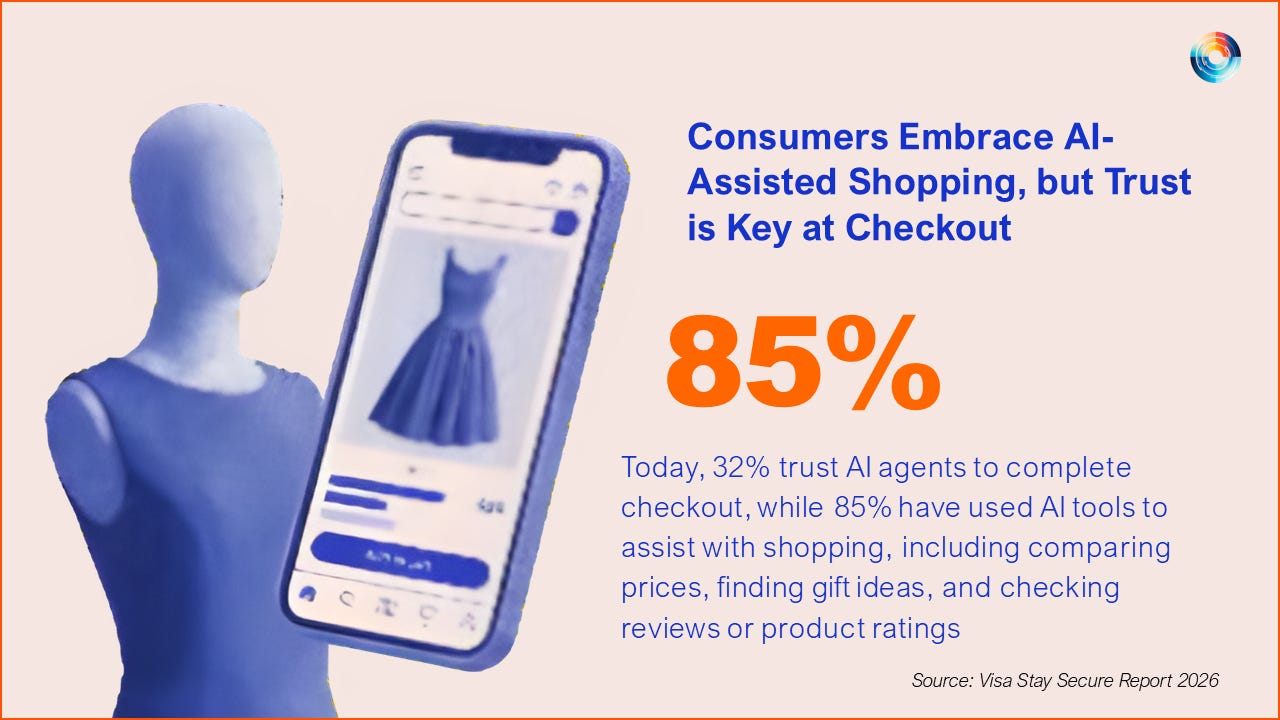
#UAE #Egypt #AIpayments – Global digital payments network Visa has released its annual Stay Secure study findings for the Middle East, revealing that AI-assisted shopping is now widespread. Nevertheless, consumer trust in AI completing transactions remains low. In the UAE, 85 percent of consumers have used AI tools to shop, rising to 91 percent in Egypt, yet only 32 percent of UAE consumers and 38 percent in Egypt trust AI agents to complete checkout on their behalf. The study, conducted by Wakefield Research across 5,800 adults in 17 markets, also flags rising fraud on social commerce platforms and growing concern about children’s exposure to online scams.
SO WHAT? – This study helps to record a point in time in the consumer adoption of agentic commerce (where AI agents browse, decide and pay on behalf of consumers). Agentic commerce has already become a stated direction of travel for major payment networks, including Visa’s own Intelligent Commerce platform. However, the Stay Secure findings show a clear trust deficit that the industry must close before agentic checkout becomes mainstream. With fewer than four in ten consumers across the region willing to hand payment authority to an AI agent, trust-building is now as important as the technology itself.
KEY POINTS:
Global digital payments network Visa has released its annual Stay Secure study findings for Bahrain, Egypt, Kuwait, Oman, Qatar, Saudi Arabia and the UAE, as researched by Wakefield Research
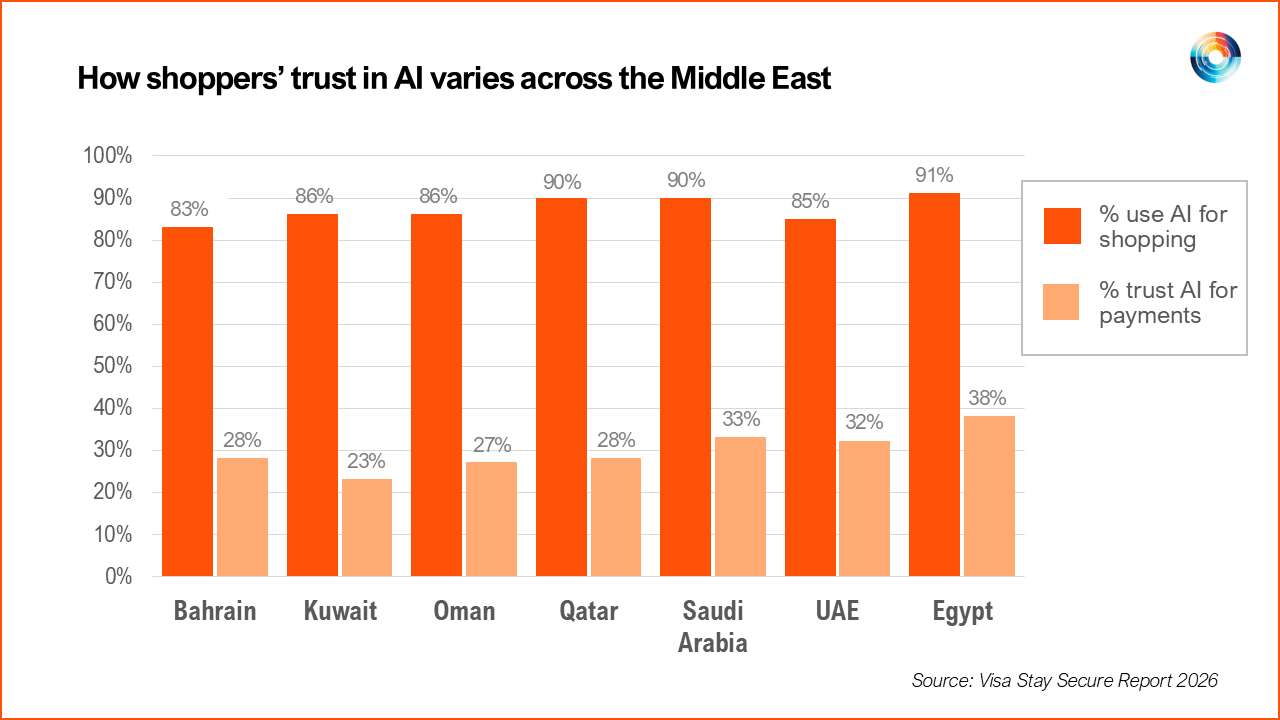
AI-assisted shopping is mainstream across all Middle East markets. In Egypt and Saudi Arabia 90% of consumers have used AI tools to shop, while the figure is 91% for Egypt. Yet only 38% in Egypt, 33% in Saudi and 28% in Qatar trust AI agents to complete checkout.
In the UAE, 85% of consumers have used AI tools while shopping (checking reviews, comparing prices, finding gift ideas). In Kuwait and Oman that figure is 86%, while in Bahrain 83% use AI for shopping. As with the other markets, consumers are enthusiastic about AI’s convenience but draw the line at payment
The majority of shoppers across the region believe that AI tools make online shopping faster and easier. Specifically, that’s 97% of those surveyed in Egypt, 95% in Qatar, 94% in Kuwait, 93% in Saudi Arabia and the UAE, 92% in Oman and 90% in Bahrain
Price comparison is the leading use case for consumers using AI for shopping across the region. Comparing prices was the top use case for 75% of Egyptians, 63% of Saudis, 60% of Qataris, 55% of Omanis and Kuwaitis and 51% of Bahrainis. However, shoppers in the UAE favour AI most for checking reviews or product ratings (60%). Discovery is also AI-driven, with 60% of UAE and 71% of Egyptian shoppers finding new brands through AI-influenced online browsing.
Social commerce has become a primary shopping channel and a primary fraud vector. In the UAE, 69% of consumers have purchased directly through social media platforms.
Financial scams remain widespread. In the UAE, 46% of consumers experienced a financial scam in the past 12 months. In Bahrain this was 42%, Saudi Arabia 41%, Kuwait 40%, Oman 38%, Egyp 36% and Qatar 33%. All markets show social media as the dominant fraud channel, outpacing websites, online marketplaces and shopping apps combined.
Children’s exposure to online scams is a growing concern in both markets. In the UAE, 80% of consumers say children in their lives struggle to recognise scams, and 67% have seen a child fall victim while gaming or shopping online. In Egypt, 91% share that concern, with 61% reporting a child they know has been caught out.
The Visa study finds that consumers expect institutions to take the lead on fraud protection. In the UAE, only 19% believe consumers themselves should bear primary responsibility for fraud prevention. For Saudi Arabia and Qatar this figure drops to 14% and in Oman only 10% beleive this to be true. Banks, regulators and payment providers are seen as the appropriate first line of defence across markets.
Real-time alerts are the most wanted fraud protection feature. In the UAE, 60% say receiving suspicious activity alerts from their bank or payment app would make them feel more secure. In Egypt the figure is 64%. A trusted payment logo at checkout also provides reassurance (valued by 33% in the UAE, 27% in Saudi Arabia and 44% in Egypt).
Consumers increasingly see AI as part of the fraud solution, not just the problem. In the UAE, 57% say AI has already made scams easier to recognise, while between 77% and 88% across regional markets expect AI to play a critical role in fraud protection in future.
ZOOM OUT – Adoption of AI for shopping among UAE consumers has been growing fast. Data from Amsterdam-headquartered financial technology company Adyen's UAE Retail Report 2025 showed that 70% of UAE consumers had already used ChatGPT or similar AI assistants for shopping, with usage surging 44% since the previous year 2024. Moreover, that usage was already more than double the EMEA average of 34% using AI assistants for shopping. Yet even then, 23% of UAE shoppers felt uncomfortable interacting with retailers' AI, and 20% worried it increased their fraud exposure. The new findings in Visa’s report suggest those concerns have not faded as adoption has grown over the past year.
[Written and edited with the assistance of AI]
Source: Visa, MEAIN. Updated 10-Jun-26