

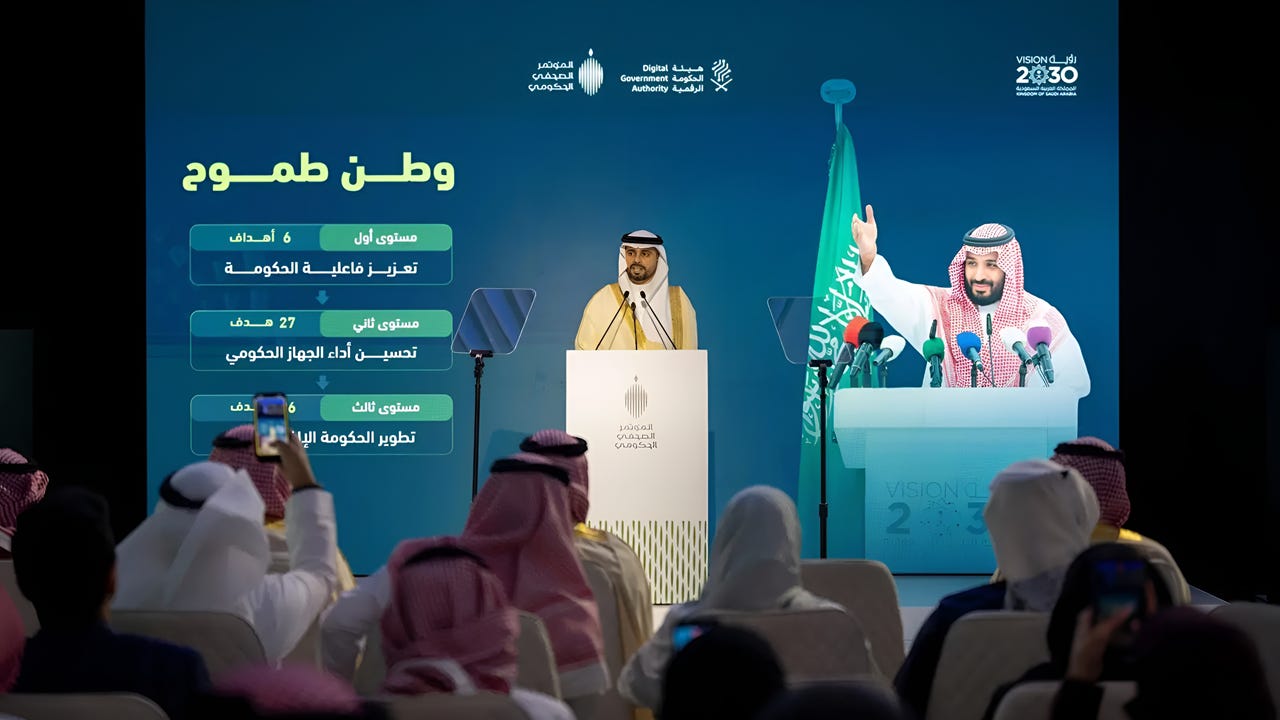
#SaudiArabia #DigitalGovernment - Saudi Arabia has risen to fourth place globally in the UN E-Government Development Index, up from 52nd in 2018, according remarks made by the Digital Government Authority (DGA) during a press conference yesterday. Government spending on telecoms and IT services exceeded SAR145 billion ($39b) between 2022 and the end of 2025. The authority further noted that cloud adoption across government entities has reached 49 percent. The Saudi government’s goal is to earn a place among the world’s top five digital governments.
ZOOM OUT - The Digital Government Authority (DGA) credited a number of government achievements to artificial intelligence deployments. Firstly, the Ministry of Energy cut oil and gas supply processing and monitoring from 25 minutes to 30 seconds using AI. Secondly, the Ministry of Municipalities and Housing cut the cost of monitoring visual blight by 76 percent, from SAR197 million to SAR47 million, while coverage rose from 11 percent to 95 percent. Lastly, the Ministry of Environment, Water and Agriculture saved about SAR120 million and cut water violation processing from six days to one. The DGA expects generative, agentic and physical AI to lift output across logistics, transport, retail, industry and mining.
KEY POINTS:
Saudi Arabia’s Digital Government Authority (DGA) held press conference in Riyadh yesterday to reveal new facts and figures regarding the government sector’s digital transformation progress. The country now ranks fourth out of 194 countries in the 2026 UN E-Government Development Index, up from 52nd in 2018, and the DGA says it met its top-five target four years early.
Government spending on ICT services exceeded SAR145 billion between 2022 and the end of 2025. Cloud adoption across government entities stands at 49%, and contracts awarded to SMEs and entrepreneurs exceeded SAR9 billion in 2025.
The digital transformation index for government entities rose from 69% in 2021 to more than 90% by the end of 2025, according to Arab News. SPA reports a 2026 target of 90%.
In justice, 95% of court hearings are held remotely, and personal status court rulings now take 20 days on average, down from 219. In healthcare, 51% of appointments are remote.
The Interior Ministry’s Absher platform cut delivery time for many services from about four hours to 30 seconds, with estimated annual savings of SAR26 billion and 1.3 million fewer daily in-person visits.
Customs clearance fell from 12 days in 2017 to two hours. Government procurement dropped from 120 days to two, through an e-marketplace with more than 219,000 products.
The Tawakkalna app offers more than 1,800 services and handles over 88 million transactions daily. Nusuk has passed 60 million users, and Hajj and Umrah visas now take five minutes, down from five days.
The digital inclusion indicator, covering older people and people with disabilities, reached 77% against a 90% target. Government platforms were cut from more than 800 to about 400, and the DGA’s Innovation Centre has served more than 4,000 government employees.
[Written and edited with the assistance of AI]
Source: DGA, SPA
Read more about digital transformation and AI progress in Saudi Arabia:
Only 10% of GCC firms scale governed agentic AI - study (Middle East AI News)
90% of Saudi firms say AI has met or beaten ROI goals (Middle East AI News)
UAE, Saudi lead world on AI agent use (Middle East AI News)
Saudi Arabia, UAE AI spend surges, execution lags behind (Middle East AI News)
Saudi AI-native startups nearly 5X more likely to hit $1M (Middle East AI News)