

#UAE #telecom - UAE telecom and digital services provider du has published the whitepaper The Intelligence Network: A 6G Blueprint for Telcos, developed with the Digital Future Institute at Khalifa University. The blueprint sets out how telecom operators can evolve into AI-native, autonomous infrastructure providers. It follows du’s upper 6GHz field trials in Mohamed Bin Zayed City, Abu Dhabi, which achieved outdoor coverage of up to 500 metres and peak downlink speeds approaching 1.5Gbps using existing 5G macro infrastructure.
SO WHAT? - The du network trials matter because they were run on live commercial sites rather than a lab, showing that operators could reach 6G-level speeds without replacing existing towers. That’s a meaningful cost argument, since network upgrades are usually judged as much on capital spend as on raw performance. Coupled with the whitepaper’s push into monetising network intelligence itself, du is trying to get ahead of an industry-wide problem: data traffic is set to more than triple by 2030 while operator revenues may stay flat.
KEY POINTS:
UAE telecom operator du has published the whitepaper The Intelligence Network: A 6G Blueprint for Telcos, developed with the Digital Future Institute at Khalifa University. The paper combines academic research with data from real-world deployment testing.
du’s field trials in Mohamed Bin Zayed City, Abu Dhabi, tested upper 6GHz spectrum on live macro infrastructure, achieving outdoor coverage of up to 500 metres and peak downlink speeds approaching 1.5Gbps, among the first such validations in the region at scale.
The du-KU partnership aimed to translate research into practical solutions for intelligent telecom netwrks, reinforcing the UAE’s position in advanced technology and knowledge-driven economic growth.
Fahad Al Hassawi, CEO of du, said the trial results show that AI-native, autonomous telecom infrastructure is being built now rather than remaining theoretical, positioning du to lead the region’s transition.
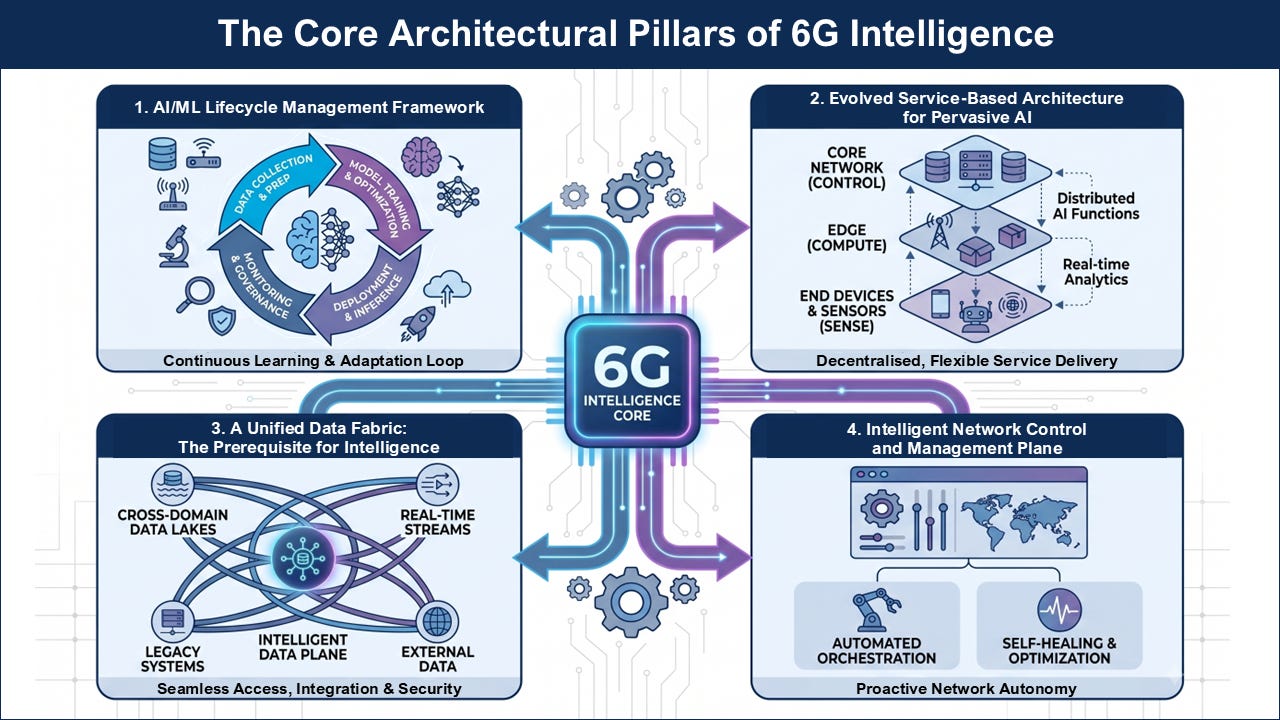
The whitepaper addresses industry projections showing mobile data traffic will more than triple by 2030 against modest revenue growth, according to the GSMA Mobile Economy Report 2024, framing 6G as a shift toward software-defined, AI-native platforms that sense, predict, decide and act in real time.
Key technical concepts outlined include intent-based orchestration, Network Digital Twins and Telecom World Models, with the Radio Access Network repositioned from a radio transmission layer into an energy-efficient, sensing-enabled intelligence hub.
The blueprint identifies new commercial opportunities from AI-native networks, including AI-powered operations, enterprise digital twins, autonomous AI agents and outcome-based service guarantees, as operators look to move beyond flat-rate data revenue.
du’s 6G roadmap builds on its existing 5G-Advanced network and its commitment to the TM Forum Autonomous Networks Manifesto, an industry framework for progressing telecom networks toward full autonomy.
[Written and edited with the assistance of AI]
Source: du / Khalifa University
DOWNLOAD
Read more about 6G research:
6G could mark the beginning of self-reasoning networks (Middle East AI News)
Khalifa University builds an AI brain for 6G telecom (Middle East AI News)
e& UAE, Khalifa University whitepaper sets out 6G roadmap (Middle East AI News)
Khalifa University unveils breakthrough RF AI model (Middle East AI News)