


#UAE #AgenticAI - AI agents running in the background will change what UAE smartphone users demand from their networks, according to Ericsson. Its research arm, Ericsson ConsumerLab, found that 63 percent of UAE smartphone users expect to delegate everyday tasks to AI agents by 2030. The UAE is already well ahead of the global average, with 10 percent of users using agentic AI compared with 4 percent worldwide. Today’s AI super users (18% of phone owners) provide an indication of future mobile network demand, rating AI response time as 2.4 times more critical to network satisfaction than for an average user. AI super users could reach 46 percent of total users by 2030, according to the survey.
SO WHAT? - As agentic AI becomes more advanced and adoption grows, mobile devices will carry out more autonomous tasks that create network demand. Agents will book services, compare user choices and monitor live data in the background, so network load will increasingly follow the agent’s schedule, rather than relfect the owner’s screen time. For UAE operators, that puts uplink capacity and consistent response speed at the centre of planning. It also hands them a greater trust role. More than half of daily AI users worry about fake assistants acting in their name, and they see operators as the most trusted verifiers.
KEY POINTS:
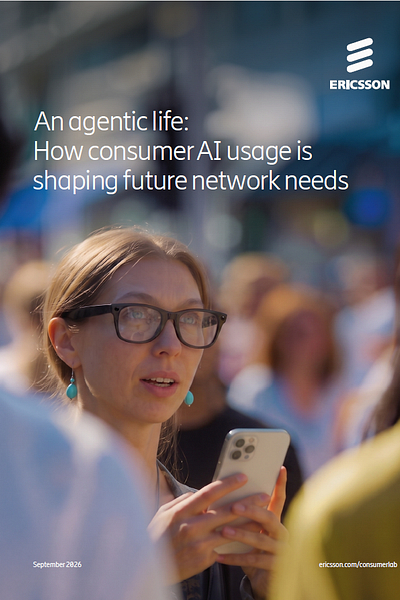
Ericsson’s report, An Agentic Life: How consumer AI usage is shaping future network needs, projects that 63% of UAE smartphone users will delegate everyday tasks to AI agents by 2030.
According to the study, 10% of UAE respondents already use agentic AI for tasks they once did themselves. The global figure is about 4%, so the UAE rate is already more than double.
About 18% of UAE smartphone owners are AI super users who engage heavily with multimodal AI and Ericsson expects that share to reach about 46% by 2030.
Ericsson found that AI response time is 2.4 times more critical to network satisfaction for super users than for the average user. This expectation makes speed of reply a measurable test of how well an operator’s network performs.
As AI processing spreads across devices and the cloud, and agents work in the background, reliable uplink and consistent responsiveness become more important. This will bring about a massive change in network usage: the level of network demand will no longer depend on a user’s active screen time. AI agents will become the primary driver of network demand.
About 38% of UAE respondents expect to add AI on another type of device by 2030, with smart glasses given as an example. That would create a new source of network requests beyond the phone.
Some 54% of daily AI users in the UAE are strongly worried about fake AI assistants acting in their name, and they see communication service providers as the most trusted sources for verifying agent identity.
The research surveyed more than 43,000 smartphone users aged 15 to 69 across 27 markets, including the UAE, Saudi Arabia and Qatar. Ericsson says the sample represents about 1.7 billion smartphone users worldwide.
ZOOM OUT - Globally, Ericsson ConsumerLab's findings show a lower level of agentic AI usage than in the UAE. About 4 percent of smartphone users across the 27 markets use agentic AI today, but 38 percent expect to by 2030. AI super users currently make up roughly 10 percent of owners, which is expected to triple over the next four years. The study found that super users already spend 2.5 times longer on AI services than average users, usage that could rise by four times by the end of the decade. Respondents to the survey expect AI to save them up to an hour of browsing daily on delegated tasks such as scheduling and product comparison. Meanwhile, smart glasses are expected to lead mobile complementary devices, leading to bursts of upload-heavy demand.
[Written and edited with the assistance of AI]
Source: Ericsson
DOWNLOAD
Read more about AI in telecom:
Etisalat UAE, DataRobot extend sovereign agentic AI deal (Middle East AI News)
Nokia opens Riyadh R&D centre for network automation (Middle East AI News)
UAE, Saudi telcos bet big on AI networks (Middle East AI News)
e& first to embed AI in core connectivity (Middle East AI News)
du shares MENA’s blueprint for AI-native 6G networks (Middle East AI News)