

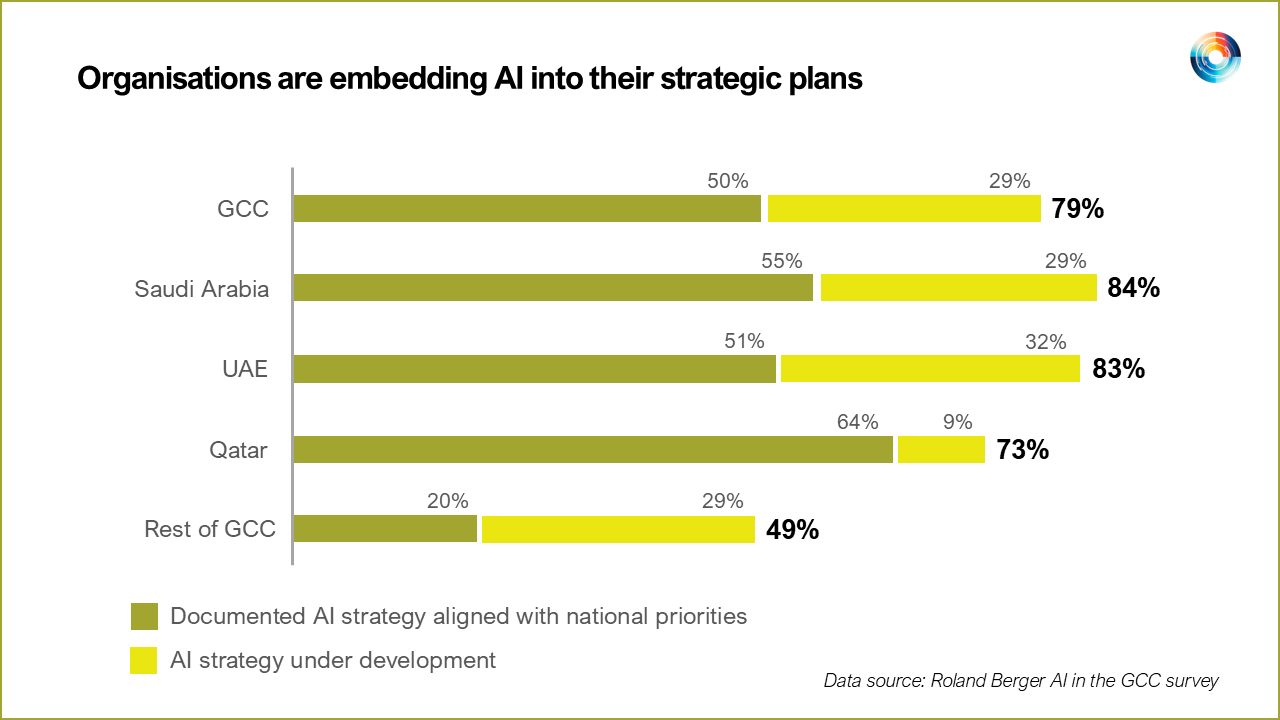
#GCC #strategy – Nearly 80 percent of Gulf Cooperation Council (GCC) organisations have embedded artificial intelligence into their strategic plans, according to strategy consultancy Roland Berger Middle East’s report AI across the Gulf: From ambition to scalable impact. The study, based on insights from C-suite and director-level decision makers across the GCC, reveals that 85% of organisations expect AI budgets to rise in 2026, with nearly 40% anticipating significant increases. Meanwhile, enhancing customer and citizen experience now ranks as the top AI priority cited by 46 percent of respondents. However, the report also highlights a growing execution gap, with only one-third of organisations maintaining an enterprise-wide data strategy and fewer than one in three possessing the operating model and formal governance needed to scale AI deployments.
SO WHAT? – A number of survey’s have found that GCC organisations are integrating AI more and more into their operations. The findings from Roland Berger’s survey demonstrate that whilst AI strategies have become widespread across the Gulf (with all six GCC countries having either adopted national AI strategies or developing them) operational readiness remains limited, creating a disconnect between ambition and execution capability. The study revealed that only 28 percent of organisations have established dedicated AI ethics or compliance boards and that key barriers include data quality challenges, limited funding beyond pilots, and weak cross-functional collaboration.
Here are some key points about Roland Berger’s study:
A new survey report AI across the Gulf: From ambition to scalable impact from Roland Berger Middle East has found that nearly 80% of Gulf Cooperation Council (GCC) organisations have embedded artificial intelligence into their strategic plans.
Public sector organisations are advancing more rapidly than private enterprises, with over 90% reporting an AI strategy in place or under development compared to 75% in the private sector, driven by national mandates and digital government programmes accelerating adoption.
Generative AI has emerged as the leading technology focus cited by 35% of respondents, driven by immediate business impact, visible productivity gains and ease of adoption, whilst many organisations are shifting toward multi-vendor AI ecosystems to balance flexibility, compliance and performance.
Organisations increasingly view AI as a driver of tangible business value supporting faster decision-making, improved customer and citizen experiences, new revenue opportunities and stronger risk management across both public and private sector deployments.
Key barriers to scaling AI include data quality challenges, technology readiness gaps, limited funding beyond pilot initiatives, resistance to change, weak cross-functional collaboration and ongoing talent shortages, particularly regarding integration of AI into everyday workflows.
To move from experimentation to scale, the report outlines actions including conducting organisation-wide AI readiness assessments, translating strategy into business-led roadmaps with defined ownership and key performance indicators, strengthening data and technology foundations, establishing cross-functional delivery teams supported by central AI Centres of Excellence, and embedding AI outcomes into daily operations.
The report provides detailed market perspectives on Saudi Arabia, the UAE and Qatar, alongside practical recommendations tailored to the region’s evolving digital landscape and specific execution challenges facing Gulf organisations.
[Written and edited with the assistance of AI]