

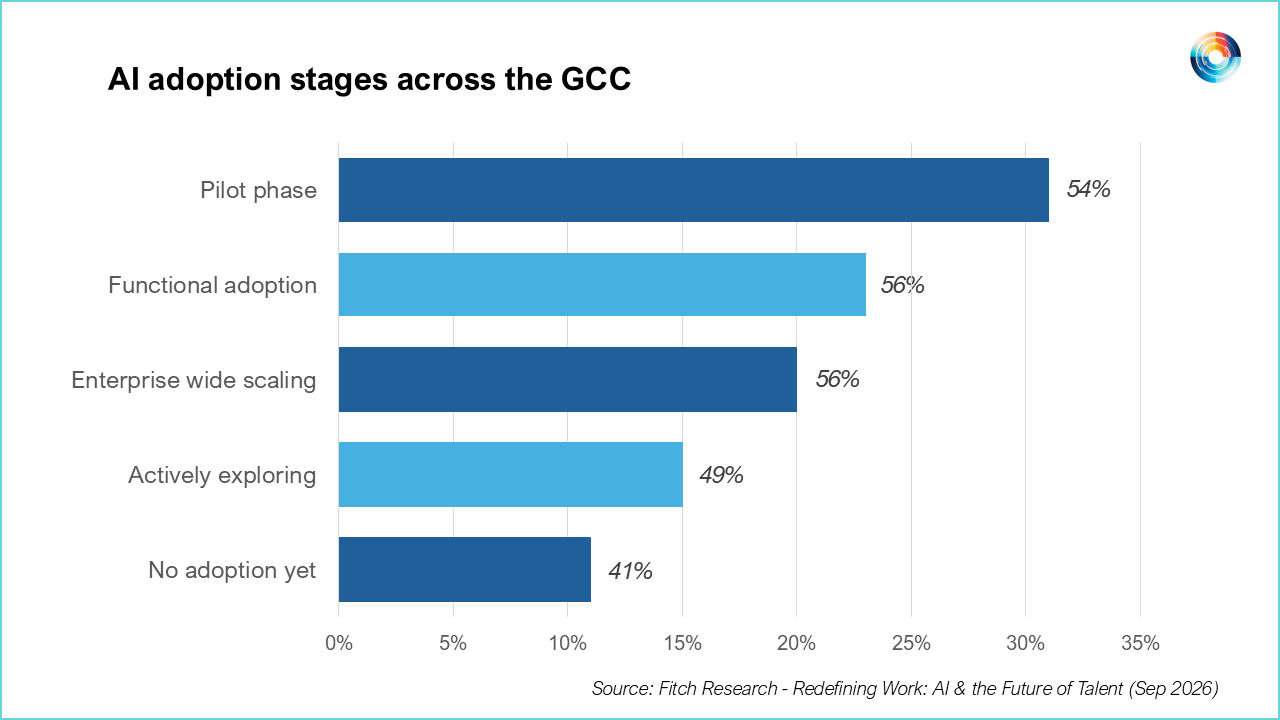
#GCC #adoption - Nine in ten organisations across the Gulf have started adopting or scaling artificial intelligence, according to research from recruitment firm Cooper Fitch. The research finds that multinational companies are scaling AI enterprise-wide at six times the rate of local Gulf businesses (42 percent versus 7 percent). Rather than cutting jobs, 55 percent of organisations are merging roles and restructuring teams. Corporate investment in training hasn’t kept pace with AI adoption, though, with only 29 percent of firms have formal upskilling programmes in place.
SO WHAT? - The survey findings somewhat undercut the narrative that AI is wiping out jobs. Research shows is a widening gap between what AI can do and what staff are equipped to do with it. Three-quarters of firms report productivity gains, but fewer than a third have trained people to sustain them. The gap, more than the technology itself, may decide which organisations actually benefit and which end up with expensive tools nobody knows how to use properly.
KEY POINTS:
90% of GCC organisations surveyed have begun adopting or scaling AI, with multinational companies scaling enterprise-wide at six times the rate of local Gulf-owned businesses (42% versus 7%). This, according to Cooper Fitch’s “Redefining Work: AI & the Future of Talent” report, which surveyed executives representing more than 200,000 employees across the GCC.
Government and semi-government entities were found to have varying levels of Ai adoption. 21% have scaled AI across functions, 42% remain in pilot or exploratory stages, and 16% report no adoption yet.
Just 8% of organisations invest more than $5 million annually in AI, and around a third of those spend upwards of $25 million, pointing to enterprise-level commitment among a small group of high spenders.
About 30% of organisations have no defined AI owner. The exception is financial services, where 73% place responsibility with the C-suite (53%) or IT leadership (20%).
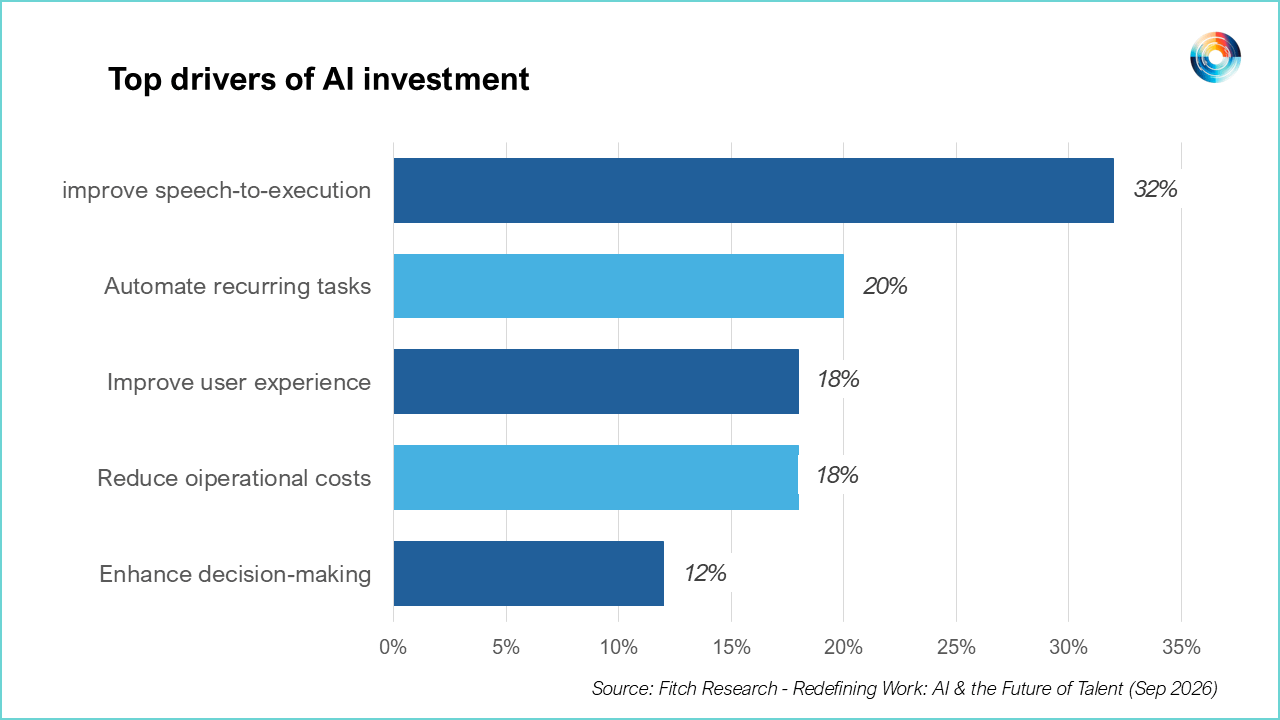
Speed-to-execution has overtaken cost-cutting as the top driver for AI investment, cited by roughly a third of respondents. Many organisations are now shifting focus from automating single tasks to redesigning entire workflows.
55% of organisations are merging responsibilities and restructuring teams rather than cutting jobs outright, with AI removing specific tasks rather than eliminating whole roles.
76% of organisations report productivity gains from AI, including moderate gains of 10-30% for most and gains above 30% for a smaller group. Only 29% have formal training programmes to match.
Employee sentiment appears to falls sharply with seniority. Senior executives remain the most optimistic about AI outcomes, but that positive sentiment drops 33 percentage points between C-level executives and individual contributors, the steepest decline of any seniority band.
UAE organisations lean on internal training programmes to build AI awareness, while Saudi companies favour partnerships and external hiring to close capability gaps.
Sector priorities vary widely: finance and banking (46%) focus on compliance and risk modelling, technology (42%) on innovation and customer experience, and consulting (30%) on speeding up research and proposal work.
[Written and edited with the assistance of AI]
Source: Cooper Fitch
Read more about the Gulf’s AI adoption:
UAE, Saudi telcos bet big on AI networks (Middle East AI News)
Saudi Arabia, UAE AI spend surges, execution lags behind (Middle East AI News)
UAE ranks top in MENA on QS World Future Skills Index (Middle East AI News)
45% of Saudi Internet users now use AI (Middle East AI News)
UAE firms locked into AI vendors, IBM finds (Middle East AI News)