

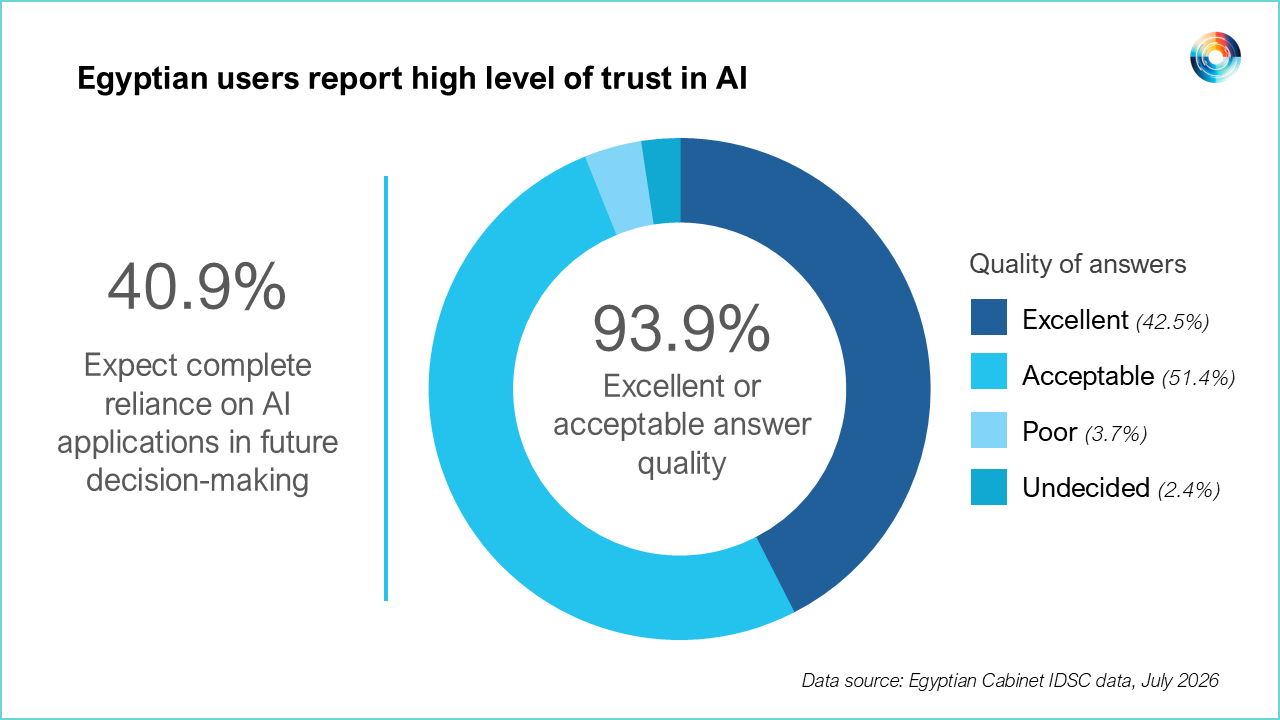
Egypt #GenAI - Public awareness of AI applications in Egypt has nearly tripled, according to a new survey by the Cabinet’s Information and Decision Support Centre (IDSC). Among Egyptians who had heard of AI tools, the poll found that OpenAI’s ChatGPT is the most widely used platform (26.3%), with Google Gemini coming in second (10.9%). Meanwhile, 93.9 percent of users rated AI outputs positively, 55 percent remain concerned about sharing personal data, and 56 percent still believe wider AI adoption will eliminate jobs (a figure barely changed since 2023).
SO WHAT? - The new IDSC poll finds that awareness of AI in Egypt has surged, but attitudes toward its risks have barely moved in three years. Based on the data, public familiarity with AI tools hasn’t translated into greater public confidence. This is highly relevant to the National AI Strategy 2025-2030, which prioritises public awareness and data governance. Persistent job-loss fears remain, especially in clerical, administrative and manual roles, suggesting the government’s programmes to increase AI awareness and technical education, also need to address public trust.
KEY POINTS:
Egyptian public awareness of AI applications rose to 65% in 2026 from 22% in 2023, according to a new Cabinet Information and Decision Support Centre (IDSC). The survey was conducted between 15 and 28 July, 2026.
ChatGPT was the most used AI platform among those aware of AI tools, cited by 26.3% of respondents, followed by Gemini at 10.9%, Meta applications at 2.9%, and other tools at 2.2%.
Work was the leading reason for using AI, cited by 51.7% of Egyptian users, ahead of personal matters at 38.3% and study at 32.3%. Respondents were able to select multiple answers.
Satisfaction with AI outputs was high, with 93.9% of users rating results as acceptable or excellent, while only 3.7% described them as poor.
Despite the positive experiences with AI identified by the survey, 55% of AI users said they worried about sharing personal data with these platforms.
Concerns about job losses from AI remained largely unchanged from three years ago, with 56% of respondents believing greater AI reliance would eliminate many jobs, against 57% in 2023.
Clerical and administrative roles topped the list of jobs respondents expected AI to affect, at 6.2%, followed by factory and manual work at 5.3% and teaching at 5%.
Nearly half of respondents, 48.8%, said AI could pose a future danger, with 46.1% of those rating the risk between eight and ten on a ten-point scale; reduced independent thinking was the most cited concern at 17.8%.
The government plans to introduce programming and AI courses in technical schools from the 2026/27 academic year as part of efforts to prepare young people for a changing labour market.
ZOOM OUT - Egypt’s National AI Strategy 2025-2030 targets lifting the ICT sector’s GDP contribution to 7.7 percent by 2030 and building 250 AI companies employing 30,000 professionals. The government has already rolled out a public Arabic-language BelMasry platform and piloted its own large language model, Karnak, alongside free Gemini access for university students. Egypt’s ICT sector record 24.3 percent growth in the last fiscal quarter, according to new Minister of Communications and Information Technology data, with outsourcing exports reaching $5.1 billion. The persistence of public concern over jobs and privacy, even as AI adoption and acceptance climbs, appears to show that public trust lags, even as national technology programmes make real progress.
[Written and edited with the assistance of AI]
Source: IDSC, MCIT, MEAIN
Read more news from Egypt:
TokenAI to release Horus cybersecurity model (Middle East AI News)
Egypt approves two more AI insurance sandbox projects (Middle East AI News)
Konecta opens $100M generative AI hub in Cairo (Middle East AI News)
TokenAI’s Horus Hiero multimodal AI reads hieroglyphics (Middle East AI News)
Egypt to draft national data centre strategy (Middle East AI News)