

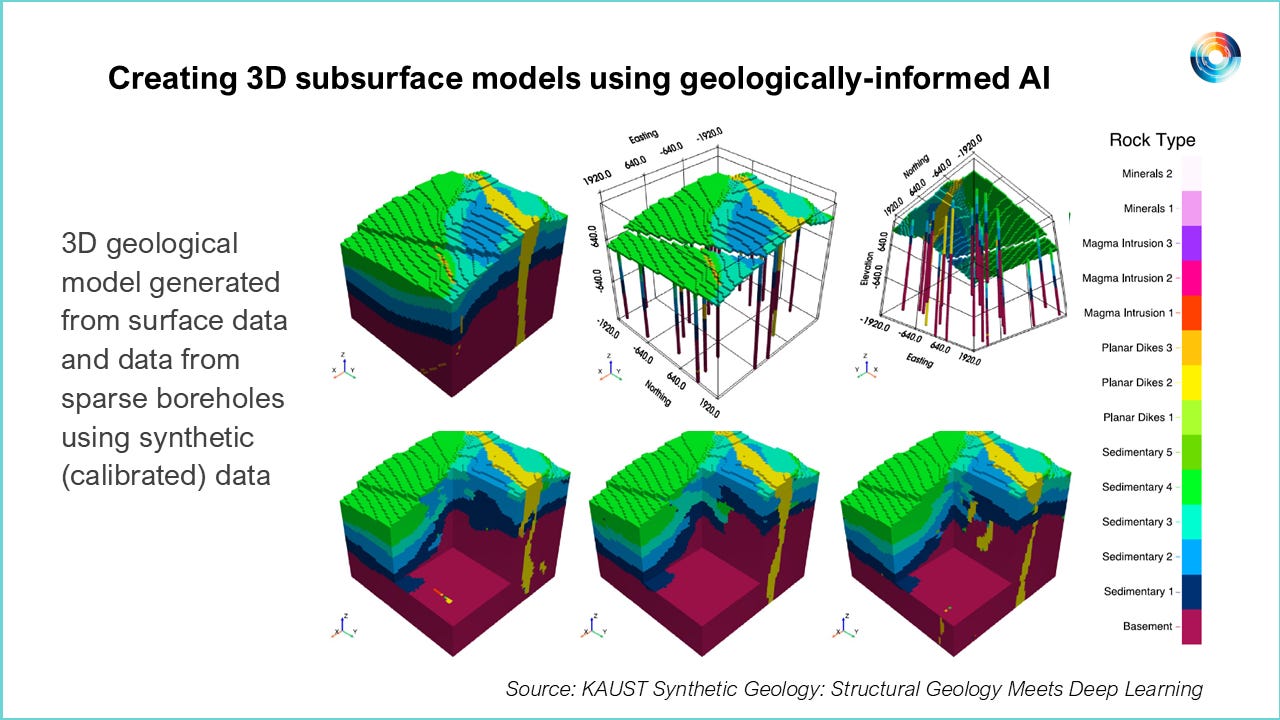
#SaudiArabia #geology - Thuwal-based research university KAUST (King Abdullah University of Science and Technology) has built a foundation model for synthetic geology, designed to reduce uncertainty in mineral exploration. Led by Professors George Turkiyyah and David E. Keyes with geophysical imaging experts from Canada’s University of British Columbia, the project generates multiple plausible 3D models of underground rock formations from surface data and sparse borehole samples. The prototype model attracted Saudi national mining company Maaden, which has signed a follow-on 30-month research and development contract to test the model against real Saudi geological data.
SO WHAT? - Mineral exploration has always relied on sparse, indirect data, boreholes and surface samples that leave huge gaps in what’s actually underground. Traditional digital modelling fills those gaps with a single best guess built by hand over many hours. KAUST’s approach instead generates multiple plausible underground scenarios and assigns each a level of uncertainty, giving geologists several hypotheses to test rather than one static answer. For Saudi Arabia, which is trying to expand its domestic mining sector, that could mean faster, cheaper exploration decisions in terrain that’s expensive and slow to survey by conventional methods.
KEY POINTS:
KAUST (King Abdullah University of Science and Technology) has developed a computational prototype using generative AI to reduce uncertainty in mineral exploration. Researchers believe the geological foundation model could help deepen understanding of geological formations beneath the Arabian Shield.
The researcher built a foundation model on synthetic training data produced by StructuralGeo. The geological simulator can be used to reproduce millions of years of tectonic, magmatic and sedimentary processes to generate synthetic 3D rock formation data for model training.
Researchers trained a 78-million-parameter 3D attention U-Net foundation model on several hundred thousand synthetic geological models using the Shaheen III supercomputer.
The model uses a generative diffusion approach to produce multiple plausible 3D subsurface scenarios from limited surface observations and borehole data, each with quantified uncertainty, rather than a single deterministic model.
Saudi Arabia’s national mining company Ma’aden was impressed by the prototype’s potential, which led to a 30-month research and development contract to test and deploy the model using real Saudi geological data.
The project is cited by KAUST as a model example of its research translation strategy, which recently added four new translational faculty members tasked with moving early-stage research toward industry application and commercialisation.
However, the research team stressed that the tool is designed to enhance geologists’ ability to explore multiple hypotheses and make informed decisions under uncertainty, rather than replace traditional geological expertise.
The research team includes KAUST Professors George Turkiyyah and David E. Keyes; Simon Ghyselincks from Department of Computer Science, University of British Columbia; Valeriia Okhmak and Dr. Stefano Zampini from KAUST; and Eldad Haber from the Department of Earth, Ocean and Atmospheric Sciences, University of British Columbia.
ZOOM OUT - The KAUST/UBC research team set out to solve one of the oldest challenges in geology: producing meaningful geological assessments based on sparse data. Developing subsurface geological models has traditionally been a slow, manual process. Geologists must reconcile limited field data, rock samples and geophysical surveys by hand, usually producing just one deterministic interpretation at a time. The single model approach ignores the fact that multiple different underground configurations can fit the exact same surface observations equally well.
The data interpretation challenge is compounding further by the complexity of underground data, where structures span scales from microscopic mineral deformation, to tectonic movements playing out over millions of years. Disparate data from structural geology, geophysics and geochemistry all need reconciling at once. KAUST's model doesn't claim to solve all the ambiguity, but it makes the ambiguity visible, generating a range of plausible scenarios instead of one answer dressed up as certainty.
[Written and edited with the assistance of AI]
Source: SPA, SDAIA, NVIDIA
LINKS
Synthetic geology research paper (arXiv)
StructuralGeo source code (Github)
Flowtrain package (Github)
UNet code (Github)
Read more about KAUST:
HUMAIN to share KAUST’s Shaheen III supercomputer (Middle East AI News)
Cisco and KAUST establish AI research institute (Middle East AI News)
KAUST opens 1,000-square-metre robotics research facility (Middle East AI News)
Saudi scientists break Quantum security speed records (Middle East AI News)
Lucid, KAUST partnership to boost EV & AV tech research (Middle East AI News)