

#UAE #biomedical - Mohamed bin Zayed University of Artificial Intelligence (MBZUAI) has announced DoAtlas-2, a causal world model of human biology. The new model runs the full research cycle on its own, from forming a question to testing its hypothesis using real human data. It draws on more than 720,000 participants across 48 countries and has evaluated 2,031 research questions end to end. MBZUAI plans an open-source release in the near future, starting with 1,000 research questions and 30,000 experimental results.
SO WHAT? - AI can now produce hypotheses faster than scientists can test them. DoAtlas-2 aims to solve that problem, testing which ones hold up. Study designs are frozen before results are revealed, and failed tests are kept and used to steer analysis. Every claim that the model tests also traces back to its evidence, a feature that is crucial in the medical field, where ‘black-box’ outputs are not trusted.
KEY POINTS:
Mohamed bin Zayed University of Artificial Intelligence (MBZUAI) has revealed DoAtlas-2, a causal world model of human biology. The new model runs full research cycles autonomously, formulating questions, designing studies, testing them in real human data. It then uses the results to decide what to study next.
DoAtlas-2 draws on 771 research resources covering more than 720,000 participants across 48 countries. Data spans clinical phenotypes, continuous physiological signals, medical imaging and seven layers of molecular omics.
The causal model holds 93,566 biomedical concepts, 149,383 candidate causal relationships and 4,696,704 literature-derived evidence records. It has a research space of 8,724 candidate questions. (All as of 22 September 2026)
It has evaluated 2,031 research questions end to end, covering 88,731 result estimates. Each question took a mean of 5.26 hours and about 781 million model tokens, using GPT-5.6 Sol with xhigh reasoning.
Across three research rounds, the catalogue of candidate pathway questions grew from 175 to 1,079 and then to 4,014. Results from each round shaped the follow-up questions in the next.
The core source of data is Israel’s Human Phenotype Project, which had enrolled 27,916 participants by December 2024.
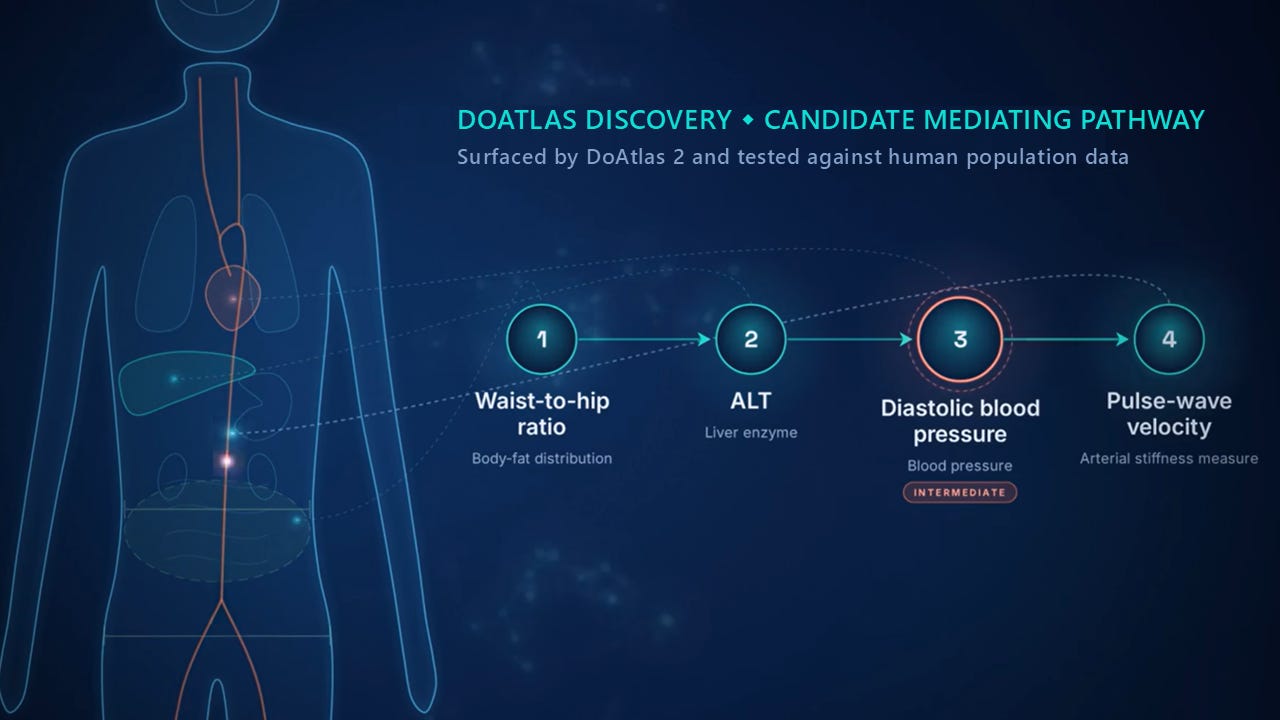
Example findings from DoAtlas include blood pressure linking to adiposity, liver and lipid markers linked to vascular outcomes. The model’s vascular network of 19 nodes and 29 connections doubles as an interpretable predictive model, with every prediction written as an explicit closed-form expression.
MBZUAI plans to release DoAtlas as open source in the near future. The first open-source release will include 1,000 research questions with 30,000 corresponding experimental results.
The MBZUAI DoAtlas 2 research team includes: Yulong Li , Rong Xia, Yuxuan Zhang, Jianxu Chen, Xiwei Liu, Haochen Xue, Maosheng Li, Yuhang Liu, Yibo Yuan, Yutong Xie, Chong Li, Jionglong Su, Hagai Rossman, Eran Segal and Imran Razzak.
[Written and edited with the assistance of AI]
Source: MBZUAI
LINK
DoAtlas 2 research paper (arXiv)
Read more about MBZUAI research:
MBZUAI’s IFM releases world’s largest fully open AI model (Middle East AI News)
MBZUAI builds first cultural benchmark for Arabic AI (Middle East AI News)
MBZUAI builds AI to save researchers drowning in papers (Middle East AI News)
UAE lab breaks the speed barrier in AI video generation (Middle East AI News)
MBZUAI researchers advance medical AI, cut training costs (Middle East AI News)