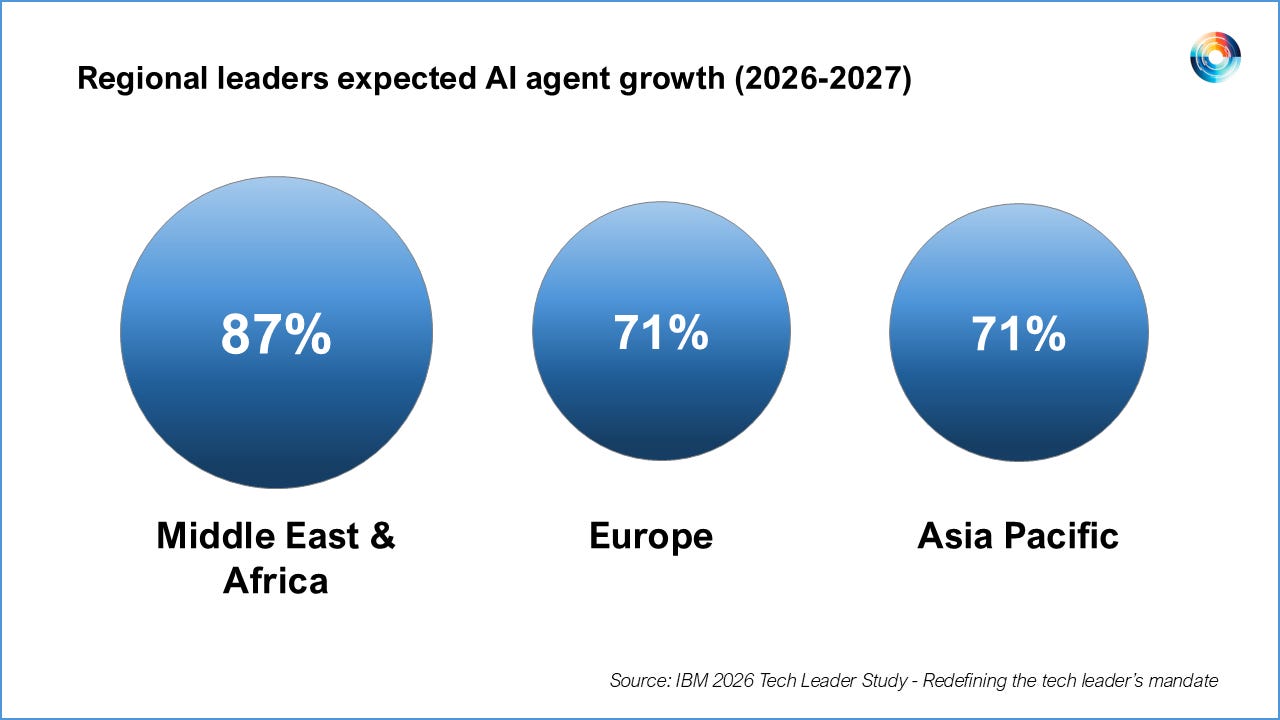
#MiddleEast #Africa #AgenticAI – Technology leaders in the Middle East and Africa expect up to 87 percent AI agent growth between 2026 and 2027, significantly exceeding the forecasts of their peers in Europe and Asia Pacific, according to IBM’s 2026 Tech Leader Study. The IBM Institute for Business Value surveyed 2,000 CIOs and CTOs across 33 geographies, finding that two-thirds are already accountable for AI systems they do not fully control. Globally, only 11% feel completely prepared for the scale of AI agent deployment ahead, while 77% say AI adoption is outpacing their governance capabilities.
SO WHAT? – Large enterprises around the world are adopting agentic AI very fast and nowhere as fast as the Middle East and Africa region. However, this is largely being done by organisations that, by their own admission, as yet lack the governance structures to manage them safely. That combination of high growth and low readiness is a risk profile that boards, regulators and technology leaders need to take seriously. The IBM data shows clearly that organisations which build control into their AI systems from the start deploy more agents, spend less, and deliver better margins. The IBM study concludes that the architecture decisions being made right now will define outcomes for years ahead.
KEY POINTS:
Middle East and Africa technology leaders expect AI agent numbers to grow by up to 87% between 2026 and 2027: the highest anticipated growth rate of any region globally, according to the new IBM 2026 Tech Leader Study - Redefining the tech leader’s mandate. The global average across all surveyed regions is a 38% increase over the same period.
A striking finding is that two-thirds of surveyed CIOs and CTOs globally are today accountable for AI systems they do not fully control. At the same time, 70% report that business teams are deploying technology faster than IT can track, compounding the governance challenge.
Only 11% of global technology executives say they are fully prepared for the scale of AI agent deployment expected by 2027. This is despite 80% of those operating under CEO-driven mandates to accelerate AI transformation. A finding which reveals real tension between board-level ambition and operational readiness.
Surveyed organisations experienced an average of 54 AI agent incidents last year, each requiring human correction. Of those, 17% were classified as high severity: taking more than four hours to contain. Among the high-severity incidents, 37% resulted in data exposure or security breaches, and 33% caused cascading system failures.
Organisations that embed control directly into their AI systems experience 25% fewer incidents than those relying on manual governance. Those organisations also deploy 16 times more AI agents, deliver 18% higher operating margins, and spend four times less of their AI budget. So, the case for investing in governance architecture early appears compelling.
According to the study, AI spend is projected to jump from just under 15% of IT budgets in 2025 to nearly 25% by 2027 (a 71% increase in two years). Yet 84% of technology executives have not fully operationalised AI financial management, and 85% lack real-time visibility into what they are actually spending on AI.
Organisations that kept workloads portable and avoided hard technology dependencies reported a 10% higher return on AI investment in 2025. Flexibility in AI architecture is emerging as a measurable financial advantage, not just a best practice.
Security and compliance concerns are the top barrier to scaling AI agents, cited by 59% of surveyed technology leaders globally. As agent numbers grow and incident rates rise, the pressure on security teams is set to intensify considerably across the region.
ZOOM OUT – In its conclusion, the IBM study argues that IT architecture has become a strategic business asset and that asset now determines what a company can pursue and how fast it can move. As AI agents shift from pilots to production, they make autonomous decisions at volumes no manual governance process can realistically supervise. Most technology leaders are still running infrastructure built for stability, governance models dependent on human review, and investment frameworks designed for multi-year asset cycles. None of those are fit for the speed AI now demands. IBM’s research finds that organisations which have built three specific capabilities — infrastructure adaptability, governance by design, and portfolio discipline — report 38% higher expected revenue growth than those that have not. The implication for MEA technology leaders is direct: the architecture decisions being made today are not IT choices, they are business strategy.
[Written and edited with the assistance of AI]
Source: IBM