

#MiddleEast #GenAI — Three quarters of the Middle East workforce used AI tools in their jobs over the past 12 months, significantly ahead of the global average of 69 percent, according to PwC Middle East’s Workforce Hopes and Fears Survey 2025, drawing on responses from 1,286 employees across the region. In the UAE, 72 percent of employees report using AI at work; in Saudi Arabia, 69 percent; and in Qatar, 69 percent, all well above the global benchmark of 54 percent. The survey reveals a workforce confidently integrating AI into daily work, with 92 percent of regional respondents reporting productivity improvements against a global figure of 77 percent. At the same time, job security has emerged as the top workforce priority, with 85 percent of regional respondents rating it very important.
SO WHAT? — The Middle East is not just adopting AI faster than most of the world, its workforce is reporting stronger productivity gains, higher creativity benefits and greater optimism about AI’s impact on job security than global peers. That combination of high adoption and positive sentiment is not accidental. It reflects years of deliberate national investment in AI strategy, digital infrastructure, skills development and public education across the UAE, Saudi Arabia and Qatar. For employers in the region, the PwC data signals a workforce ready to scale AI.
KEY POINTS:
PwC Middle East has released new country-specific data points from its Middle East Workforce Hopes and Fears Survey 2025, for Qatar, Saudi Arabia and the UAE.
75% of Middle East employees surveyed used AI tools at work in the past 12 months, compared to 54% globally, with 32% using generative AI daily, above the global daily usage rate of 28%. The survey covered 1,286 public and private sector employees across the Middle East region.
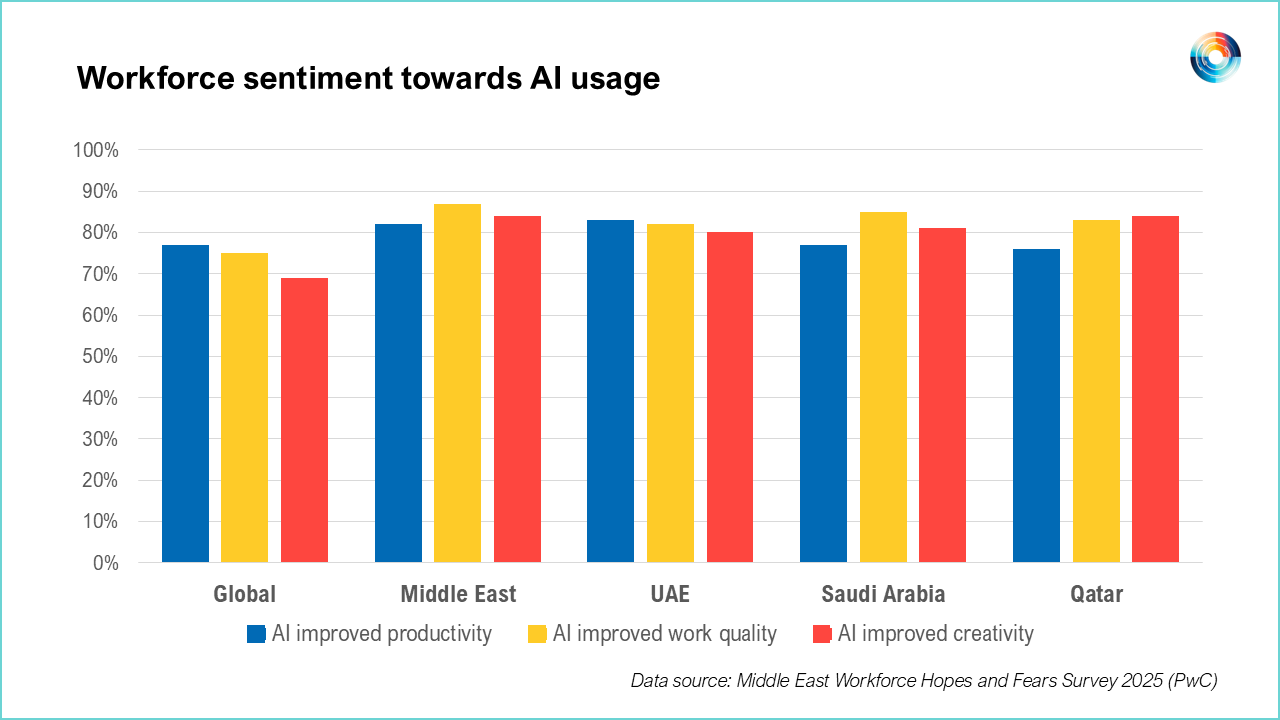
92% of Middle East respondents say AI has improved their productivity, well above the global figure of 77%. Regional employees also report higher-than-average gains in work quality (87%) and creativity (84%), consistently outperforming their global counterparts across all three measures.
In the UAE, 72% of employees report using AI at work, with 24% using it daily and 83% reporting productivity gains (all above global benchmarks). The UAE’s advanced adoption is attributed in part to the visibility and ambition of the UAE National Artificial Intelligence Strategy 2031.
In Saudi Arabia, 69% of employees report using AI at work, with 36% using generative AI weekly or daily. Notably, 55% of Saudi respondents expect AI to improve their job security (well above the global average of 38%) reflecting a broadly optimistic workforce attitude toward AI’s long-term role.
In Qatar, 69% of employees have used AI at work in the past year, with 44% using generative AI weekly or daily, ahead of the global rate of 32%. Over 80% report improvements in work quality, productivity and creativity, with optimism remaining strong about AI’s continued impact over the next three years.
Job security has become the top workforce priority across the region, with 85% of Middle East respondents rating it very important, compared to 79% globally. The share of employees planning to ask for a pay rise fell sharply from 71% in 2024 to just 46% in 2025, signalling a more cautious approach to career advancement.
Skills development is a defining feature of the regional workforce, with 69% of Middle East employees reporting they gained new skills in the past 12 months, compared to 56% globally. 81% prefer jobs offering transferable skills (12 percentage points above the global average).
Fatigue is emerging as a significant pressure point, with 45% of regional employees reporting they feel fatigued at least once a week and nearly half saying they feel overwhelmed. This is true even as engagement levels remain among the highest globally, with 78% saying they look forward to going to work.
Millennials and Gen Z employees are the most active AI users, adopting new tools quickly and often outpacing older colleagues in both usage and creative application. This positions younger talent as a key driver of digital adoption for employers across the Middle East.
ZOOM OUT — The workforce survey findings are consistent with those of PwC's 29th Global CEO Survey, published in January 2026. Based on insights from more than 300 Middle East chief executives, the survey found that 82 percent say that their organisation's culture enables AI adoption, with UAE CEOs at 85%. Meanwhile, 70 percent have a clearly defined AI roadmap. Nearly 40 percent of Middle East CEOs have adopted AI for demand generation, customer service and support, significantly ahead of the global benchmark of 22 percent. Overall, Middle East businesses reported 12 percent average revenue growth against a global figure of 8 percent, with stronger profit margins.
[Written and edited with the assistance of AI]
LINKS
Read more about PwC:
Middle East CEOs lead globally in AI adoption (Middle East AI News)
Qatar signs AI partnership with PwC and OpenAI (Middle East AI News)
GCC CEOs see AI as key to growth - survey (Middle East AI News)