

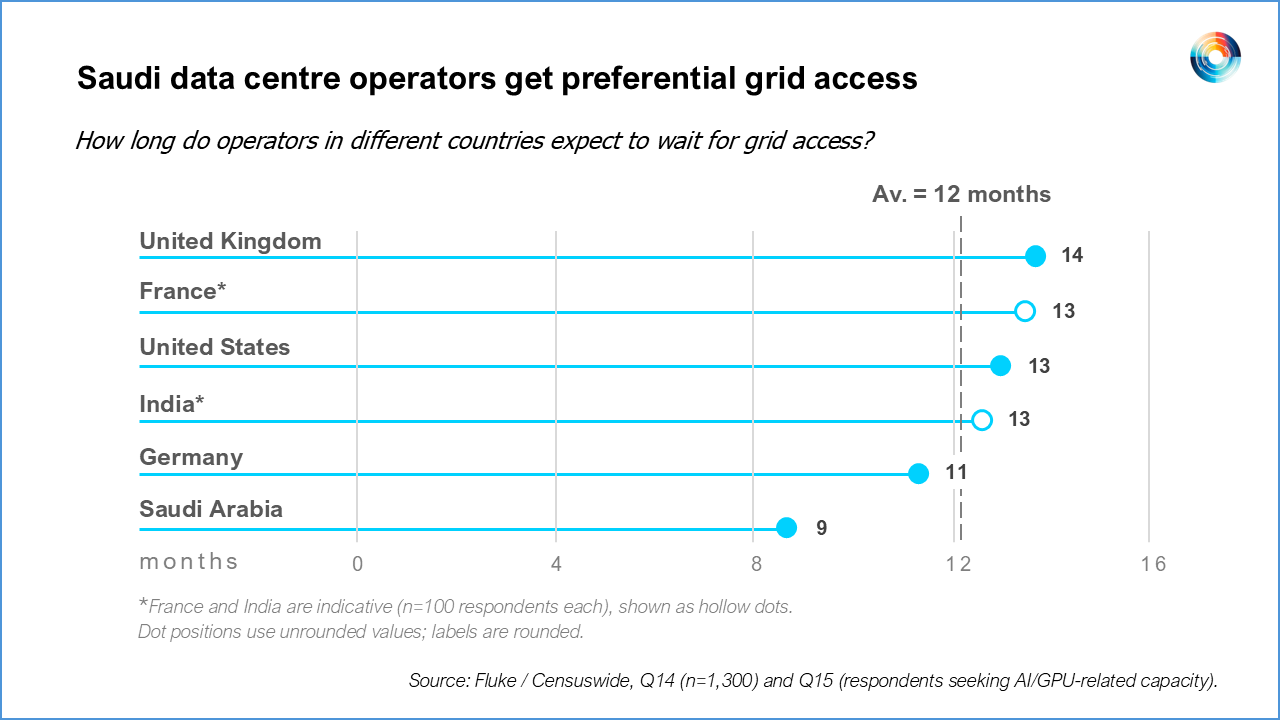
#SaudiArabia #DataCentres - Data centre operators in Saudi Arabia expect to wait nine months for extra grid capacity to scale AI, the shortest waiting period of the six countries surveyed by electrical testing company Fluke Corporation. The global average waiting time for a new data centre to get grid access is 12 months. The UK is longest at 14 months, ahead of France, the US and India at 13 and Germany at 11. Censuswide surveyed 1,300 professionals on behalf of Fluke, including 200 in Saudi Arabia.
SO WHAT? - Waiting for power is one of the main limits on how fast AI data centres can expand. Fortunately, Saudi operators expect a shorter wait than those in the US, UK, France, Germany and India. Speaking at a conference in September, CEO of HUMAIN Tareq Amin revealed that Saudi Arabia has already made the decision to allocate about 14 gigawatts of power capacity specifically for AI data centres. The Kingdom’s AI infrastructure build-out is prioritsed in its national AI strategy and so multiple government ministries and departments are actively helping to accelerate the allocation of land and infrastructure required for AI data centres.
KEY POINTS:
Saudi operators expect an average wait of nine months to secure extra grid capacity for scaling AI, compared with a global average of 12 months, according to Fluke Corporation’s 2026 AI Infrastructure Research Report.
The UK has the longest expected wait at 14 months. France, the US and India each expect 13 months, and Germany expects 11.
Fluke commissioned Censuswide to survey 1,300 data centre professionals in Saudi Arabia, the US, the UK, Germany, France and India, including 200 respondents in the Kingdom.
82% of Saudi respondents say their cooling and electrical systems are well or very well equipped for projected AI workloads during periods of extreme heat.
76% of Saudi respondents believe their electrical infrastructure is fully or largely equipped to meet the demands of AI and high-performance computing.
Only 47% of Saudi respondents report comprehensive or extensive real-time visibility across their critical electrical systems, and 52% have difficulty recruiting qualified electrical technicians, compared with 60% globally.
73.5% of Saudi respondents say their organisations combine international expertise with local recruitment, training and knowledge-transfer initiatives.
Saudi AI company HUMAIN plans to deploy 3 gigawatts of AI data centre capacity by 2030, and has a financing framework of up to $1.2 billion with the National Infrastructure Fund for up to 250 megawatts of hyperscale capacity.
ZOOM OUT - Fluke’s global findings are far less upbeat than the Saudi results alone. According to the report, just 33 percent of data centre operators believe that their electrical infrastructure is fully ready to support higher-density AI workloads. About eight out of ten respondents said that they faced electrical or power-system issues in the past year that caused disruption, delays or downtime. Skills were also identified as a constraint with 60 percent saying that recruiting qualified electrical technicians has become harder, and 34 percent report that shortages have delayed upgrades or new capacity. Power quality has reduced the ability of 29 percent to run high-density AI or GPU workloads. The report warns that such internal problems, together with limits on electricity supply, risk slowing global AI expansion.
[Written and edited with the assistance of AI]
Source: Fluke Corporation
Read more about data centres:
du launches Sovereign AI platform (Middle East AI News)
DAMAC targets 10GW of data centres by 2027 (Middle East AI News)
Syntys breaks ground on 20 megawatt Qatar data centre (Middle East AI News)
Infra, HUMAIN sign SAR 2.5 billion AI financing deals (Middle East AI News)
Oman consortium plans $3 billion, 400MW AI data centre (Middle East AI News)