

AI is making technology that was once difficult and expensive to reproduce increasingly accessible. Recent examples of developers using AI tools to create alternatives to established software applications raise an uncomfortable question: if a competitor can build a useful alternative in a fraction of the time and cost, what happens to the value of your invention?
We are seeing similar developments in gaming, where familiar characters appear in entirely different environments and developers experiment with running software on platforms for which it was never intended.
These examples may be entertaining, but there is a serious issue underneath.
Software is often distributed in compiled form, making it difficult to read, understand and reverse-engineer. For decades, that complexity has provided a practical barrier to copying valuable technology, although it was never a guarantee of security.
AI is beginning to lower that barrier. Tools that help developers analyse code, understand software behaviour and accelerate development are changing the economics of reproducing technology.
That matters deeply to the UAE.
We are investing in research, AI infrastructure and technology we can call our own. We want “Made in the UAE” to represent businesses that export, grow and continue funding the next generation of innovation.
Yet a company can retain legal ownership of its software and still lose customers to competitors developing alternatives with AI assistance.
Protecting intellectual property is therefore becoming as much an architectural challenge as a legal one.
In my previous article, I argued that AI agents need an Emirates ID. We should know who they represent, what they are authorised to do and who remains accountable for their actions.
That was part of a broader principle: ‘Connect and Protect’.
Now we need to apply that thinking to the technology those agents use and the information they exchange.
The challenge is not to close our doors. UAE innovators need international customers, technology partnerships and access to global markets.
The challenge is to enable those connections without unnecessarily exposing the intellectual property that makes our innovations valuable.
Consider a UAE company selling software that helps a factory reduce its electricity consumption.
The customer wants lower energy bills and evidence that the technology works. It does not necessarily need access to the supplier’s proprietary algorithms, underlying data or the methods that make those savings possible.
The supplier should be able to deliver the benefit while protecting the knowledge that allows it to keep improving its product.
That distinction should influence how technology is designed from the beginning.
What do we share? What remains under our control? What could a competitor learn by using our product repeatedly?
Simply making software difficult to read is no longer sufficient protection.
Sometimes the right answer is to deliver a service without handing over the software behind it. Sometimes an international customer needs technology to operate within its own infrastructure.
In those circumstances, we need architectures that allow customers to retain control of their data while protecting the supplier’s proprietary technology.
That is sovereignty through architecture.
Sovereignty is not simply about where information is stored. It is about understanding and controlling who can access it, how it is used and what is exposed when systems interact.
AI agents make these questions even more important.
Imagine a customer’s AI agent requesting prices, negotiating terms and placing orders directly with a supplier’s agent.
Transactions that previously required human intervention could increasingly happen automatically, at machine speed.
But how do those agents establish trust without exposing information that neither organisation needs to share?
One promising approach involves zero-knowledge proofs, a cryptographic technique that allows one party to demonstrate that a specific condition has been satisfied without revealing the private information behind it.
Imagine a buyer’s agent proving that a purchase falls within an authorised spending limit without revealing the company’s entire budget.
The supplier receives the assurance it needs. The buyer retains control of its confidential financial information.
Identity establishes who is acting. Authorisation determines what they are permitted to do. Cryptographic proof can help verify that a particular condition has been met.
These are different elements of the same trust framework.
Of course, this is not a magic shield.
A cryptographic proof cannot protect information that has already been disclosed, and a verified AI agent can still behave in unexpected or harmful ways.
We still need secure infrastructure, effective access controls, monitoring, clear accountability and the ability to restrict or revoke permissions.
And these protections must be practical. Security that makes technology too difficult or expensive to use will ultimately undermine adoption.
The UAE has an important opportunity here.
Much of the next generation of AI infrastructure and digital services is being designed and deployed now. We have an opportunity to build these protections into the foundations rather than attempt to introduce them after something has gone wrong.
That means asking difficult questions before products reach international markets.
What information must remain protected? What can customers legitimately access? How do we identify and authorise autonomous agents? And how do we maintain control as technology becomes more interconnected?
These are decisions that need to involve developers, technology integrators, customers, investors and policymakers.
The opportunity also extends beyond protecting individual products.
As AI agents become increasingly involved in commercial transactions, the UAE could help shape trusted approaches to how those agents identify themselves, establish permissions and exchange information securely.
Done properly, that could make UAE-developed technology easier for international customers to adopt, while strengthening confidence in the protection of valuable information.
We should also recognise that protection does not always mean restricting access.
There are circumstances where sharing technology creates commercial value, encourages innovation and builds stronger ecosystems. The UAE’s Technology Innovation Institute has demonstrated this through its Falcon AI models.
The important point is that sharing should be a deliberate decision, supported by a clear understanding of what we want to protect and what we want others to build upon.
The same AI tools helping competitors develop alternatives can also help UAE businesses accelerate innovation, improve products and respond to customers more quickly.
We should embrace that opportunity while ensuring the value we create remains sustainable.
For the UAE, this is about more than protecting software. It is about building national capability, developing commercially successful technology and establishing the confidence to compete internationally.
We have an opportunity to help define a new future for “Made in the UAE”: world-class innovation, trusted infrastructure and sovereign control built into the architecture from the beginning. Technology designed to reach global markets without surrendering the knowledge and value that allow us to keep innovating.
Connect and Protect. The game is afoot.
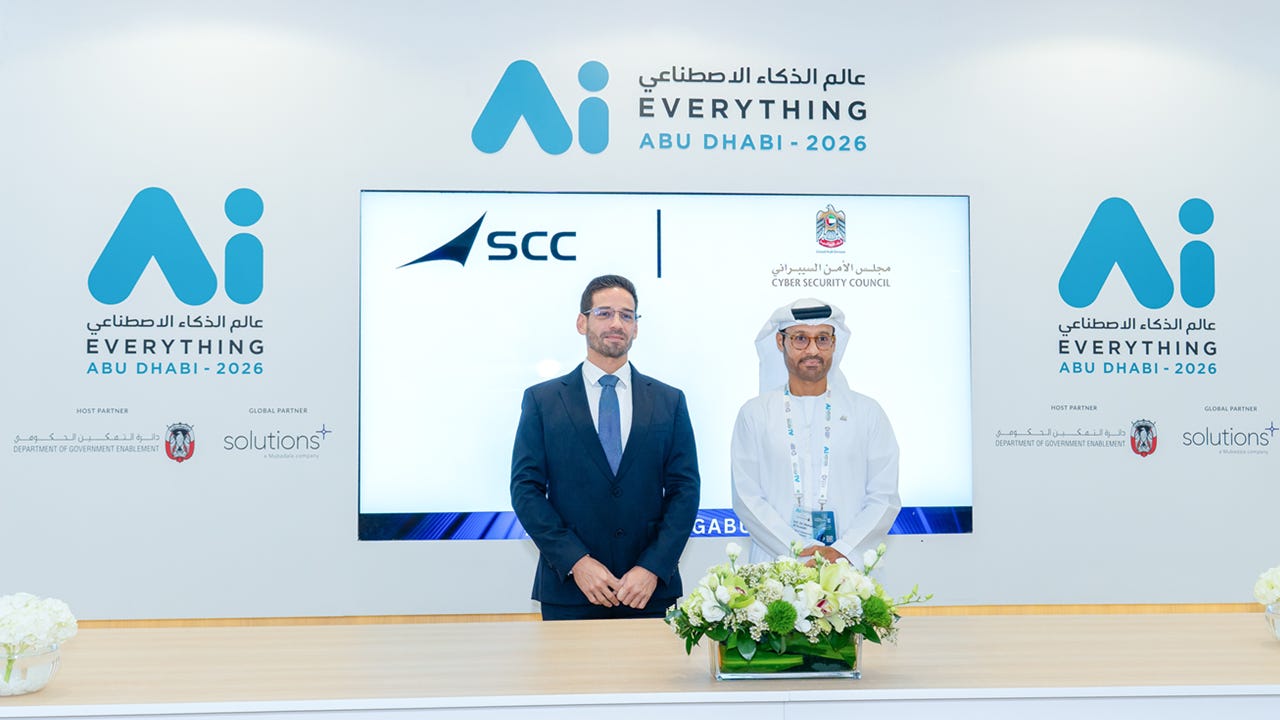
Daniel Valle is CEO of SCC Middle East.
Get in touch with SCC
Sponsored content. Views expressed are those of the author.
Read more from Daniel Valle:
An Emirates ID for AI Agents (Middle East AI News)
