

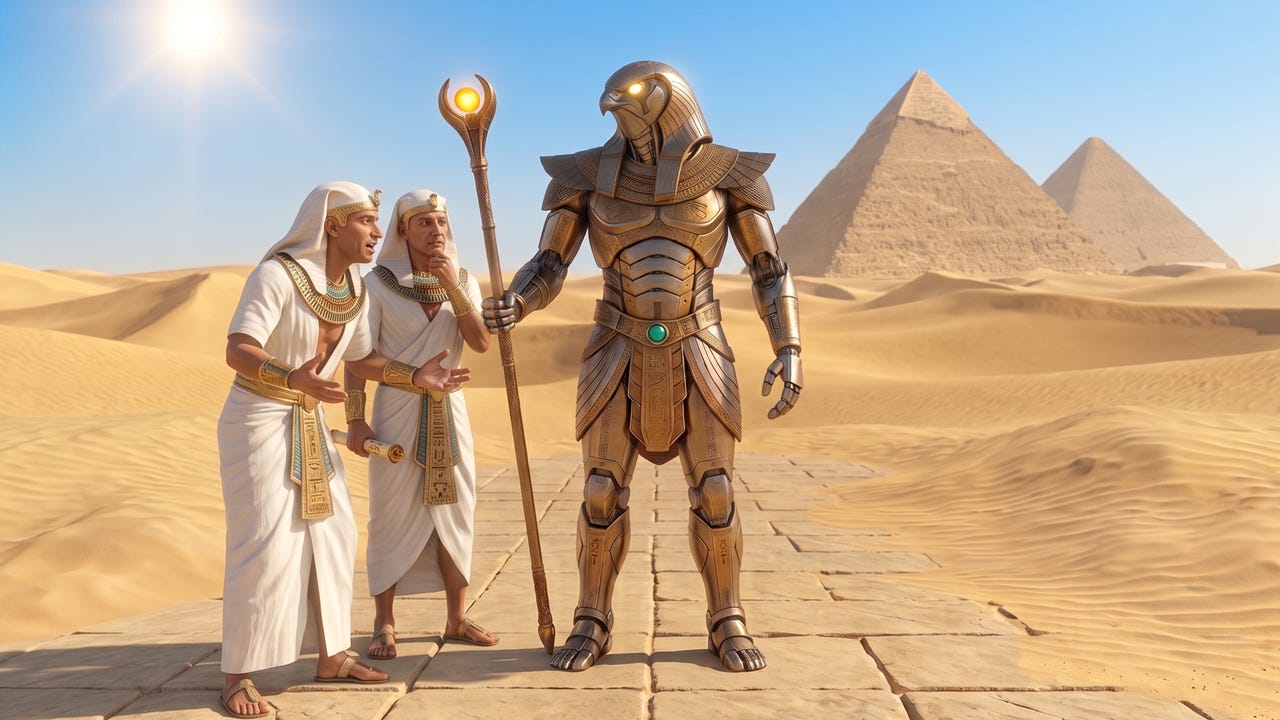
#Egypt #LLMs - AI technology company and nonprofit TokenAI has released Horus Taleeq 0.2B Base, an open-source Arabic-only small language model, alongside its training code and data sources under an MIT Licence. The new model was trained from scratch on 6 billion Arabic tokens, over a period of 30 hours on a single NVIDIA RTX PRO 6000 Blackwell server. However, the Arabic-first model is released at the pretraining stage only, without instruction tuning or safety alignment. The company’s fourth major model release this year, TokenAI is positioning Horus Taleeq as a foundation for the developer community to build conversational Arabic models on top of, rather than a finished product.
SO WHAT? - Most Arabic-language AI work happens behind closed doors, while training data and methodology are kept proprietary. TokenAI is doing the opposite in giving away the base model, the training code and the data sources at once. The MIT licence allows anyone reuse or modify them. For a language with far fewer open training resources than English, every initiative like this helps the Arabic language developer community to move Arabic AI forward. Whether the Horus Taleeq gets adopted depends on what the community builds on top of it, which will in turn inform the development of the next model.
KEY POINTS:
Alexandria-based TokenAI has released Horus Taleeq 0.2B Base, an Arabic-only small language model, as an open pre-training foundation for researchers and developers building more capable conversational systems. The new model has a decoder-only causal Transformer architecture.
The model was trained from scratch on 6 billion Arabic language data tokens, with no other languages included in training.
According to TokenAI, training took 30 hours of continuous running on a single NVIDIA RTX PRO 6000 Blackwell Server Edition GPU with roughly 95.6 GiB of VRAM, paired with an Intel Xeon Platinum 8559C CPU and around 62 GiB of system RAM.
TokenAI has open-sourced the training code, training data sources and supporting release materials through GitHub under the MIT Licence, with remaining training-data materials still being uploaded.
The release is a base model only, meaning it has not undergone supervised instruction tuning, preference optimisation or safety fine-tuning, and is not intended for production chatbot use without further work.
Intended uses include Arabic language-model research, continued pretraining and fine-tuning experiments, dialectal text generation research, and building separate instruction-tuned or chat checkpoints.
Horus Taleeq 0.2B Base marks the start of a planned model series specialised for Arabic and its dialects, with TokenAI saying future work may include instruction-tuned checkpoints and broader evaluation, to be published separately.
TokenAI was founded in 2025 and has now released four major model releases, including Horus Taleeq, so far this year.
ZOOM OUT - Horus Taleeq is TokenAI's fourth major release this year. Founded in 2025 by developer Assem Sabry, the company started 2026 with Horus 1.0-4B in April, a fully open-source model that scored 88 percent on the MMLU benchmark, ahead of larger rivals like Qwen 3.5-4B and Llama 3.1-8B. This was followed by Horus Hiero in July, a multimodal model built to read Ancient Egyptian hieroglyphics alongside modern Arabic dialects. Meanwhile, earlier this month TokenAI released Horus Cyber Nano, a small footprint cybersecurity model. Four releases in six months, from a new startup, is fast work by any measure.
[Written and edited with the assistance of AI]
Source: Token AI
LINKS
Horus Taleeq 02.B Base (Token AI)
Horus Taleeq 02.B Base (Hugging Face)
Horus Taleeq 02.B Base (Github)
Read more about 2026 TokenAI model releases:
TokenAI releases Horus Cyber Nano 1.0 (Middle East AI News)
TokenAI to release Horus cybersecurity model (Middle East AI News)
TokenAI’s Horus Hiero multimodal AI reads hieroglyphics (Middle East AI News)
Egyptian open-source LLM Horus punches above its weight (Middle East AI News)