

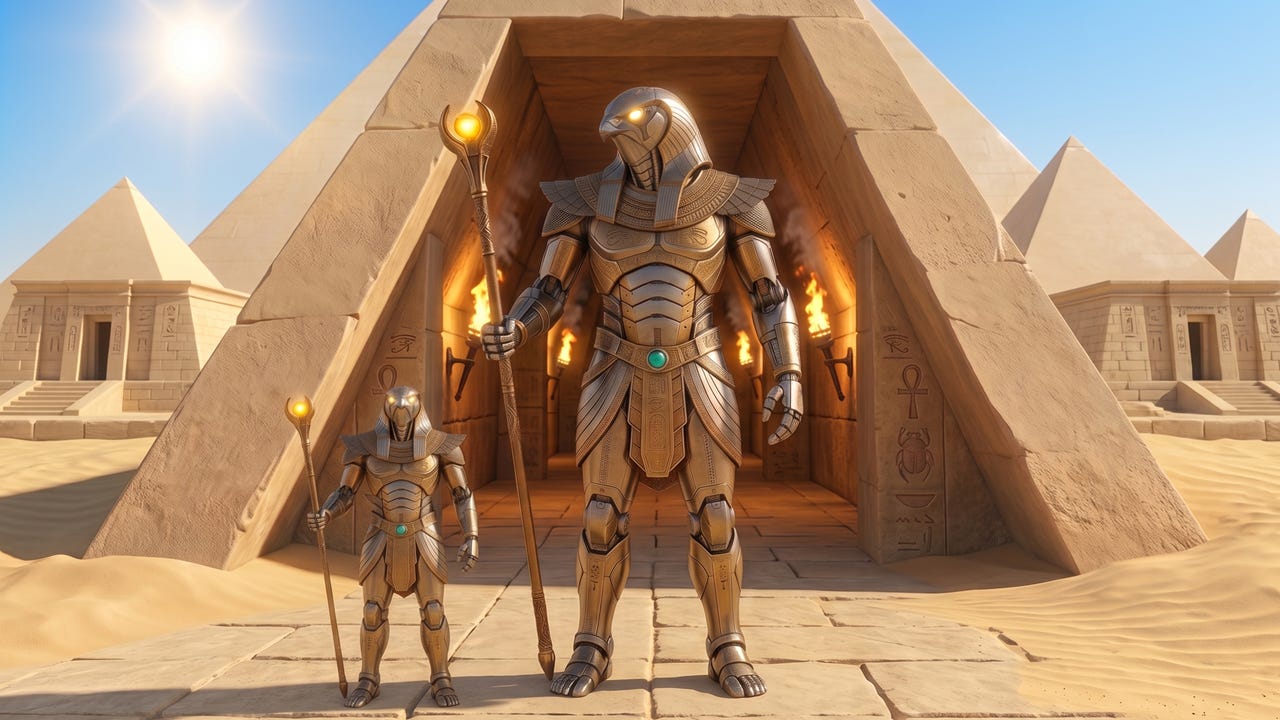
#Egypt #cybersecurity - Alexandria-based TokenAI has released Horus Cyber Nano 1.0, a compact 16-billion parameter multimodal model built for cybersecurity, secure coding and defensive technical work. The release followed confirmation that the release of the full-size mixture of experts model was paused in order to meet further open weight safety requirements. According to the developer, the smaller model outperforms OpenAI’s GPT-4o on some vision and reasoning tests and approaches the performance of Qwen2.5-VL-72B, a model several times its size.
SO WHAT? - TokenAI pausing its own release over a safety violation, then publishing a compact version with added safeguards, provides useful evidence of the company’s commitment to responsible AI. The future version of the full Horus Cyber model is also expected to be released with the blessing of Egypt’s National AI Council. For the region’s wider AI ecosystem, Horus Cyber Nano also matters because it’s a specialised open-source model built for a specialised commercial use case, cybersecurity and secure coding. This comes at a stage when most of the region’s open-source model releases are more general in nature.
KEY POINTS:
TokenAI has released the official compact weights for Horus Cyber Nano 1.0 on 8 September 2026 via Hugging Face. This comes shortly after the initial release was paused in order to comply with the open-source community’s safety policy.
The compact version is built on a Mixture-of-Experts architecture and is available through the Horus Cyber Nano 1.0 collection on Hugging Face, alongside GGUF variants for local deployment.
Horus Cyber Nano 1.0 is a 16-billion parameter multimodal reasoning model that processes text, images and video, targeting secure code review, visual inspection, video understanding and defensive technical workflows.
The model uses 64 routed experts and 2 shared experts with 6 active per token, a 131,072-token maximum context length, and can process images up to 3.2 million pixels.
TokenAI’s internal and published evaluations show the model outperforming GPT-4o on some vision and reasoning benchmarks, while approaching the performance of Qwen2.5-VL-72B, a model roughly 100 times larger, on several multimodal tasks.
Published benchmark scores include 84.4 on MMBench-EN-v1.1, 91.8 on MATH, 82.0 on MMLU and 91.4 on ScreenSpot-V2, though TokenAI cautions that testing conditions vary across model comparisons.
TokenAI is already working on a further Horus Cyber Nano release aimed at stronger capabilities, higher performance and lower computational cost.
The company’s Horus Cyber Pro models remain closed source, with TokenAI planning to release open weights in the coming months pending approval from Egypt’s National AI Council.
ZOOM OUT - Horus Cyber Nano 1.0 is TokenAI's significant open weight release after Horus 1.0-4B, a 4 billion parameter open-source model the Alexandria-based startup released in April 2026. Horus 1.0-4B scored 88% on the MMLU (Massive Multitask Language Understanding) benchmark, beating Qwen 3.5-4B, Llama 3.1-8B and Gemma-2-9B, all larger models. Egypt graduates around 60,000 technology students a year and employs half a million people in ICT, yet homegrown AI models built from scratch remain rare, making founder TokenAI’s Horus family something of an outlier.
[Written and edited with the assistance of AI]
Source: Token AI
LINKS
Horus Cyber Nano 1.0 (Token AI)
Horus Cyber Nano 1.0 (Hugging Face)
Read more about the Horus family of models:
TokenAI to release Horus cybersecurity model (Middle East AI News)
TokenAI’s Horus Hiero multimodal AI reads hieroglyphics (Middle East AI News)
Egyptian open-source LLM Horus punches above its weight (Middle East AI News)