

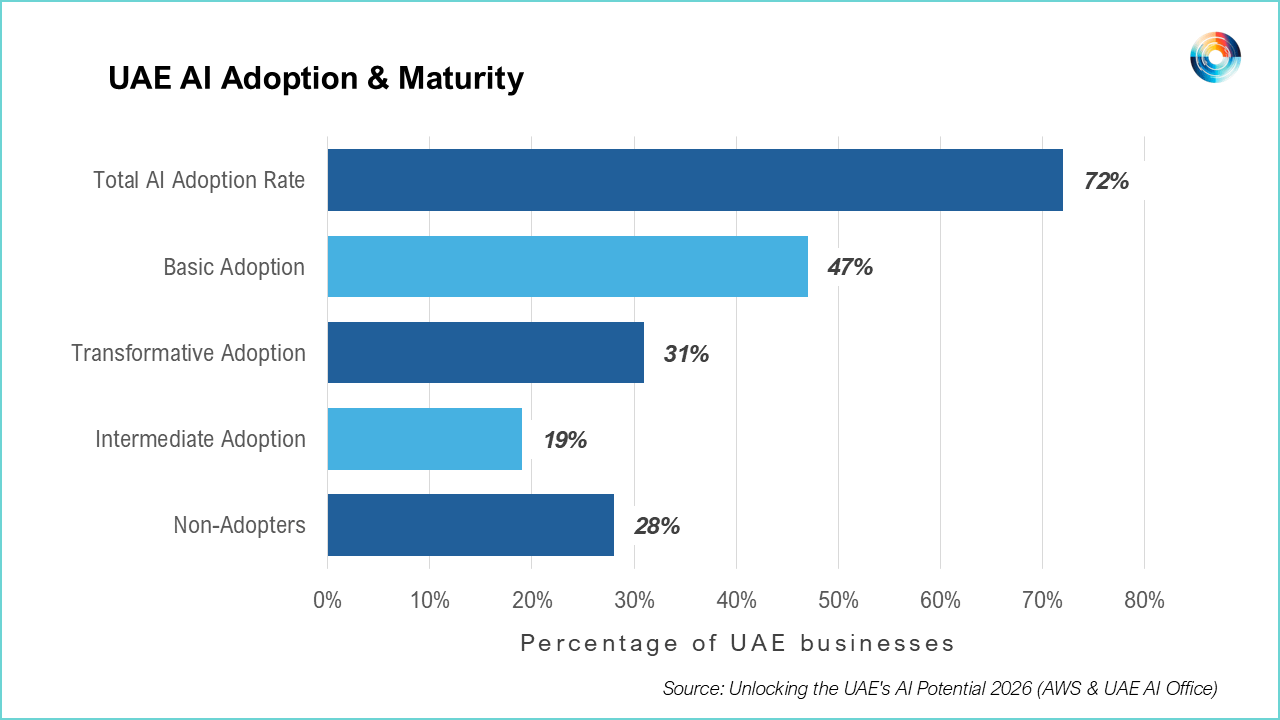
#UAE #AIadoption - Artificial intelligence adoption among UAE businesses reached 72 percent in 2026, marking a 36 percent year-on-year increase according to research released by Amazon Web Services (AWS) and the UAE Artificial Intelligence Office. The “Unlocking the UAE’s AI Potential 2026” report by research firm Strand Partners shows that while 85 percent of adopting companies report accelerated innovation timelines,. The study highlights the potential for a digital divide, where 31 percent have reached the transformative stage of AI adoption, while 47 percent of businesses remain focused on the basic uses of AI and routine efficiencies.
SO WHAT? - The surge in UAE AI adoption reflects a payoff from the consistent implementation of national digital agendas including the national AI strategy. Nearly half of businesses stuck in basic, incremental use cases and facing a 5.8-month wait to recruit skilled digital talent. Therefore, the UAE risks a widening productivity split between agile, AI-first startups and lagging traditional enterprises. Unlocking the next wave of economic growth requires moving beyond initial pilots to sovereign cloud execution, targeted upskilling, and clearer cross-border data governance.
KEY POINTS:
Amazon Web Services (AWS) and the UAE Artificial Intelligence Office have punlished a new report “Unlocking the UAE’s AI Potential 2026”, in collaboration with UK-baesed Strand Partners.
According to the report, UAE enterprise AI adoption reached 72% in 2026, up from 53% in 2025 (a 36% year-on-year increase). The rate of growth outpaces Europe’s 54% adoption rate and 29% growth rate.
74% of those surveyed UAE businesses consider AI adoption a top or high priority, with 47% citing it as critical or important to their core business strategy.
The new report identifies four priorities to sustain and accelerate the UAE’s AI leadership:
Accelerate responsible AI adoption supported by secure, scalable cloud infrastructure
Ensure policy and regulation enable rather than slow innovation
Address skills shortages to build the UAE’s knowledge economy
Increase access to funding for businesses of all sizes, with a focus on AI-first startups and SMEs
The report found that 47% of businesses remain at a basic adoption level (using ready-made tools for routine tasks), 19% have reached intermediate integration, while 31% engage in transformative adoption using custom, agentic, or autonomous AI systems.
Only 51% of large UAE businesses have adopted AI, whereas 88% of startups have adopted the technology. In fact, 53% of those startups leveraging advanced use cases and 61% reporting significant productivity gains.
AI adoption is highest in media and entertainment (82%), financial services (79%), retail (76%), and hospitality (69%).
Despite the fact that 32% of businesses are aware of agentic AI, only 9% have fully deployed it. 21% feel ready for next-generation AI; main hurdles include skills shortages (46%), internal financial constraints (38%), and legal uncertainty (21%).
48% of firms cite digital skills shortages as a key barrier, reporting that it takes an average of 5.8 months to recruit qualified personnel, with 81% willing to offer a 39% salary premium to secure talent.
66% of firms define digital sovereignty as robust data protection and governance, while 87% emphasize that ongoing access to global technology providers remains vital for scaling AI.
AWS is investing up to AED 20.1 billion ($5.47 billion) in its UAE cloud region through 2037 (projected to add AED 41 billion to GDP), alongside a $1 billion partnership with telecom operator e& enterprise to launch the UAE Sovereign Launchpad.
To address talent gaps, AWS and e& launched the AI Nation – Afaaq Program to train 30,000 individuals, alongside multi-year research and startup enablement collaborations with Mohamed bin Zayed University of Artificial Intelligence (MBZUAI).
ZOOM OUT - The findings align with the UAE National Strategy for Artificial Intelligence 2031 and the UAE government framework to deploy agentic AI across 50 percent of government sectors, services and operations within two years. Over the past three years, the Gulf state has aggressively built out capital and physical infrastructure to position itself as a primary node in global AI supply chains. Resolving operational bottlenecks like local talent development and access to funding remain critical factors to converting infrastructure investments into broad-based productivity gains. However, the gains in AI skills, adoption and early returns on agentic AI all come as a result of the UAE’s far-sighted AI policies and methodical implementation of its AI strategy over the past decade.
[Written and edited with the assistance of AI]
Source: Core42, Microsoft, Cyber Security Council
DOWNLOAD
Read more about AI adoption in the UAE:
UAE firms run AI agents at massive scale (Middle East AI News)
UAE leads world on industrial AI in F&B (Middle East AI News)
UAE, Saudi telcos bet big on AI networks (Middle East AI News)
Saudi Arabia, UAE AI spend surges, execution lags behind (Middle East AI News)
UAE firms locked into AI vendors, IBM finds (Middle East AI News)