

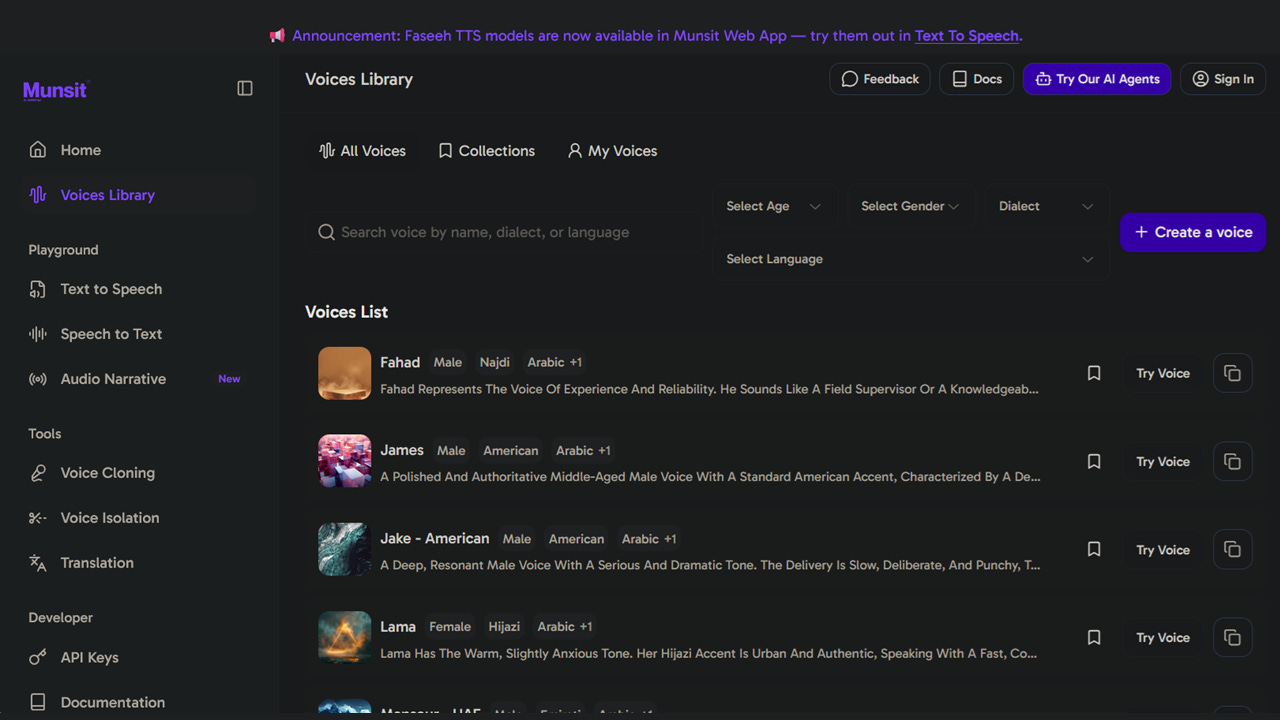
#UAE #Arabic – Abu Dhabi-based data and AI company CNTXT AI has expanded its Arabic voice platform Munsit into a unified system that combines speech recognition and voice generation in a single engine, covering more than 25 Arabic language dialects. The upgrade integrates CNTXT AI’s patented speech-to-text technology with a new text-to-speech model called Faseeh. The result is a closed-loop workflow where Arabic audio can be captured, transcribed, analysed, and regenerated within the same system. The platform already serves more than 250 government and enterprise organisations across the region.
SO WHAT? – The Arabic language has consistently been underserved by global AI voice platforms, which were largely built around English and a handful of other high-resource languages. However, dialect diversity and the lack of quality Arabic data makes the language particularly difficult for AI to handle at scale. A platform that processes spoken Gulf Arabic as accurately as Modern Standard Arabic, could remove a bottleneck for governments and enterprises across the region that are sitting on large volumes of voice data they currently cannot use.
Here are some key points from the announcement:
CNTXT AI has relaunched Munsit as a full Arabic voice AI platform, combining its patented speech recognition engine with the new Faseeh text-to-speech model. The system supports more than 25 Arabic dialects and is designed for deployment across government, finance, customer service, and digital platforms.
The platform creates a closed-loop voice workflow, allowing organisations to capture audio, transcribe it, analyse it, and convert it back into natural spoken Arabic, all within a single integrated system rather than across separate tools and vendors.
Munsit has already processed over 86 million Arabic words and more than one million minutes of audio since launch. More than 250 government and enterprise organisations are actively using the platform across the UAE and wider region.
The platform’s mobile application reached 150,000 users within two months of launch, suggesting strong consumer-side demand alongside the enterprise uptake. The platform is accessible via API, web workspace, and mobile app.
Deployment options include cloud, private infrastructure, and fully on-premise, giving organisations with sensitive data the ability to keep all voice data within their own infrastructure and maintain full data sovereignty.
Practical use cases span several sectors. Call centres can analyse entire customer interaction libraries rather than small samples. Financial institutions can apply voice data to compliance and quality control. Government entities can search and transcribe citizen interactions in the dialect they were originally spoken.
For developers, Munsit provides an API-based route to integrate Arabic voice capabilities directly into applications, avoiding the cost and time of building Arabic speech models from scratch. This could remove a significant barrier given the complexity of dialect variation across the Arab world.
CNTXT AI describes itself as a sovereign AI company, focused on helping organisations build and deploy AI while retaining full control over their data. Munsit sits alongside TestAI, its platform for assessing AI performance and reliability before deployment.
[Written and edited with the assistance of AI]