

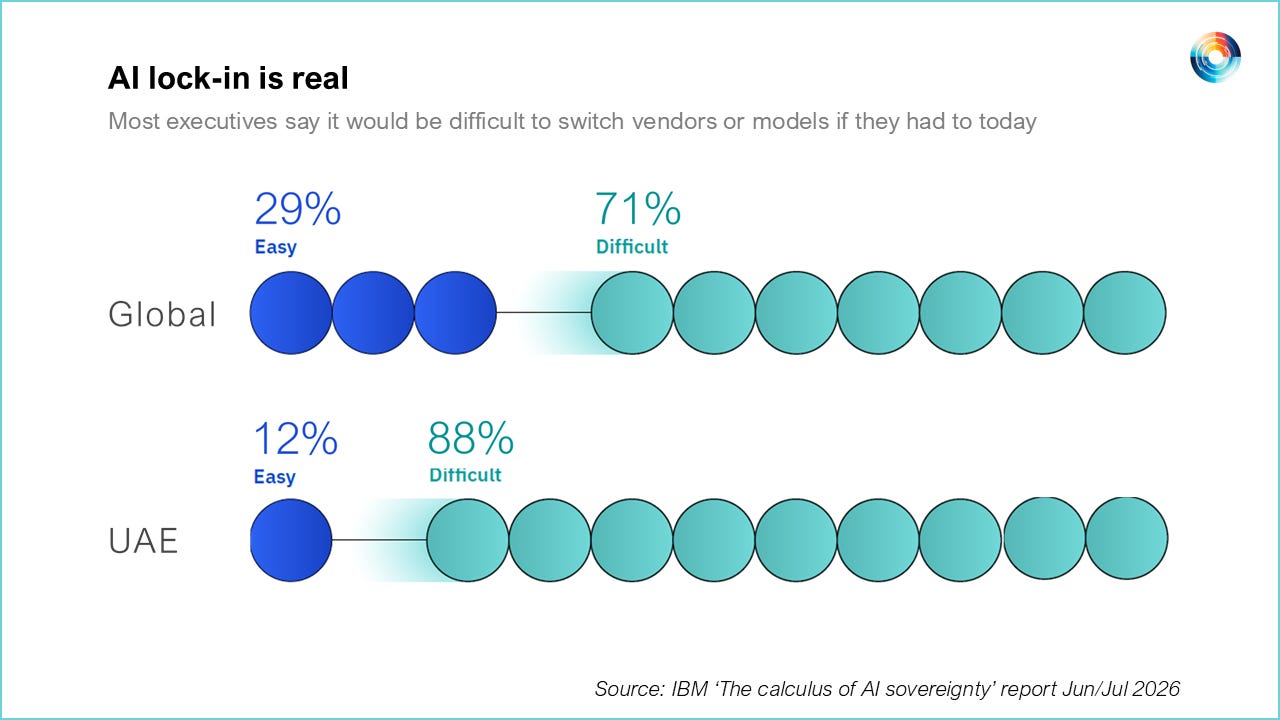
#UAE #AIadoption - A new IBM Institute for Business Value study finds 88 percent of surveyed UAE executives say switching their primary AI vendor or model would be difficult today, and 96 percent admit they don’t fully understand their organisation’s dependencies across AI vendors, models and infrastructure. The Calculus of AI Sovereignty study, based on 1,000 senior executives across 16 countries, found UAE respondents report seven AI-related disruptions on average over the past two years, and 84 percent say a seven-day vendor outage would cause severe or critical disruption to their operations.
SO WHAT? - The findings puncture the idea that running AI across multiple vendors automatically protects a business from disruption. Most UAE organisations describe their AI setup as intentionally multivendor, but IBM’s data suggests that diversity is largely accidental, perhaps the product of inherited decisions rather than deliberate design .Some 80 percetn of executives say moving core AI systems to a different vendor would take at least six months. Globally, organisations with genuine control over their AI stack protect 55 percent more operating profit from AI-driven disruptions, yet only 7 percent currently operate at that level.
KEY POINTS:
IBM’s Institute for Business Value surveyed 1,000 senior executives across 16 countries and 17 industries between February and April 2026, working with Oxford Economics, to examine control over AI systems.
88% of surveyed UAE executives say switching their primary AI vendor or model would be difficult today, much higher than the 71% global average.
74% of UAE respondents say meeting data residency and sovereignty requirements across geographies is challenging (versus 68% globally).
96% of UAE executives say they don’t fully understand their organisation’s AI dependencies across vendors, models and infrastructure (91% globally).
UAE organisations reported an average of seven AI-related disruptions over the past two years, against six globally, with 84% saying a week-long vendor outage would cause severe disruption.
82% of UAE organisations describe their AI environments as intentionally multivendor, against 73% globally, yet 80% say moving core AI systems to a new vendor would take at least six months.
UAE executives estimate it would take an average of 150 days to move their AI training and operational data to a different environment.
78% of UAE executives say they’d accept a 20% cost increase to maintain their AI vendors if it improved strategic flexibility (72% globally).
Globally, organisations with the most advanced AI control capabilities protect 55% more operating profit from AI-driven disruptions than peers, though only 7% of surveyed organisations currently reach that level.
ZOOM OUT - The Calculus of AI Sovereignty study highlights a global trend that enterprises now let AI make roughly a quarter of operational decisions, a figure they expect to reach 48 percent by 2030. However, only 9 percent of the 1,000 executives surveyed say they understand their AI dependencies well and 71 percent would struggle to switch vendors today. That lack of control carries a real cost and so organisations with the strongest grip on their AI stack see 55 percent more operating profit. IBM’s answer is “selective AI sovereignty”: rather than chasing full control everywhere. It recommends tiering AI systems by business risk, investing heavily in flexibility for mission-critical platforms like fraud engines, and accepting vendor dependency for commodity tasks like transcription and translation where switching costs matter less.
[Written and edited with the assistance of AI]
Source: IBM Institute of Business Value
DOWNLOAD
Read more about AI adoption and adoption challenges:
startAD launches AI health sector barometer for UAE (Middle East AI News)
AI activity is pushing Gulf networks toward breaking point (Middle East AI News)
Quarter of UAE, Saudi firms run AI unchecked (Middle East AI News)
Many UAE firms unprepared for AI risk (Middle East AI News)
91% of Saudi firms seeing AI pay off, SAP survey finds (Middle East AI News)