

#UAE #trends - The World Bank Group has recognised the UAE’s progress across a variety of key metrics for national AI strategy. As part of its new World Development Report 2026: The Promise of Artificial Intelligence, the World Bank references multiple examples from the Emirates to illustrate how economies are adopting, adapting and advancing AI. The report credits Abu Dhabi’s Technology Innovation Institute (TII) with building the Falcon family of sovereign AI models, places the UAE among the top 20 countries for ChatGPT use per Internet user, and cites its residency incentives for AI talent and new federal AI authority as examples of coordinated policy.
SO WHAT? - The World Bank Group report is deliberately cautious about naming leaders, focusing instead on what countries are actually doing with the technology. Against that backdrop, the UAE turns up repeatedly and favourably: as a model-builder, a talent magnet, and an early adopter, each drawn from a different section of the report. Few emerging economies are mentioned across that many categories, which says something about the breadth of the UAE’s AI push even without the World Bank framing it as a ranking exercise.
KEY POINTS:
The World Bank Group has published the World Development Report 2026: The Promise of Artificial Intelligence.
The report credits the Technology Innovation Institute (TII), Abu Dhabi’s government-backed AI research centre, with developing the Falcon family of AI models and training them further on Arabic language and regional dialects. Falcon is one of only a handful of examples cited of an emerging economy building AI models from scratch rather than adapting existing ones.
The UAE appears on the report’s list of the top 20 countries by ChatGPT use per internet user, well above the low single-digit adoption rates the report records for most middle-income economies.
The UAE recorded one of the highest net inflows of AI workers per 10,000 LinkedIn members in 2025, alongside Luxembourg, Australia, Saudi Arabia and Switzerland, according to the Artificial Intelligence Index Report 2026 cited in the study.
The report notes the UAE offered long-term residency incentives for AI experts, part of a wider strategy the World Bank links to strengthening the domestic AI ecosystem through global talent and capital flows.
The UAE is cited for embedding AI literacy into its national competency framework, one of the report’s examples of countries pairing infrastructure investment with foundational skills-building.
The report also credits the UAE with establishing AI executive leaders across federal entities and a unified federal authority for AI, data and digital government, which it frames as institutional capacity that helps governments test, buy and scale AI tools.
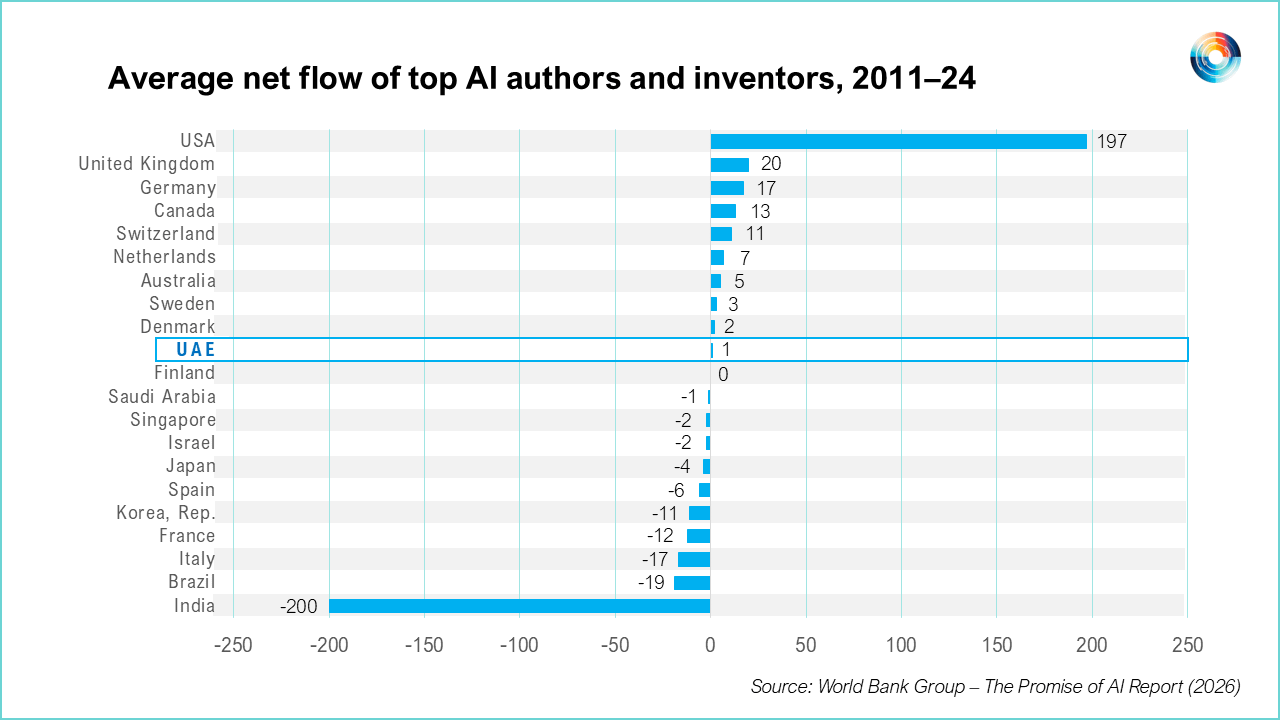
On the report’s measure of net flow of top AI authors and inventors between 2011 and 2024, the UAE ranks 10th globally with a score of 1, behind the United States (197), the United Kingdom (2), Germany (17) and Canada (13), a reminder that its strengths lie more in broader workforce and policy metrics than in frontier research talent.
The report separately notes that leading AI hyperscalers, including Alphabet, Amazon, Meta, Microsoft and Oracle, are projected to spend $572 billion on capital expenditure in 2026, a sum it says exceeds the nominal GDP of several countries, including the UAE, illustrating the scale of global AI investment the UAE is positioning itself within.
[Written and edited with the assistance of AI]
Source: World Bank Group
LINK
Check out the World Bank Report (website)