

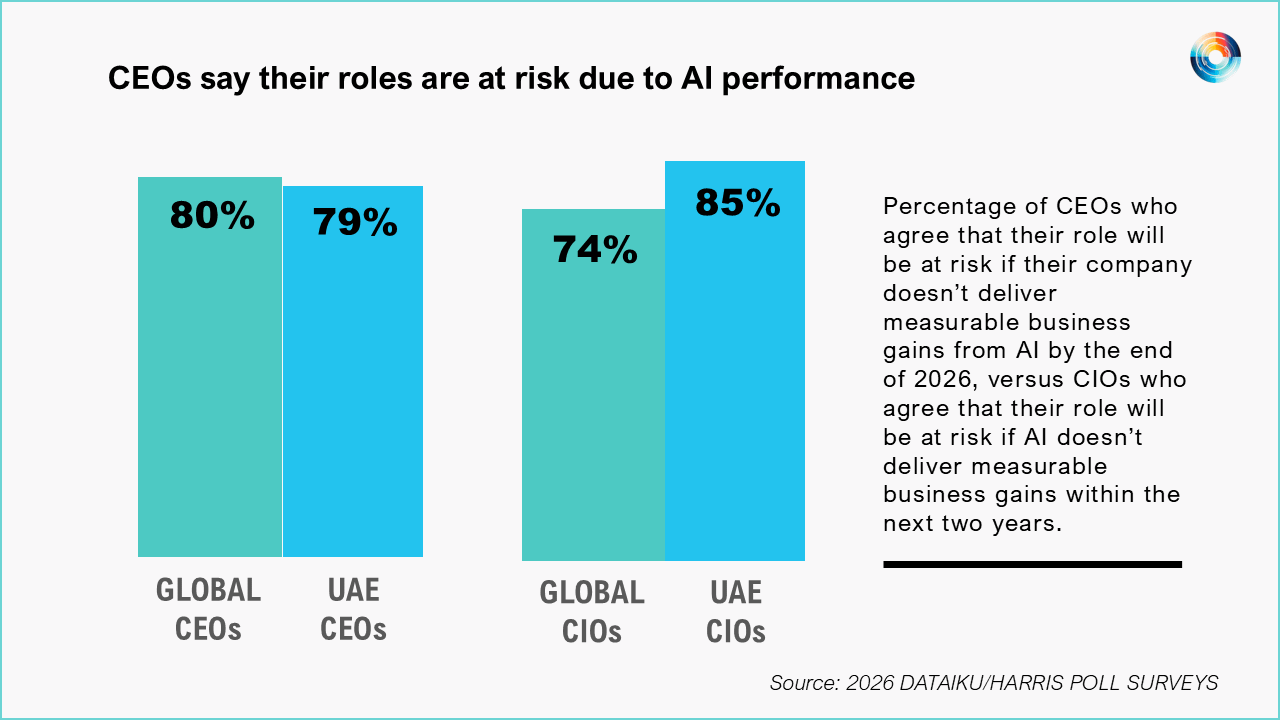
#UAE #AILeadership – New global research from US AI and analytics platform Dataiku, conducted by Harris Poll across 900 CEOs in eight countries, reveals that AI could become the defining measure of CEO success, tenure and legacy. According to Dataiku’s 2026 CEO Confessions Study, 79 percent of UAE CEOs believe their role is at risk if their organisation fails to deliver tangible business gains from AI by the end of 2026. The finding is in line with responses from other global CEOs, however the UAE ranks highest globally for the proportion of CEOs who believe their organisation’s current AI approach could jeopardise their long-term legacy (23% compared with a global average of 10%).
SO WHAT? – When eight in ten UAE CEOs say their job depends on AI results, and 85% of UAE CIOs say the same, the technology has moved decisively into the C-suite accountability framework. Dataiku's research, spanning both CEOs (May ‘26) and CIOs (Feb. ‘26) in the UAE, tells a consistent story. As enterprises accelerate their transition from AI pilots to full implementation, AI is no longer something senior leaders can simply delegate. Senior leadership must now personally own AI implementation, and be able to defend to boards and investors, even staking their professional reputation on its performance. The pressure is real and increasing, as is the gap between confidence and proven governance capability.
KEY POINTS:
79% of UAE CEOs believe their role is at risk if their organisation fails to deliver measurable AI outcomes by the end of 2026, according to Dataiku’s 2026 CEO Confessions Study. The study was conducted by Harris Poll among 900 CEOs across eight countries including the UAE, US, UK, France, Germany, Japan, South Korea and Singapore.
The UAE ranks highest globally for CEO concern about AI legacy risk, with 23% of UAE CEOs saying their organisation’s current use of AI could jeopardise their long-term legacy: more than double the global average of 10%. This places the UAE at the sharpest end of global CEO accountability for AI outcomes.
More than half of UAE CEOs (53%) say that within two years, experience leading a successful AI strategy will become the top criterion boards use when appointing a new CEO, signalling a fundamental shift in what leadership capability means in the UAE’s most senior executive ranks.
Three-quarters of UAE CEOs say their personal involvement in AI decisions has increased over the past year, with 55% identifying themselves as the single most influential stakeholder in determining their organisation’s AI direction, ahead of IT, data and business leaders.
Board and investor pressure is mounting. Nearly six in ten UAE CEOs say they feel board pressure to deliver measurable AI outcomes, with 90% believing those expectations are realistic. Meanwhile, 76% say AI strategy and execution are important to investors, and 75% believe CEOs could be removed in 2026 due to a failed AI strategy or high-profile AI-driven crisis.
Despite the urgency, caution is prevalent. 44% of UAE CEOs say their organisations have delayed or cancelled AI initiatives due to concerns about potential failure. The finding highlights the increasingly narrow path between moving fast enough to satisfy boards and moving carefully enough to avoid costly missteps and reputational damage to the management team.
According to Dataiku’s insights, a governance gap is emerging. While 73% of UAE CEOs say they trust their governance frameworks, the UAE ranks lowest globally in CEO confidence in explaining AI-driven decisions to regulators or courts. Additionally, 41% say they have not challenged AI vendor or platform decisions made within their organisation over the past year.
Systemic risk awareness is also rising according to the report. More than four in ten UAE CEOs say their organisation would face significant risk if the AI bubble were to burst. The risk seems to underline the importance of building governance frameworks and operational flexibility in tandem with performance.
ZOOM OUT – The pressure on UAE CEOs mirrors findings Dataiku published earlier this year about the country's CIOs. In February 2026, research found that 85 percent of UAE CIOs believe their role could be at risk if their organisation fails to deliver measurable AI gains within one to two years. Of those surveyed, 98 percent say their professional reputation will be shaped by their success with AI, the highest figure globally. The CIO data also revealed a governance challenge that the CEO findings echo: 78 percent of UAE CIOs report that employees are creating AI agents faster than IT teams can govern them, while only one in five have complete oversight of all AI agents in use across their organisation. Taken together, the two datasets paint a consistent picture: AI accountability is elevating through UAE leadership ranks, from boardroom to C-suite, at a speed that governance frameworks are still struggling to match.
[Written and edited with the assistance of AI]
DOWNLOAD
Read more research from Dataiku:
85% of UAE CIOs say role at risk over AI delivery (Middle East AI News)
UAE data leaders cannot trace AI decision-making (Middle East AI News)