

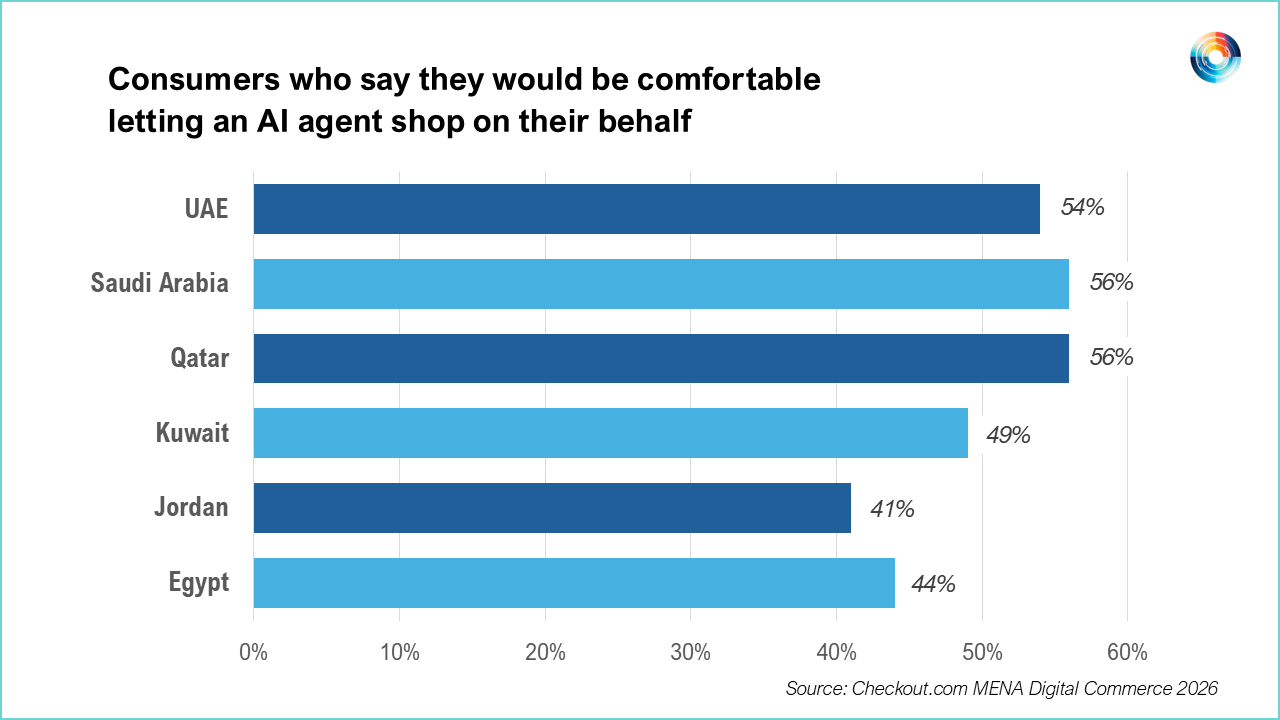
#MENA #shopping — Consumer demand for AI-powered shopping is accelerating across the Middle East and North Africa, but trust seems to be the critical condition for growth. A new 2026 report from London-headquartered global payments platform Checkout.com finds that 97 percent of consumers across MENA want invisible, frictionless payments, yet 62 percent rank payment security as their top shopping priority. With half of all regional consumers already open to AI agents buying on their behalf, MENA is emerging as one of the world’s most demanding and dynamic digital commerce markets.
SO WHAT? — The data from the new digital commerce report shows that MENA could play an increasing role in shaping global digital commerce trends, in particular when it comes to the use of AI agents for shopping. Saudi Arabia has already hit Vision 2030’s 70% cashless society target ahead of schedule. The UAE has built one of the world’s most advanced digital economies. Now, AI-driven agentic commerce is the next frontier for the entire region, with MENA consumers willing to embrace AI agents for shopping. However, the signal is clear: convenience without security will not convert, and it will not retain.
KEY POINTS:
Global payments platform Checkout.com has published its MENA Digital Commerce 2026: A new era of AI in payments. The research shows that consumer demand for AI-powered shopping is accelerating across the Middle East and North Africa, with the region’s love of AI making it a key testbed for agentic commerce.
Online shopping is popular across MENA. 45% of regional consumers now shop online at least weekly, and 63% expect to increase the frequency of their online purchases over the next 12 months. In Saudi Arabia and the UAE, those figures rise to 50% and 52% respectively shopping weekly.
50% of MENA consumers are comfortable with AI agents shopping on their behalf. In Saudi Arabia that rises to 56%, and in the UAE to 54%. The tasks consumers are most willing to delegate are finding the best price (50% regionally), comparing products and reviews (41%), and creating shopping lists (30%).
Privacy remains the single biggest barrier to AI commerce adoption, cited by 55% of MENA consumers overall and 54% in both Saudi Arabia and the UAE.
Adoption also skews toward men and higher-income groups. In the UAE, 79% of high-income earners are comfortable with AI agents versus just 50% of lower-income consumers.
Demand for invisible payments (transactions requiring no manual credential entry or page redirection) is near-universal. 97% of MENA consumers say they want this kind of frictionless checkout. In Saudi Arabia the figure reaches 98%, and in the UAE 96%.
Security is not a bonus feature, it is the price of entry. 62% of MENA consumers say a safe and secure payment process is the most important factor when shopping online. In the UAE that figure rises to 63%, and in Saudi Arabia to 57%. The report also highlights that false declines carry an immediate cost: 35% of MENA consumers would switch to a competitor on the spot.
Cart abandonment driven by security fears is a measurable and growing problem. 28% of MENA consumers have abandoned a purchase due to payment security concerns. In the UAE, that figure climbs to 32%, with 38% saying they would avoid a website entirely if uncertain about payment safety.
Digital wallets have become central to everyday financial life across the region. 64% of MENA consumers use them at least monthly for purchases, budgeting, and financial management, while 74% use them for money transfers. In the UAE, 67% use wallets monthly for spending, and 71% for transfers.
Checkout.com’s own processing data reflects the regional momentum. Total processing volume across MENA grew 62% year-on-year, while remittance volumes across the region surged 169% between 2024 and 2025.
Spending patterns are diversifying fast. Food delivery is the most active online category across MENA at 59% of consumers, followed by clothing at 54% and travel at 40%. Social commerce is also growing, with 25% of regional consumers now shopping through social media platforms (this figure rises to 26% in Saudi Arabia and 27% in the UAE).
AN AGENTIC AI TESTBED — MENA is quietly becoming one of the world's most important testing grounds for agentic commerce infrastructure. Mastercard's Agent Pay, which is designed to integrate AI directly into the payment experience, made its debut outside the United States in the UAE, through a pilot with Dubai-based retail and leisure conglomerate Majid Al Futtaim. Checkout.com is working with Mastercard, Visa, Microsoft, OpenAI and IBM to build secure payment frameworks purpose-built for AI agents. With Qatar (56%), Saudi Arabia (55%), and the UAE (54%) posting some of the highest consumer comfort levels with agentic shopping anywhere in the world, and 65 percent of MENA consumers already familiar with agentic AI, the region has the consumer appetite and the commercial partnerships to move fast.
[Written and edited with the assistance of AI]
DOWNLOAD

Read more about MENA shopping habits and AI
70% of UAE consumers have used AI assistants to shop (Middle East AI News)