

#MiddleEast #IndustrialAI — Manufacturers across the UAE and Saudi Arabia are advancing faster than any other region in adopting and scaling industrial AI and digital transformation technologies, according to the 11th annual State of Smart Manufacturing Report from industrial automation giant Rockwell Automation. Based on research with more than 1,500 manufacturing leaders across 17 countries, the report finds that 98 percent of Middle East manufacturers recognise digital transformation as essential, significantly higher than Europe, the United States, and the global average. The region’s manufacturers are backing that conviction with close to 30 percent of operating budgets allocated to industrial technology investment.
SO WHAT? — There seems to be no debate in the Middle East as to whether to adopt digital technologies. Furthermore, AI adoption is no longer confined to pilots or isolated use cases, it is being embedded directly into operational technology systems. This is happening across quality control, cybersecurity, and process optimisation. The commitment of regional manufacturers to digital transformation, coupled with its high budget priority make the Middle East as the global epicentre of AI adoption in the manufacturing sector.
US industrial automation giant Rockwell Automation‘s has released its 11th annual State of Smart Manufacturing Report with input from 1,500 global manufacturing leaders across 17 countries.
Middle East manufacturers lead the world in digital transformation commitment, with 98% recognising it as essential, a figure that significantly outpaces Europe, the United States, and the global average, according to Rockwell survey.
Investment levels back up the ambition. Regional manufacturers are allocating close to 30% of operating budgets to industrial technology, reflecting a clear and sustained strategic focus on building globally competitive manufacturing capabilities rather than incremental modernisation.
AI adoption has reached near-universal levels across the region. Almost all manufacturers are either using or planning to use AI, with generative AI now fully embedded. Notably, AI is no longer confined to isolated use cases, it is actively integrated into operational technology systems across quality control, cybersecurity, and process optimisation.
AI and machine learning are identified as delivering the strongest return on investment of any technology across the region, reinforcing a broader shift toward outcome-driven digital transformation focused on production efficiency, resilience, and real-time decision-making.
Digital twin technology is gaining rapid traction, with most regional manufacturers planning investment within the next year — significantly outpacing other regions globally. These simulation tools enable organisations to model production environments and optimise performance before implementing changes on the factory floor.
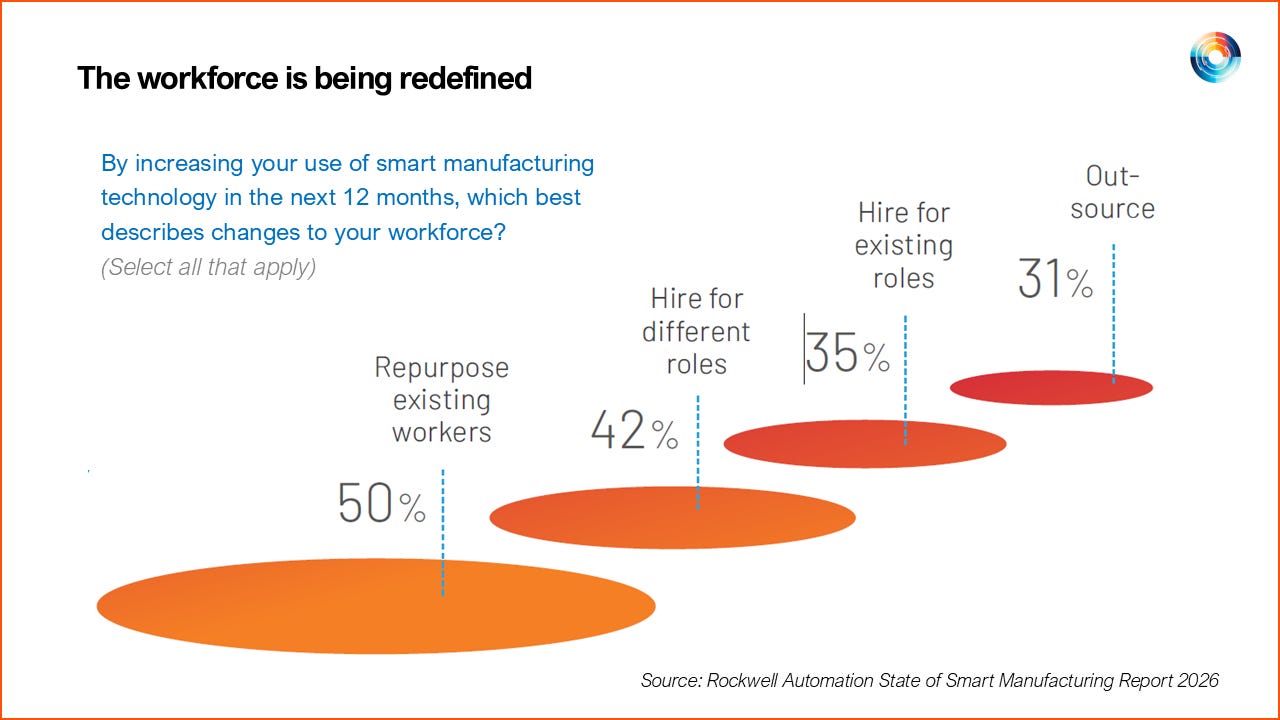
Meanwhile, workforce capability has emerged as the primary constraint on transformation. Change management pressures have increased significantly year-on-year as organisations introduce new technologies at scale. Reskilling programmes are expanding across the region, with AI skills now a structural requirement rather than a specialist capability.
Cybersecurity remains a central and evolving priority. As connectivity expands across industrial operations, manufacturers are managing the challenge of securing increasingly complex systems while operating in highly connected environments where cyber risk is a constant consideration.
Data remains an underutilised asset. While manufacturers are generating large volumes of operational data, a significant proportion remains unused for decision-making. Closing the gap between data collection and data-driven action is identified as critical to sustaining the region’s transformation momentum.
ZOOM OUT — The State of Smart Manufacturing Report is now in its 11th year, making it an important barometer of industrial digitalisation. This year's edition drew responses from more than 1,500 manufacturing leaders across 17 countries. The report classifies 62% of respondents as decision-makers, giving the findings meaningful weight. Geographically, EMEA accounted for the largest share of respondents at 41% (Saudi Arabia and the UAE together representing 6%), followed by the Americas at 30% and Asia Pacific at 28%. Sectors covered include automotive, life sciences, consumer goods, and industrial manufacturing, with research spanning AI adoption, cybersecurity, digital twins, and workforce transformation. One finding that cuts across all geographies is the strength of forward momentum: even among manufacturers not yet adopting smart manufacturing technologies, 70% plan to invest within the next 12 months.
[Written and edited with the assistance of AI]
DOWNLOAD
Read about last year’s report:
Saudi, UAE manufacturers lead GenAI adoption (Middle East AI News)