

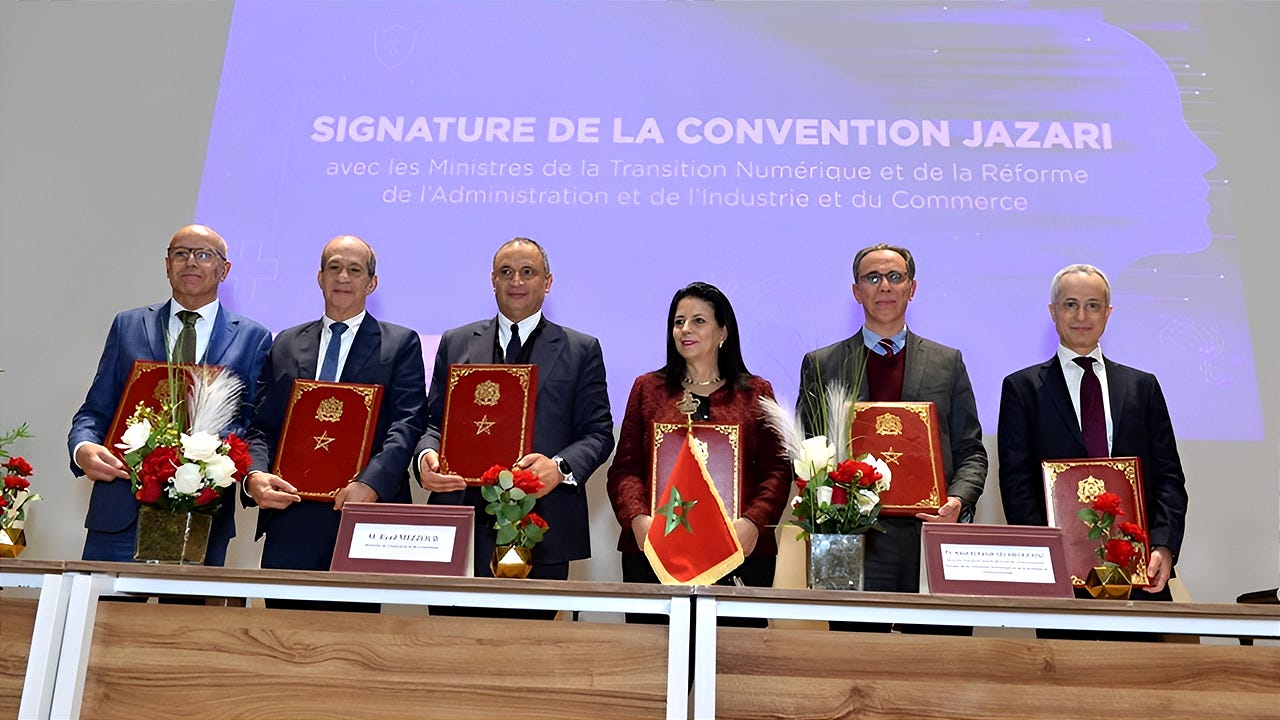
#Morocco #AIstrategy - Morocco’s Ministry of Commerce & Industry, Ministry of Digital Transition and Administrative Reform, and Ministry of Economy and Finance have signed a founding agreement with four Moroccan universities to establish the JAZARI Industry X.0 Institute. The new research and innovation centre will be designed to integrate AI into industry and accelerate technology transfer from academic research into industrial applications. The signing, held during an event at the Euromed University of Fez (UEMF), forms part of Morocco’s national AI Made in Morocco strategy launched in January 2026. The national strategy targets a 100 billion dirham ($10 billion) contribution to GDP by 2030, the creation of 50,000 AI-related jobs and the training of 200,000 graduates in AI skills.
SO WHAT? – The new announcement of JAZARI Industry X.0 Institute demonstrates increasing momentum in the Moroccan government’s plans to engage all sectors in AI adoption and building AI solutions. In July 2025, the Jazari Institutes was announced as a national network of AI centres of excellence with a goal of building sustainable national capacity and ultimately span Morocco’s 12 regions. This January, during the launch of AI Made in Morocco, the government revealed Jazari Root Racine, the central hub of the Al Jazari Institute network. The launch of JAZARI Industry X.0 Institute provides further evidence that this programme is progressing fast and will the have breadth and depth it needs to meet objectives.
Here are some key points about the announcement:
Morocco’s government and four universities have signed a founding agreement for the JAZARI Industry X.0 Institute, with the Ministry of Commerce & Industry, Ministry of Digital Transition and Administrative Reform, and Ministry of Economy and Finance representing the government. Academic institutions Euromed University of Fez (UEMF), Sidi Mohamed Ben Abdellah University, Moulay Ismail University and Al Akhawayn University signed the agreement, while a number of key industry partnerships are also planned.
The institute forms part of Morocco’s national AI Made in Morocco strategy, launched in January, which targets a 100 billion dirham ($10 billion) contribution to GDP, 50,000 AI-related jobs and 200,000 AI-trained graduates by 2030.
JAZARI Industry X.0 is specifically designed to accelerate technology transfer from university research into industrial application. The institute will play a leading role in developing integrated value chains running from fundamental research through to large-scale industrial deployment, deepening collaboration among universities, startups, industrialists and investors.
The institute is part of the national Jazari Institutes network, launched in July 2025 to align AI specialisation with regional academic strengths and economic priorities. The programme will expand across all 12 Moroccan regions with Jazari Root in Rabat operating as the national coordinating hub.
Each Jazari Institute is mandated to deliver four primary functions: training and skills development, applied research and co-innovation, shared digital platforms and data infrastructure, and incubation and acceleration of AI solutions.
The AI Made in Morocco strategy is aligned with the Maroc IA 2030 roadmap and translates outcomes of Morocco’s National Conference on Artificial Intelligence into an operational programme positioning AI as a pillar of national sovereignty, inclusive economic development and regional leadership across the African continent.
ZOOM OUT – According to a Mordor Intelligence report published this month, Morocco's ICT market is projected to grow from $6.95 billion in 2025 to $10.08 billion by 2030 at a compound annual growth rate of 6.37 percent, driven by a strategic shift from basic infrastructure toward advanced digital services underpinned by the national Maroc Digital 2030 strategy. The simultaneous 5G launch by all three Moroccan telecoms operators in November 2025 has already unlocked industrial applications at scale, such as automated cranes at Tanger Med port cutting container processing times by 18 percent. Cloud services represent 44.1 percent of IT spending and AI is deepening its footprint across automotive, aeronautics and banking.
However, Morocco faces is a critical shortage of ICT talent, a challenge that is exasperated by brain drain toward Gulf countries, which can offer qualified professionals salaries that can be 40 to 60 percent higher than at home. The country currently graduates 18,000 ICT professionals annually against an estimated demand of 40,000. So, building sovereign AI talent at scale is an economic necessity for Morocco and one that the JAZARI network has been designed to address.
[Written and edited with the assistance of AI]
Read more news about Morocco’s national AI strategy:
‘AI Made in Morocco’ strategy aims for $10B impact (Middle East AI News)
Morocco to develop responsible national AI platform (Middle East AI News)
Morocco to create AI CoE network nationwide (Middle East AI News)
Consortium plans 500MW of AI compute in Morocco (Middle East AI News)