


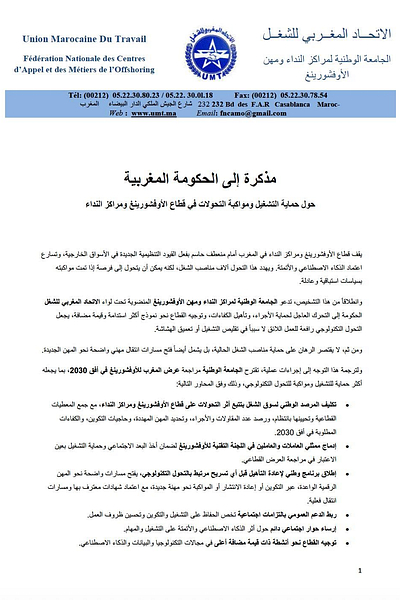
#Morocco #jobs - Morocco’s National Federation of Call Centers and Offshoring Professions (FNCAMO), a union body affiliated with the Moroccan Workers’ Union (UMT), has warned that artificial intelligence and automation threaten thousands of jobs in the country’s outsourcing sector. Federation president Ayoub Saoud called on the government to introduce a national retraining programme and recognised certifications to help workers move into new digital roles as AI adoption accelerates. The warning follows estimates cited by a parliamentarian that up to 4.6 million Moroccan jobs could be affected by AI by 2030.
SO WHAT? - Morocco launched a $10 billion “AI Made in Morocco” strategy, aiming to position itself as an AI producer, creating new jobs in the process. The FNCAMO letter to the government highlights a gap in the AI strategy: the impact on existing domestic jobs. The outsourcing sector is a a major employer in Morocco, although built on customer service work that AI can increasingly handle. How the government responds, will test whether its AI strategy delivers job transition rather than just job loss in the sectors most exposed.
KEY POINTS:
Morocco’s National Federation of Call Centers and Offshoring Professions (FNCAMO), affiliated with the Moroccan Workers’ Union (UMT), has warned that AI and automation could threaten thousands of jobs in the country’s outsourcing sector, urging government action.
In a letter to the Moroccan government, Federation president Ayoub Saoud asserted that the union is not opposed to technology, but wants adoption to drive what he called a ‘fair transition’, so that workers and the wider sector benefit rather than lose out.
The union is calling on the government to set policies that go beyond protecting existing jobs and instead help workers move into new professions as automation reshapes the sector.
Its main proposal in the FNCAMO’s letter is a national retraining programme that would let workers acquire new skills before AI-related layoffs occur, paired with recognised certifications for transitioning into digital roles.
The federation also wants public financial support for outsourcing companies made conditional on commitments to job protection, worker training and improved working conditions.
In June 2026, parliamentarian Fatima Ezzahra Batta said up to 4.6 million Moroccan jobs could be affected by AI by 2030, with 1.5 million facing significant change and 3.1 million seeing their tasks reshaped.
The job figures also point to roughly 180,000 new digital jobs being created over the same period, suggesting AI’s labour impact in Morocco may centre on task transformation rather than outright elimination.
The outsourcing sector is particularly exposed because it relies heavily on customer service and similar functions that many AI systems are being developed to replace.
ZOOM OUT - FNCAMO letter follows January’s launch of the government’s AI Made in Morocco, a national strategy targeting a $10 billion contribution to GDP by 2030 alongside 50,000 new AI-related jobs and training for 200,000 graduates. The plan rests on sovereign infrastructure, including a National Data Factory, a National Software Forge, and a planned 500 megawatt renewable data centre in Dakhla, plus a network of regional Jazari Institutes. A separate draft law, Digital X.0, is meanwhile working through government review to set rules on data governance and digital identity. The government's own job creation targets sit well below the 4.6 million jobs unions and MPs say could be affected by AI, exposing the gap between Morocco's ambition to build AI and its plan for workers displaced by it.
[Written and edited with the assistance of AI]
Source: Moroccan media, FNCAMO - UMT
DOWNLOAD
Read more about AI law initiatives:
Qatar’s Shura mulls next steps for future AI legislation (Middle East AI News)
UAE’s FNC approves new AI legislative recommendations (Middle East AI News)