

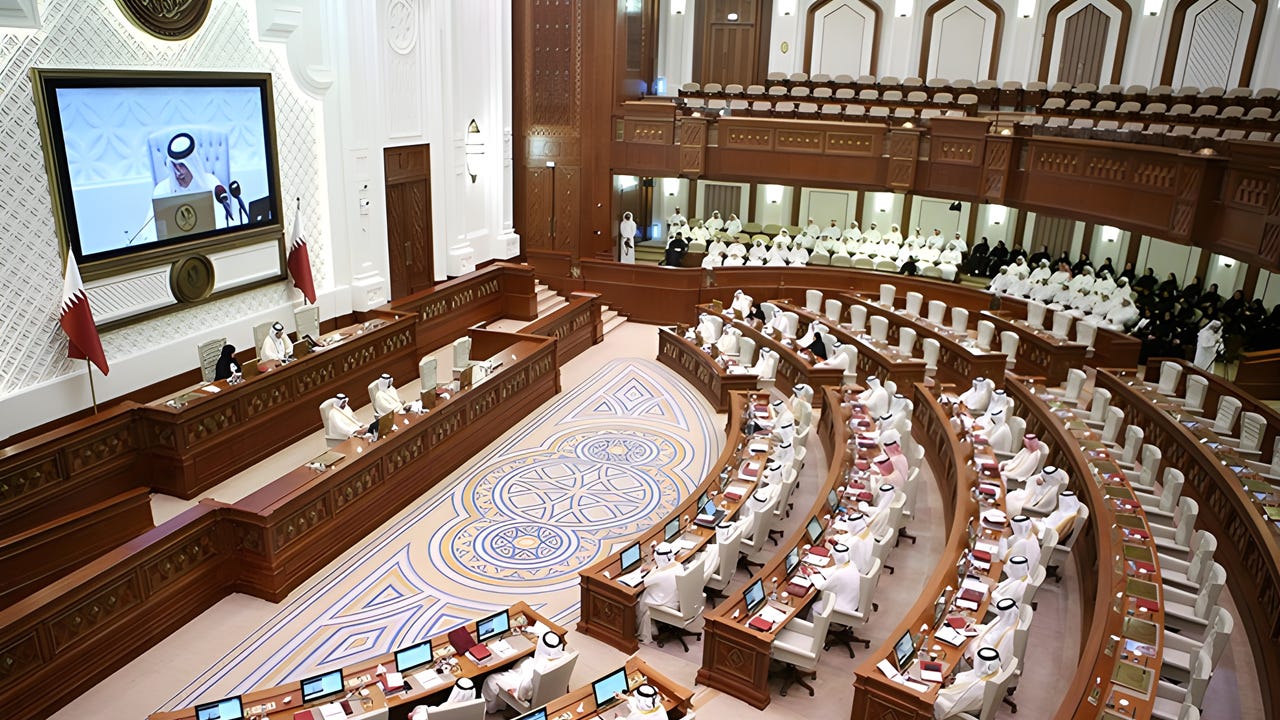
#Qatar #law — Qatar’s Shura Council has convened a formal debate on the governance of artificial intelligence, with members raising concerns about algorithmic bias, data protection, privacy, intellectual property rights and legal liability arising from AI systems. Presided over by Speaker HE Hassan bin Abdullah Al Ghanim, the session concluded with a motion to referred the issue to the Health, General Services and Environment Committee for detailed scrutiny and a formal report back to the council. The debate is another step in Qatar’s effort to establish a coherent national legal framework for AI, aligned with Qatar National Vision 2030 and the country’s Third National Development Strategy.
SO WHAT? — Qatar has a brief national AI policy and a digital agenda, but no AI-specific legislation yet on the table. The Shura Council motion aims to change that picture and formally place AI legislation on the parliamentary agenda. Voices from the council warned that the pace of technological change is outrunning the pace of legal scrutiny. Other concerns raised by Shura Council members included algorithmic bias, labour market disruption, reliance on foreign technology and digital sovereignty.
KEY POINTS:
Qatar’s Shura Council debated the country’s lack of specific AI legislation on Monday, with members raising substantive concerns about algorithmic bias, data protection, privacy, intellectual property rights, legal liability from AI systems and the risks of dependence on external technologies.
A motion to draft AI-specific legislation has been referred for detailed scrutiny to the Health, General Services and Environment Committee, which is headed by H.E. Abdullah bin Nasser bin Turki Al Subaie. The committee with review potential next steps and report back to the full council.
Speaker HE Hassan bin Abdullah Al Ghanim opened the debate by framing AI as a factor in public policy and decision-making, not merely a technical tool, stressing the need for a coherent national framework that balances innovation with robust oversight.
Members highlighted the widening gap between the pace of technological innovation and legislative scrutiny, a concern that echoes debates in parliaments and assemblies across the world as AI deployment accelerates faster than legal frameworks can respond.
Digital sovereignty emerged as a central concern, with members raising questions about Qatar’s reliance on external technologies and the implications for national control over data, systems and AI infrastructure, themes increasingly prominent in government discussions across the region.
Labour market disruption was also raised, with members underscoring the need to equip the national workforce with skills suited to the digital economy as AI-driven structural shifts accelerate across sectors.
Members reviewed international AI regulatory approaches, noting global movement toward proportionate, risk-based frameworks that balance oversight with support for innovation. How how those models might be adapted to Qatar’s national context was also discussed.
Qatar’s Ministry of Communications and Information Technology published a National AI Policy Brief in September 2025, establishing a framework for ethical, inclusive and coordinated AI deployment across sectors, aligned with Digital Agenda 2030 and the 3rd National Development Strategy. No AI-specific draft law has yet been proposed.
ZOOM OUT — Qatar's move toward AI legislation builds on a national AI journey that began in 2019 with the launch of its National Artificial Intelligence Strategy. The strategy is structured around six pillars covering education, data access, employment, business, research and ethics. In 2021, Cabinet Decision No. 10 established the Artificial Intelligence Committee to coordinate AI initiatives across government entities and align them with Qatar National Vision 2030 and Digital Agenda 2030. The country has strategic partnerships with Microsoft, Google Cloud and Scale AI as strategic partners to support strategy implementation. Meanwhile, Qatar Investment Authority (QIA) launched Qai in December 2025, as a global AI company headquartered in Doha formed to develop and invest in AI and AI infrastructure.
[Written and edited with the assistance of AI]
Read more stories from Qatar:
Middle East workers lead the world on AI adoption at work (Middle East AI News)
Dubai, Abu Dhabi top Arab cities in IMD Smart City Index (Middle East AI News)
Qatar’s national AI platform’s powerful upgrade explained (Middle East AI News)
QIA joins Replit’s $400M Series D funding round (Middle East AI News)
Qatar’s ShipBee raises $500k to scale AI logistics platform (Middle East AI News)