

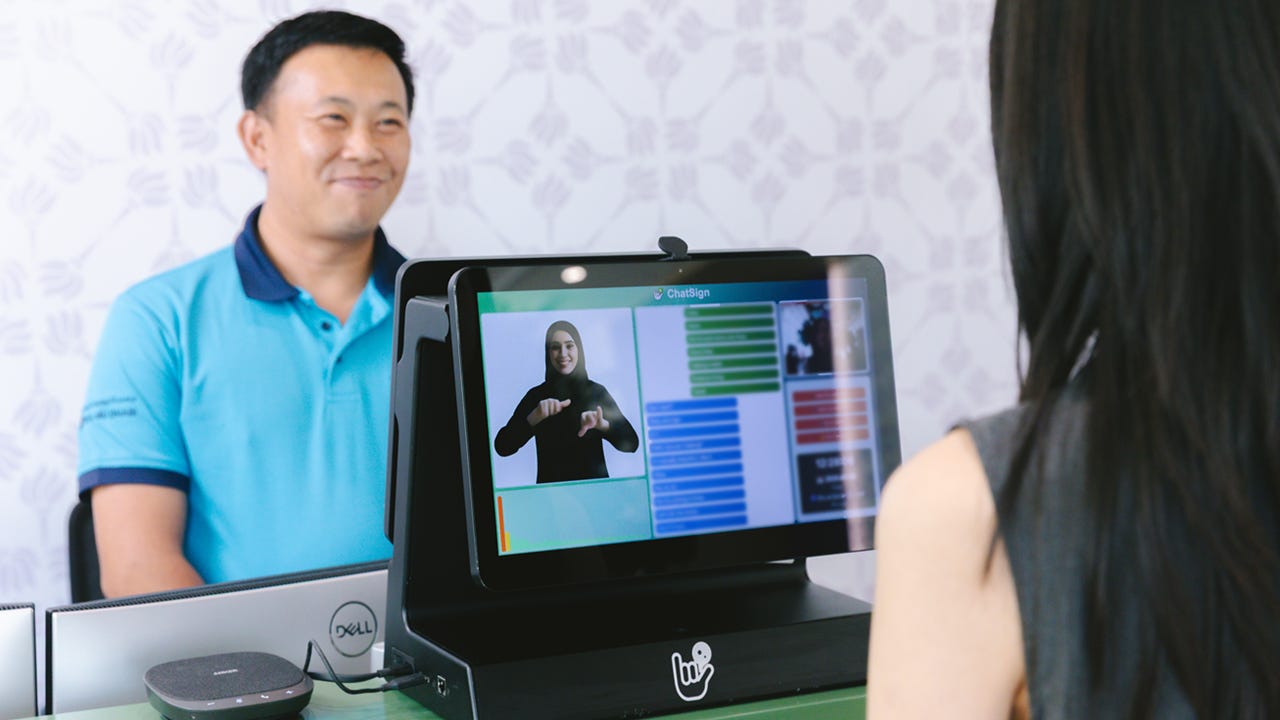
#UAE #inclusion — NYU Abu Dhabi has launched ChatSign, a commercially ready AI system that translates spoken Arabic and English into sign language in real time, supporting both American Sign Language and Emirati Sign Language. Developed at NYU Abu Dhabi’s Embodied AI & Robotics Lab ChatSign is now operating as an independent spin-out company headquartered in Abu Dhabi and registered in ADGM. The startup targets deployment across government services, healthcare, education, tourism, and transport: in fact, anywhere that interpreter availability is limited, costly, or inconsistent. Globally, the World Health Organisation estimates that more than 430 million people suffer from disabling hearing loss.
SO WHAT? — Sign language interpretation is one of the most persistent and underserved accessibility gaps in public life. Qualified human interpreters are scarce, expensive, and unavailable at scale across the settings where Deaf and Hard-of-Hearing people need them most, such as hospitals, government offices, transport hubs and schools. ChatSign has transformed from a university research project to a patent-protected, commercially ready product that has already been tested in front of a live audience of more than 200 people. Built by a graduating student and her academic co-founders at NYU Abu Dhabi, ChatSign provides another promising example of valuable technology IP developed in the UAE.
KEY POINTS:
NYU Abu Dhabi has launched ChatSign as a commercial AI spin-out company, translating spoken Arabic and English into sign language in real time. The system supports both American Sign Language and Emirati Sign Language, with sign-to-speech and text-to-sign translation capabilities nearing completion.
ChatSign was founded by a research team from NYU Abu Dhabi. Co-founders are Associate Professor and Embodied AI & Robotics Lab Director Yi Fang; CEO Zhifei (Maggie) Li, a graduating class of 2026 student with a double degree in Computer Science and Mathematics; and Chief Product Officer Zhenhua Li.
The technology went from research concept to functional prototype in under two years. Since its inception in 2024, ChatSign has secured patent protection, completed a live campus deployment in late 2025 delivering real-time translation to more than 200 students, and is now commercially ready for pilot deployments across multiple sectors.
The scale of the unmet need is significant. According to WHO, more than 430 million people globally suffer from disabling hearing loss.
The new platform is designed for high-demand public environments including government services, healthcare facilities, educational institutions, tourism destinations, transport hubs, and commercial spaces. These are precisely the settings where professional sign language interpretation is most needed and least available. ChatSign is currently in discussions with potential partners across sectors, countries, and continents.
The company’s ten-year ambition is substantial. ChatSign’s founders aim to see the system deployed wherever communication happens around the world, embedding accessibility into everyday physical and digital environments as a standard feature rather than an optional add-on.
ChatSign will be used at NYU Abu Dhabi’s 2026 Commencement Ceremony, providing live speech-to-sign translation for attendees, a public, high-profile demonstration of the system’s real-world capability at scale.
ZOOM OUT — Abu Dhabi has built one of the world's most productive language modelling research ecosystems and its output is increasingly global in reach. From the launch of the groundbreaking NOOR Arabic NLP model in 2022 by Technology Innovation Institute launched, to the more recent release of open-source frontier reasoning model K2, developed by Mohamed bin Zayed University of Artificial Intelligence, Abu Dhabi has pushed the envelope. Outputs from the ecosystem include large language models trained in multiple Arabic dialects from across MENA, Kazakh, Russian, and Turkish, and include a Hindi language model developed under a digital collaboration agreement with India. Abu Dhabi-based research teams have also produced benchmark frameworks covering Arabic generative tasks, clinical LLM evaluation, telecom LLMs, and agentic reasoning, shaping how the global research community measures model performance. The development of ChatSign provides yet another signal that the ecosystem is maturing, transforming research outputs into commercial products that could have global impact.
[Written and edited with the assistance of AI]
Read more about commercialisation of Abu Dhabi research:
TII sells advanced cryptographic AI technology (Middle East AI News)
Abu Dhabi startup turns existing CCTV & IoT into live intel (Middle East AI News)
TACTICA AI brings Agentic AI to mission-critical ops (Middle East AI News)
Abu Dhabi launches AI & robotics climate tech venture (Middle East AI News)
New ATRC venture to transform vehicles into AVs (Middle East AI News)