

Last month Oracle launched no less than 25 Fusion agentic applications across ERP, HCM, SCM, and CX to transition enterprise cloud software from passive reporting to autonomous execution. Built on Oracle Fusion Claw—a governed agentic runtime designed for long-running, specialist-grade computational work—these applications perform continuous replanning, deterministic reasoning, and autonomous multi-step tasks while producing auditable ‘Outcome Receipts’ to maintain absolute C-suite governance.
SO WHAT? - Until now, most enterprise software showed staff a status dashboard and left the work to them. Oracle’s Claw-powered Fusion Agentic Applications can now run specialist-grade business operations, from start to finish. Autonomous agents replan continuously, follow fixed rules when they act, and produce an auditable ‘Outcome Receipt’ for each task, so senior executives are able to maintain absolute control.
From dashboard navigation to autonomous execution
For decades, enterprise software has operated as a complex system of record. Executives and operational leads logged into applications, navigated deep transactional menus, gathered data, and manually initiated multi-step workflows.
Oracle Fusion Agentic Applications fundamentally alter this paradigm by establishing a ‘system of outcomes’. Autonomous AI agents now operate continuously in the background to handle cognitive workloads, manage complex logistics, and resolve business issues. These have been built-in directly into Oracle Fusion Cloud for ERP, human capital management (HCM), supply chain management (SCM), and customer experience (CX).
Increasingly, employees will no longer have to manage many processes themselves. Instead, human teams define strategic objectives, set spending limits, and assign operational authority, while agents manage the process. Based on these parameters, autonomous agents then evaluate options, make calculations, and run processes to completion.
REGIONAL CONTEXT
Enterprise AI adoption is now accelerating fast, with 38 percent of GCC organisations already operating AI agents in production and 78 percent expecting autonomous agent decision-making by 20271. However, regional leaders also face critical governance and enforcement gaps.
As the region’s regulators enforce data sovereignty compliance and begin to introduce controls over agent speed, reach, authority, and trust, technology leaders cannot deploy black-box AI agents. Enterprises need governed execution models that meet sovereign Middle East regulatory requirements, in order that CIOs can scale autonomous AI without taking on operational risk.
Oracle Fusion Claw: specialist-grade workload execution
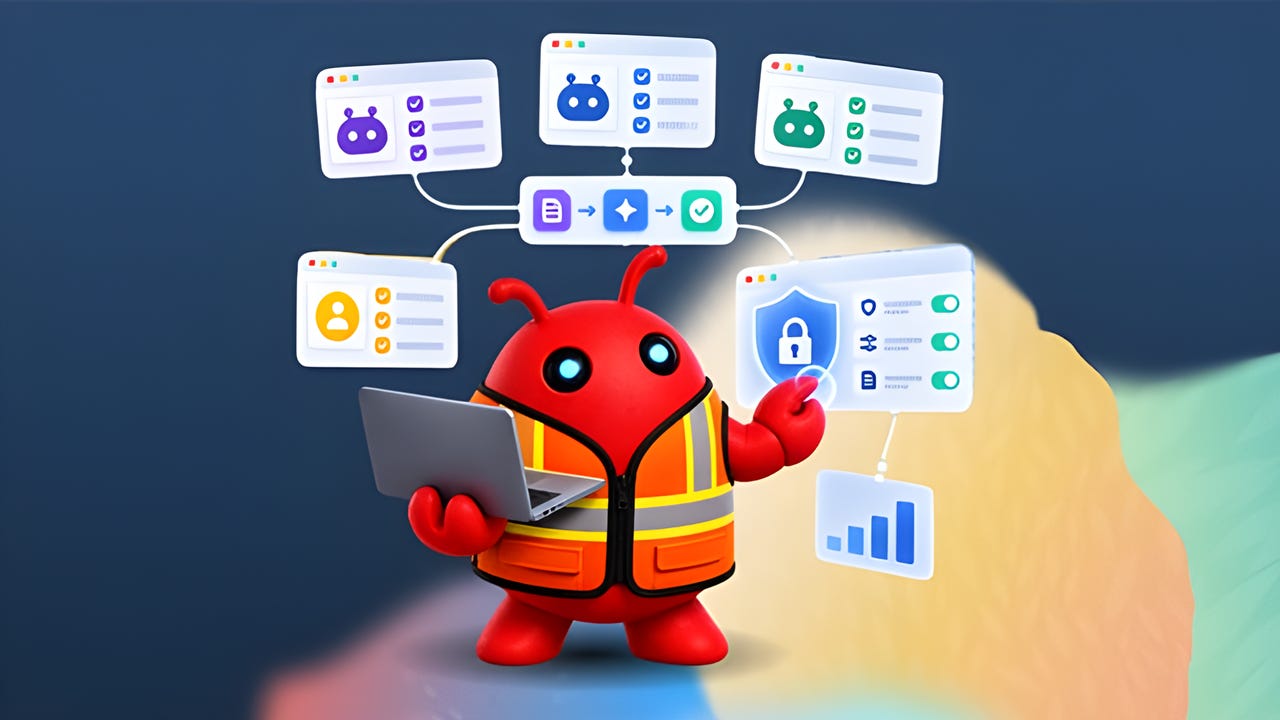
At the core of this transformation to systems of outcomes is Oracle Fusion Claw. The Claw is designed specifically for executing long-running, computationally intensive business tasks.
AI assistants answer simple questions well enough. Reconciling a financial ledger, forecasting field demand or rebalancing supply across several facilities takes far more: deep analysis, data modelling and replanning on a continuous basis. Fusion Claw is built for both kinds of work.
Key architectural capabilities of Fusion Claw
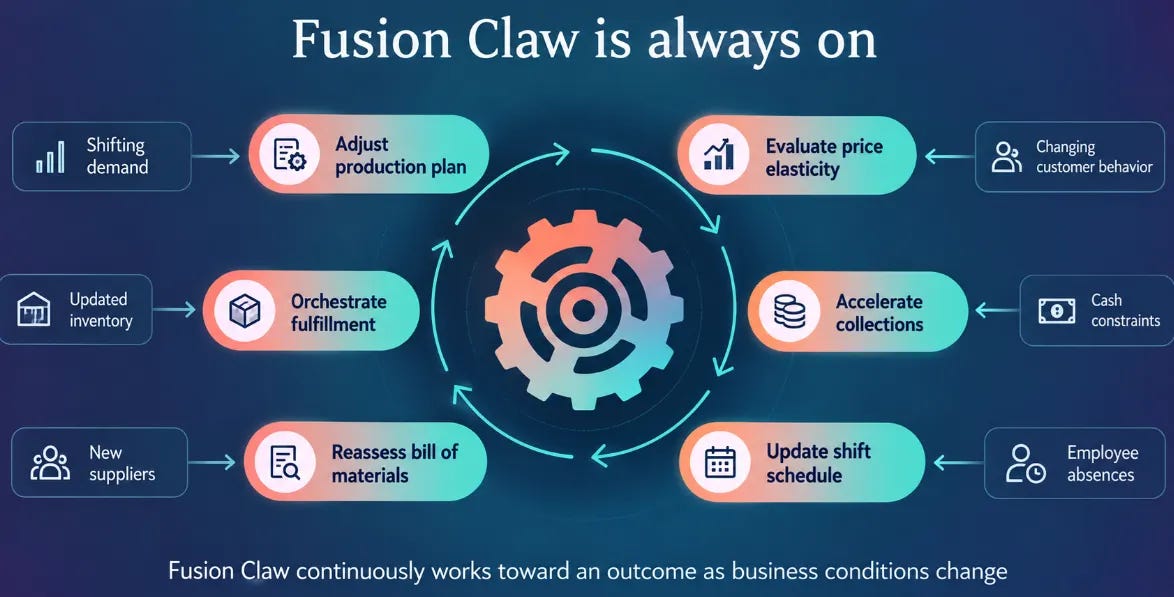
Continuous replanning: Oracle Fusion Claw automatically re-evaluates conditions in real time. If underlying supply chain data or financial records shift mid-execution, then Claw adjusts its path dynamically without crashing or stalling.
Deterministic execution: Fusion Claw continually guarantees that computational rules and business logic apply consistently across millions of transactions, ensuring zero math drift or unverified assumptions.
Governed autonomous boundaries: Fusion Claw also operates with embedded policy limits. Say an automated process tries to reassign a high-value freight load or override a budget threshold. Fusion Claw will stop, flag the task as an exception and asks a human for approval.
Real-world operational use cases
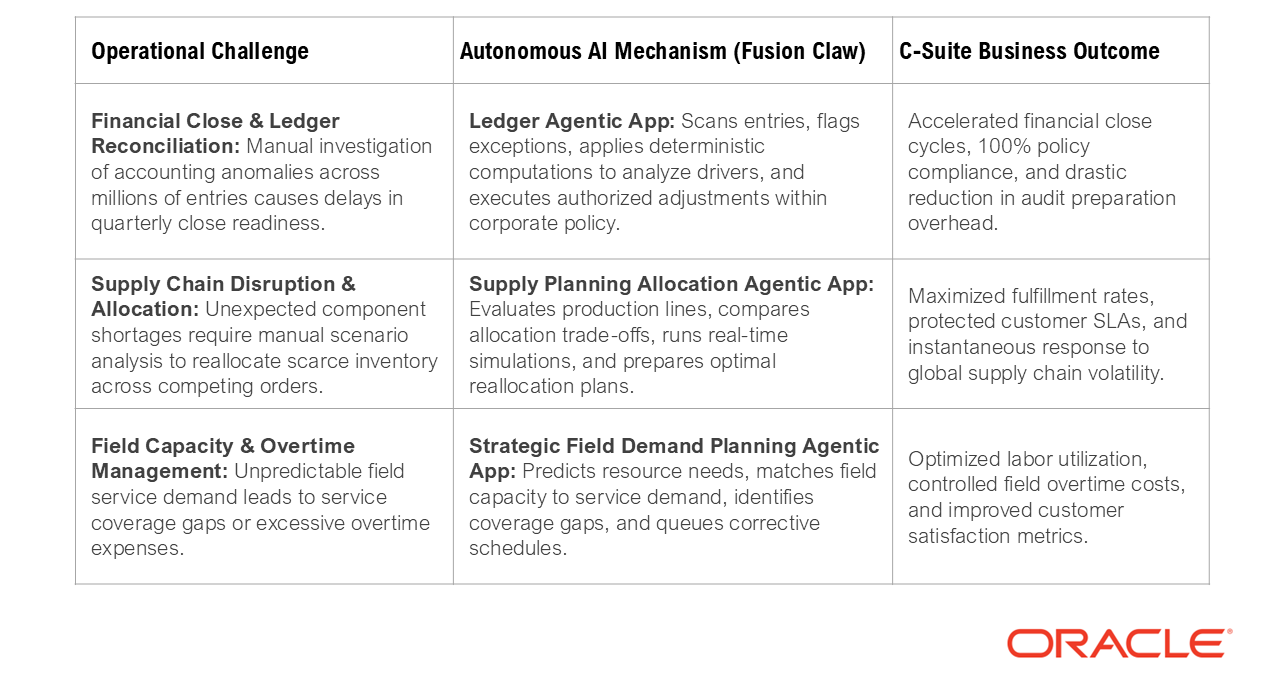
Here are a few real-world operational use cases for Oracle Fusion Claw:
‘AI with Receipts’: enforcing trust and auditability
A primary barrier to enterprise AI adoption is the ‘black box’ problem. Business leaders cannot delegate operational authority if they cannot verify how a decision was made: they need ironclad accountability.
Oracle solves this by mandating that every Fusion Claw-powered execution produces an ‘Outcome Receipt’.
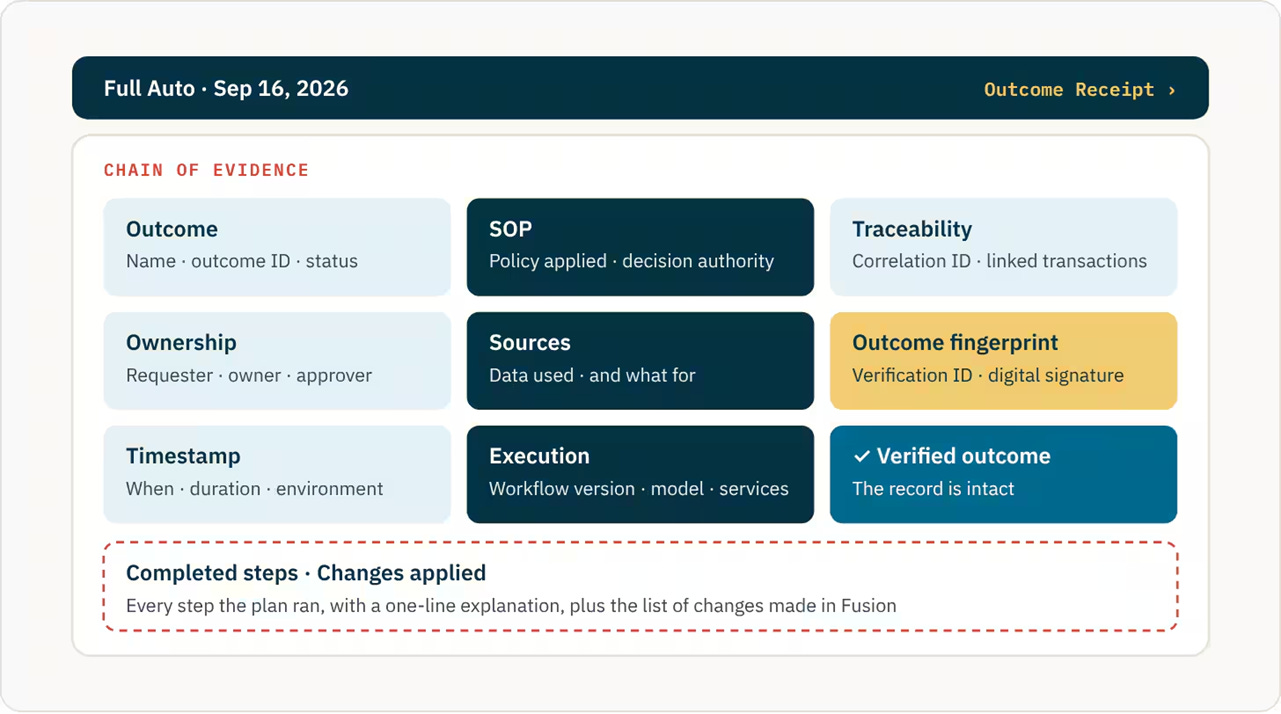
The Outcome Receipt serves as an immutable, transparent log that answers all the questions that are needed for accountability:
Who authorised the work? The Outcome Receipt traces the explicit business objective and delegate permissions.
What SOPs were followed? It proves adherence to standard operating procedures) (SOPs) and external regulatory policies.
What actions were taken? The receipt lists every transaction, order move and ledger entry the system changed while it worked in the background.
When were decisions escalated back to a human? The Outcome Receipt also lists each time the agent reached a set threshold and passed control back to a human manager.
Watch Fusion Cloud apps spotlight
Key resources
Read: what sits behind every Fusion Claw outcome (Oracle blog)
Find out more about Oracle platforms and solutions
Next article | Back to start
~This Special Report is sponsored by Oracle
Source: ‘The New Realities of AI Governance’, IBM EMEA, 2026