

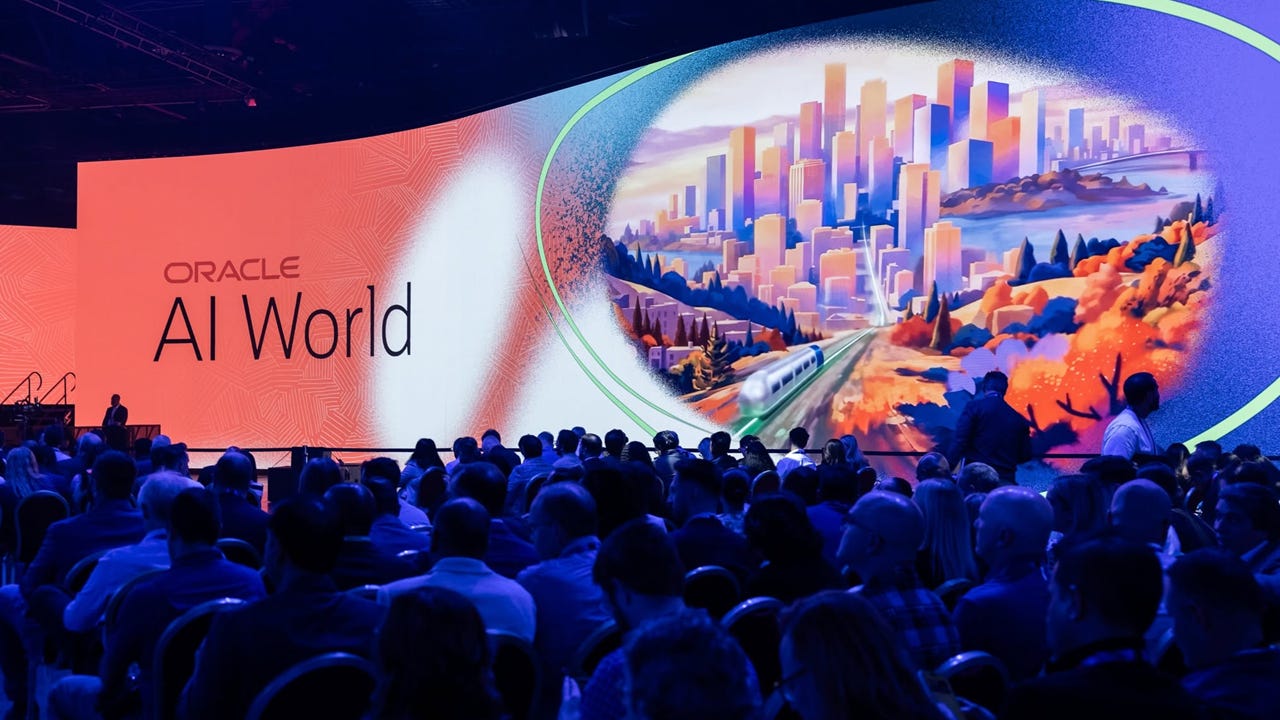
Enterprise AI adoption has reached a pivot point, as leading Middle East organisations shift their AI focus from conversational assistants and data dashboards, to agentic AI systems and autonomous execution. Today’s C-suite leaders have never been under so much pressure to unlock the business value of AI. However, they must do so without compromising cybersecurity, data protection or sovereign governance.
“AI is no longer limited to telling you what’s happening in your business. It is now telling you what can happen next. But to put AI to work where the stakes are highest, trust is what allows us to deliver measurable results.”
— Mike D. Sicilia, Chief Executive Officer, Oracle
Special report
This special report from Middle East AI News evaluates how Oracle technology strategy address these enterprise realities, shifting trust to the database layer, eliminating cross-cloud data movement friction, introducing intent-driven software interfaces, and offering customers multi-silicon infrastructure scale.
Jump straight to the analysis
Data layer security anchors enterprise AI trust (coming soon)
Natural language intent accelerates software deployment (coming soon)
Governing the GCC’s agentic AI transformation
Enterprise AI across the Middle East is reaching a strategic inflection point. Across the Gulf Cooperation Council (GCC), the era of speculative pilots, isolated chatbots, and passive reporting dashboards is drawing to a close. Driven by aggressive national strategy mandates—such as Saudi Arabia and the UAE national AI and data strategies —the region’s public and private sectors are rapidly embedding autonomous, multi-step AI agents directly into core operational workflows.
The accelerated transition has catapulted GCC organisations to the forefront of global AI leadership. Numerous market studies show this growing momentum:
Bold leadership: A recent PwC study highlights that 82% of Middle East CEOs say that their corporate culture actively enables AI adoption, while 70% of these rely on roadmaps for implementation. Meanwhile, over a third of enterprises have integrated AI directly into core offerings, outpacing their global peers.1
High AI maturity: In results that outperformed global averages, 42% of UAE and 40% of Saudi enterprises were categorised as AI Leaders by a recent maturity assessment. Boston Consulting Group found that GCC AI Leaders are generating up to 1.7 times higher total shareholder returns and 1.5 times higher EBIT margins by moving beyond experimentation into comprehensive implementation.2
Production AI deployment: Some 97% of organisations in the United Arab Emirates have integrated AI agents into their workflows, products and services. This widespread adoption has positioned the region as a primary benchmark for production-grade agentic AI integration, according to a 2026 survey by KPMG3.
The operational challenge for C-suites
This rapid cycle of AI adoption presents C-suite executives, Chief AI Officers, and lead architects with a wide variety of friction points to overcome. Perhaps the biggest one is the gap between rapid AI deployment and scalable operational control.
As companies and government departments begin to delegate more routine tasks to autonomous AI, traditional security models, built on application-layer prompts or static policies, are failing. Industry research shows that even though 100 percent of regional enterprises maintain formal policies governing AI data access, the majority of them have experienced instances where AI tools accessed sensitive enterprise data beyond their task mandate4. This disconnect—often termed the ‘fallacy of policy’—proves that a written policy does not equal execution-level control when agents act at machine speed.
“AI trust is the biggest challenge we face today. With Oracle Deep Trust AI Architecture, we are building trust into the underlying software platform, data, data access, and application development layers.”
— Juan Loaiza, Executive Vice President, AI Database Technologies, Oracle
Only forty‑one percent of regional executives say that their governance frameworks are built to scale with autonomous agents. Nevertheless, three out of four regional executives say that they have escalated an AI-related operational or security incident, to the board or the C‑suite in the last twelve months5. Enterprise leaders are under huge pressure to deliver measurable AI outcomes, and they must deliver them while protecting data sovereignty avoiding non‑compliance preventing financial unauthorised actions and stopping data leakage.
Architectural imperatives for the Agentic Era
With data and inference security, observability, agent control, public trust, and even C-suite careers directly on the line, enterprise leadership must define strategies to fix governance, security, and architectural bottlenecks.
“The next era of enterprise AI is all about delivering software that increasingly does the work, while people define the objectives and set the policies. Fusion Agentic Applications, powered by Fusion Claw, take on complex business processes economically and at scale.”
— Chris Leone, Executive VP, Applications Development, Oracle
Oracle believes that enterprise decision-makers should align their execution strategies with these core technology imperatives:
1. Moving from reporting to governed execution
Enterprise leaders now expect AI to evolve from passive reporting to autonomous, multi-step work. This requires a shift from cloud applications into ‘systems of outcomes’, Here’s where Oracle Fusion Claw comes in, enabling specialised agents to execute complex tasks across ERP, HCM, SCM, and CX. For ironclad accountability, autonomous actions generate auditable Outcome Receipts, which provide deterministic proof of standard operating procedure (SOP) compliance and authorised spending limits before execution.
2. Enforcing architectural trust at the data layer
Trust cannot be treated as an application-layer add-on or left to LLM context prompts. Under Oracle’s Deep Trust AI Architecture, access rules and business policies are hardcoded directly into the database engine via Deep Data Security and SQL Assertions. By enforcing identity and compliance rules directly at the query level, autonomous agents are structurally prevented by Oracle systems from bypassing authorisation policies.
3. Eliminating data movement & unlocking business context
Forcing massive volumes of enterprise data into external vector stores creates unsustainable egress costs, latency, and data duplication risks. Oracle’s Autonomous AI Lakehouse brings AI agents directly to live data across multi-cloud environments—including AWS, Azure, and Google Cloud—using open formats like Apache Iceberg. Embedded semantic engines (including Essbase and AI Data Catalogs) ground agentic reasoning in real-world business context and multidimensional KPIs before actions execute.
4. Transitioning to intent-driven user experiences
Complex transactional software menus are being replaced by intent-driven delegation. Connective frameworks such as Oracle Fusion Companion and voice-first Agentic Home interfaces translate natural language intent from frontline employees into orchestrated background workflows across disparate enterprise systems.
5. Leveraging open ecosystems and multi-silicon scale
Managing the economics of enterprise AI scale requires freedom of infrastructure choice and open tooling. Oracle has expanded silicon availability to include Google TPUs, NVIDIA systems, and dedicated inference accelerators, while open-sourcing executable AI skills through the Fusion Setup and Configuration Registry (FSCR), enterprises eliminate vendor lock-in and compress complex deployment timelines.
This special report unpacks how Oracle’s latest engineering releases empower Middle East enterprise leaders to navigate these critical themes, ensuring regional AI strategies deliver governed, verifiable, and high-impact business outcomes.
Watch Michael D. Sicilia’s Oracle AI World keynote
Meet Oracle at GITEX Global!

Visit the Oracle Experience at GITEX Global 2026 to see live demonstrations of Oracle Fusion Claw, Deep Trust AI Architecture, and the Autonomous AI Lakehouse in action. Stand No- H15-A10, S15.
Find out more about Oracle platforms and solutions
Page 2 | Page 3 | Page 4 |
~This Special Report is sponsored by Oracle
Source: “29th Global CEO Survey”, PwC, January 2026
Source: “Unlocking Potential: How GCC Organisations Can Convert AI Momentum into Value at Scale”, BCG, February 2026
Source: “UAE Tech Report 2026”, KPMG, June 2026
Source: “2026 Identity Security Report”, Delinea, October 2026
Source: “The new realities of AI governance", IBM, October 2026