


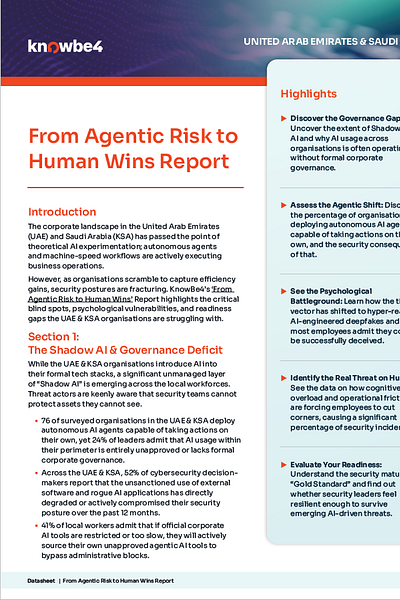
#UAE #cybersecurity — Digital workforce security company KnowBe4 has published new research showing that 24 percent of organisations in the UAE and Saudi Arabia are running autonomous AI agents with little or no governance. The report From Agentic Risk to Human Wins found 88 percent of employees say deepfake voice and video content is now too convincing to trust, and 52 percent admit they could be fooled by one at work. It also found 41 percent of staff source their own unapproved AI tools when official ones are restricted, leaving security teams blind to a growing layer of unmonitored “Shadow AI.”
SO WHAT? — KnowBe4’s numbers point to a gap between adoption and control. Companies in the UAE and Saudi Arabia have raced to deploy AI agents that act on their own inside workflows, but in some cases governance hasn’t kept pace. As a result, a quarter firms now have AI activity sits outside any formal oversight. As the world’s fastest growing adopter of AI, the Gulf’s fastest growing challenge may well be one of human governance and capacity building.
KEY POINTS:
According to digital workforce security company KnowBe4, 24% of organisations in the UAE and Saudi Arabia report unapproved or ungoverned AI use. Meanwhile, 84% of cybersecurity leaders say AI agents already take actions within their organisations’ workflows.
88% of employees surveyed for the From Agentic Risk to Human Wins report say taht deepfake voice and video content is now realistic enough that it’s hard to know what to trust, and 52% admit they could personally be tricked by a deepfake scam at work.
41% of employees say they source their own agentic AI tools when official options are unavailable or too restrictive, and 52% of security leaders say unsanctioned software and AI apps have already hurt their security posture in the past year.
54% of cybersecurity leaders say everyday human mistakes, not sophisticated exploits, have had the biggest impact on their organisation’s security over the past 12 months.
44% of employees say time pressure and workplace distractions push them to make security mistakes even when they know the correct protocol.
36% of cybersecurity leaders name AI-enabled attacks as a key driver of future human-related security risk.
76% of security leaders say they feel very well prepared for emerging AI-driven threats, yet 84% admit improvements are still needed to keep AI tools and agents within approved policy limits.
Organisations that treat cybersecurity as a culture rather than a function are seeing better results, with 82 percent of employees at these companies saying they feel safe reporting mistakes.
The findings draw on a global survey of 4,000 professionals executied research firm Vanson Bourne, including 800 security decision-makers and 3,200 employees, across the Americas, EMEA and APJ.
ZOOM OUT — KnowBe4’s full may 2026 survey of 800 security leaders and 3,200 employees worldwide found 58 percent of leaders name everyday mistakes as a key driver of cyber risk, and 42 percent point to AI-enabled attacks as a growing threat, figures that closely track the Gulf results. Globally, 97 percent of leaders already track human-related risk metrics, yet only 61 percent say those metrics actually help, and just 42 percent believe security awareness training alone changes behaviour long-term. The report frames agentic AI as a fundamental shift rather than an incremental one: AI agents now act as colleagues, decision-makers and potential attack vectors simultaneously, and organisations making progress are the ones rebuilding security as a culture rather than a checklist, with 89 percent of employees globally saying they feel safe reporting mistakes when that culture is in place.
[Written and edited with the assistance of AI]
Source: KnowBe4
DOWNLOAD
Read more about AI adoption in Saudi Arabia and the UAE:
Many UAE firms unprepared for AI risk (Middle East AI News)
91% of Saudi firms seeing AI pay off - SAP/YouGov (Middle East AI News)
Saudi, UAE outpace global peers in Agentic AI (Middle East AI News)
AI shopping is mainstream, not AI payments (Middle East AI News)
Saudi business AI adoption hits 33% in 2025 (Middle East AI News)