


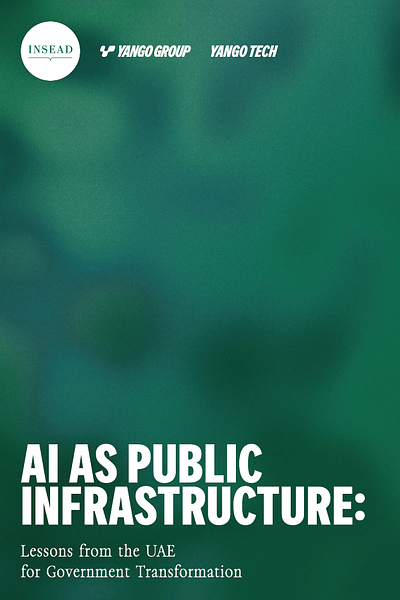
#UAE #AIGovernance — New research published by global business school INSEAD and international technology group Yango argues that the UAE has moved further than any comparable government in prioritising artificial intelligence as public infrastructure rather than a portfolio of standalone projects. The paper, AI as Public Infrastructure: Lessons from the UAE for Government Transformation also finds that the UAE’s experience offers transferable lessons for policymakers worldwide. Drawing on in-depth interviews with senior government officials and AI leaders across the UAE, the paper concludes that the future of AI in government will be determined less by access to technology than by the ability to redesign institutions around it.
SO WHAT? — Most governments have launched AI pilots, yet very few have managed to turn AI into a durable institutional capability. The INSEAD and Yango Group research identifies why and identifies the UAE government as the clearest available evidence of what success actually requires. The research found that execution failures usually arise from data fragmentation, talent gaps at the intersection of policy and technology, and governance frameworks that lag behind deployment realities. For policymakers outside the Emirates, the paper offers insight into the UAE’s institutional design principles that make AI deployments work.
KEY POINTS:
INSEAD and Yango Group have published a major research paper on AI in government, using the UAE as the primary case study to examine how governments can move from AI experimentation to durable, institutionalised capability at scale. AI as Public Infrastructure: Lessons from the UAE for Government Transformation is based on in-depth interviews with senior government and private sector leaders across the UAE.
The paper’s central argument is that governments that treat AI as institutional infrastructure — embedded in leadership structures, data systems, procurement choices, operating models, and accountability mechanisms — are more likely to move beyond pilots to sustainable systems.
The UAE’s progress is attributed to three reinforcing institutional choices, not technological advantage:
Concentrated and continuous leadership commitment;
Domain-level redesign of public-sector processes; and
Procurement and partnerships used as strategic levers rather than administrative functions.
Meanwhile, the Emirati governments of Abu Dhabi and Dubai have developed distinct, but complementary execution models aligned with federal direction.
Abu Dhabi pursues an infrastructure-led approach centred on sovereign cloud, shared platforms, and long-term governance, treating AI as foundational infrastructure with an AED 13 billion ($3.54b) commitment behind it. On the other hand, Dubai emphasises execution speed and visible service impact. The emirate has used structured pipelines and acceleration task forces to move rapidly from pilot to full-scale deployment.
Dubai’s AI acceleration approach offers a particularly concrete illustration of disciplined prioritisation. Through the Dubai Centre for Artificial Intelligence, 33 government entities generated 183 potential AI applications, which were filtered through technical feasibility, strategic alignment, and citizen impact assessments. These were ultimately narrowed to 15 high-impact deployments spanning mobility, healthcare, logistics, and urban infrastructure.
Abu Dhabi’s approach centres on the TAMM platform, which has evolved into an AI-enabled system hosting more than a thousand government services and modular containers reused across government-to-government and government-to-business channels. TAMM provides a pioneering example of AI embedded as shared public infrastructure rather than isolated departmental tools.
The research identifies five persistent structural barriers to effective government AI deployment that apply across jurisdictions:
Fragmented and poorly governed data environments;
Weak cross-entity coordination;
Shortages of policy-technology translator roles;
Rigid procurement systems misaligned with iterative AI development; and
Limited capacity to evaluate impact, risks, and unintended consequences.
Overall, the paper’s comparative review of the UK, Singapore, the United States, the EU, and China finds that governments with similar technological tools produce markedly different outcomes.
IMO - Today, the UAE’s Government 4.0 strategy is moving faster and more purposefully than it has ever done, built on the digital government foundations it has laid over the past 25 years. As one of the first countries worldwide to formulate its own national AI strategy in 2017 and as the first country to appoint a Minister of State for Artificial Intelligence, the UAE never had any doubt that AI was destined to become essential public infrastructure. Over the past month, we’ve seen successive announcements and project updates on the government’s plans to deploy agentic AI across 50 percent of government sectors, services and operations within two years. This speed of implementation has only been made possible by the government’s bold long-term vision, the sense of urgency felt by its leaders across the public sector and its willingness to make radical changes to how it actually governs.
DOWNLOAD
Read more about UAE government AI efforts:
UAE launches first AI agents for government services (Middle East AI News)
UAE Cabinet approves first AI government service bundles (Middle East AI News)
PM reviews UAE government’s Agentic AI project progress (Middle East AI News)
UAE puts AI transformation at the heart of government (Middle East AI News)
UAE to deploy agentic AI across 50% of government (Middle East AI News)
The public sector procurement angle in this piece is instructive for enterprise buyers too. Structured evaluation criteria, clear success metrics, and staged rollouts are what separate AI deployments that stick from ones that get quietly shelved.