

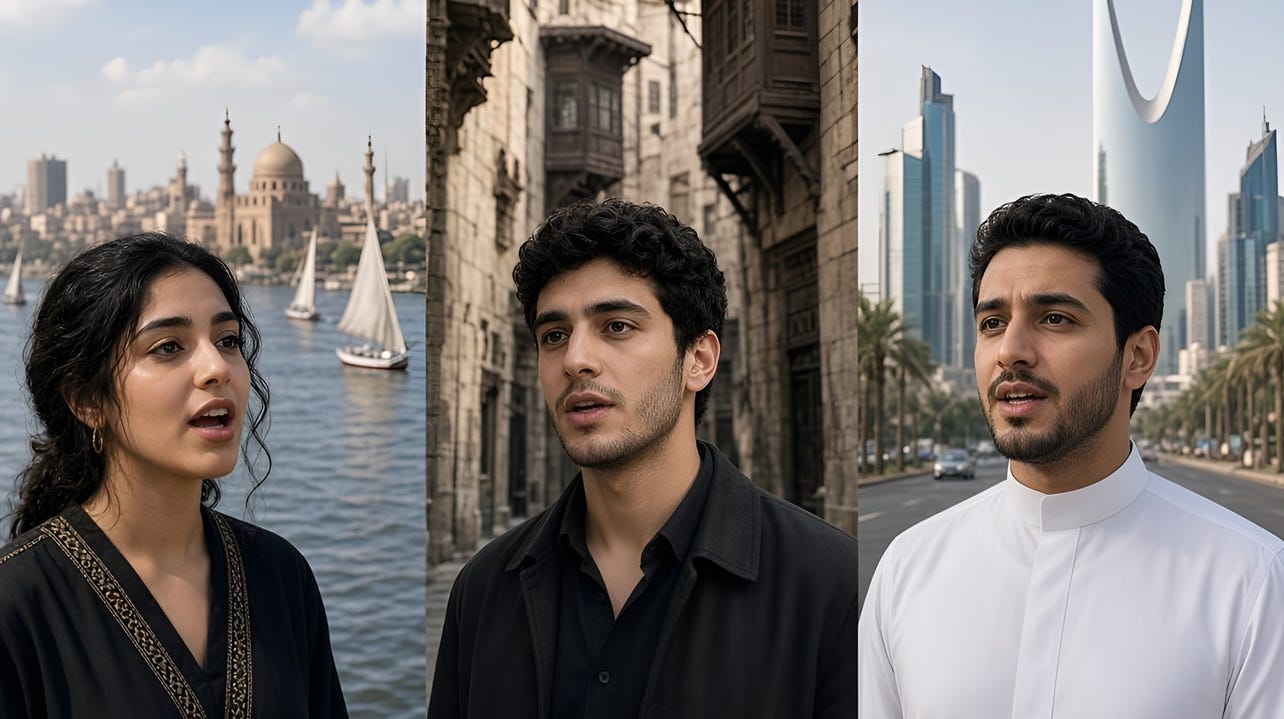
#MiddleEast #AI - Alexandria-based AI lab TokenAI has released three open-weight Arabic text-to-speech models for Egyptian, Saudi and Syrian Arabic. Each Replica Harf model is fine-tuned on its particular Arabic dialect based on the company’s Replica Preview 0.6B, which was released last week. TokenAI says the family beat the OmniVoice base model in most tests while generating speech faster.
SO WHAT? - The new open weight speech models follow TokenAI’s release of the family of Replica Preview text-to-speech models last week. Made for for voice generation and voice cloning, the models were developed to generate audio quickly and cost little to run. This week’s release of three new models are each fine-tuned to converse in one Arabic dialect. Each has been fine-tuned from Replica Preview 0.6B. The new models will allow developes to use a speech model that focuses on their target Arabic dialect, with the aim of making voice workflows more natural.
KEY POINTS:
TokenAI has released three are open-weight text-to-speech model for regional Arabic dialects. Replica Harf EG (Egyptian), Replica Harf SA (Saudi) and Replica Harf SY (Syrian and wider Levantine) are now available on Hugging Face.
Each of the new dialect models has 612 million parameters and uses a non-autoregressive diffusion architecture built on the OmniVoice framework. They were all fine-tuned from Replica Preview 0.6B.
The three dialect models support voice cloning from a sample, a Voice Design option (gender, age, pitch, style and accent) and automatic voice selection. Although each is specialised in one dialect, the Replica Harf models also inherit 646 languages from the base model.
Output runs at 24 kHz, diffusion steps range from 8 for fast generation to 48 for higher quality and smoother speech, while text is streamed in sentence chunks of up to 120 characters.
TokenAI says the family outperformed the OmniVoice base model in most tests and benchmarks, with faster voice generation.
According to the AI lab, the Saudi and Syrian Arabic dialect benchmarks used 40 dialect prompts and a matched OmniVoice base comparison. It measured word and character error rates, speaker similarity, speed, latency and memory.
Potential uses for the new models include voice assistants, customer support, education tools, accessibility features, narrated media and localisation.
All three models carry the TokenAI non-commercial licence. Free access therefore covers research and experiments, not commercial products.
TokenAI aims to lead the AI voice race in the Middle East with multiple open weight model releases.
[Written and edited with the assistance of AI]
Source: TokenAI
LINKS
Replica Harf EG (Hugging Face)
Replica Harf SA (Hugging Face)
Replica Harf SY (Hugging Face)
Read more research about Token AI:
TokenAI enters AI voice race with three models (Middle East AI News)
TokenAI releases 50k reasoning records for AI builders (Middle East AI News)
TokenAI launches compact AI decision model (Middle East AI News)
TokenAI open-sources Horus Taleeq Arabic language model (Middle East AI News)
TokenAI releases Horus Cyber Nano 1.0 (Middle East AI News)