

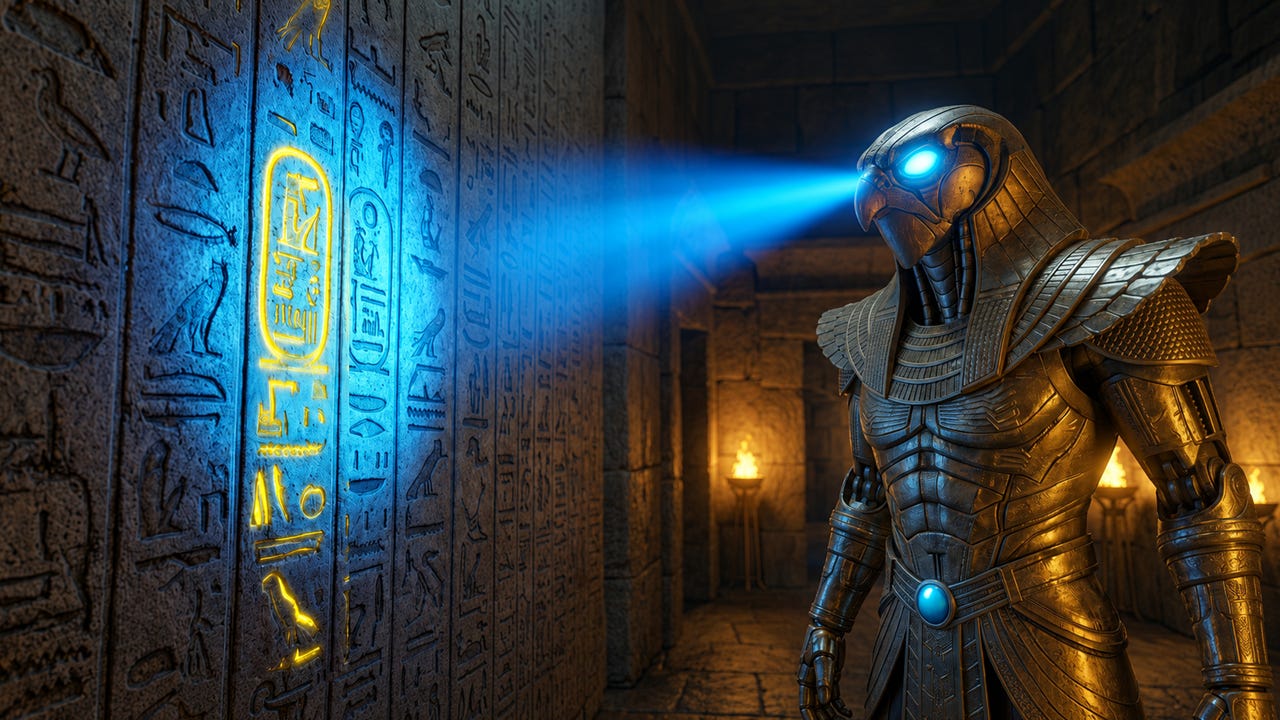
#Egypt #AI — Alexandria-based AI startup TokenAI has released two pioneering new multimodal models, Horus Hiero and Horus Hiero Mini, built to read, translate and reason across Ancient Egyptian hieroglyphics, modern Arabic dialects and more than 100 other languages. Developed without external funding, the models are believed to be the first in the Arab world to include a native hieroglyphic processing engine trained on epigraphic drawings, stone reliefs and papyrus documents. Both models will be released as open-weight under a custom developer licence, with a Horus Chat web and mobile interface to follow.
SO WHAT? — Native contextual hieroglyphic AI has no real precedent. Existing vision models can identify hieroglyphic symbols but can’t parse ancient grammar or produce structured translations from visual inputs. Egyptian startup TokenAI has built and funded that development from scratch. The Horus multimodal model’s ability to more effectively translate hieroglyphic stories will appeal to those developing museum translation apps, Egyptology research tools and others, whilst providing inspiration for researchers to build on TokenAI’s work.
KEY POINTS:
Egyptian AI developer TokenAI has released Horus Hiero 9B and Horus Hiero Mini 4B, a family of advanced vision-language and large language foundation models
optimised for the cultural heritage, languages and dialects of Egypt, and the broader Middle East and North Africa region.
Uniquely, both the new models natively read, understand and translate Ancient Egyptian hieroglyphics and the stories written using these symbols.
The Horus Hiero models’ core capability is a native hieroglyphic processing engine trained on epigraphic drawings, stone reliefs and papyrus scrolls, enabling direct visual translation of ancient inscriptions into structured English and Arabic without relying on external vision models.
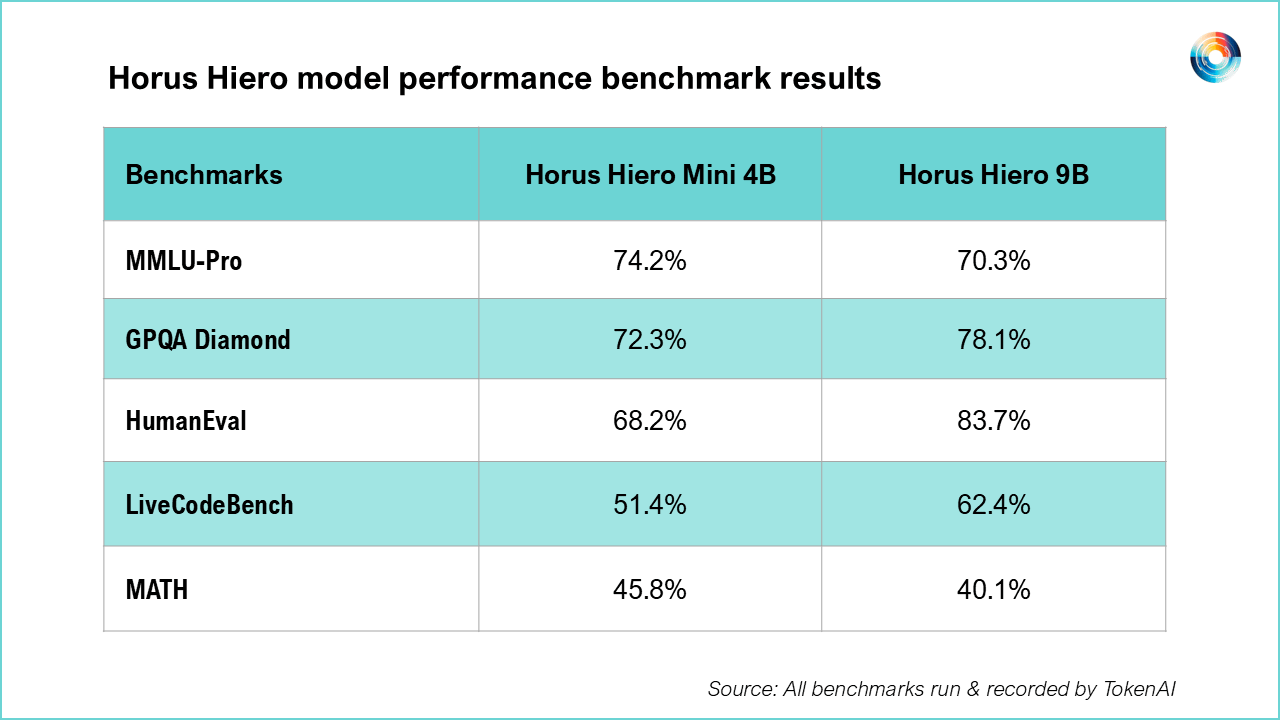
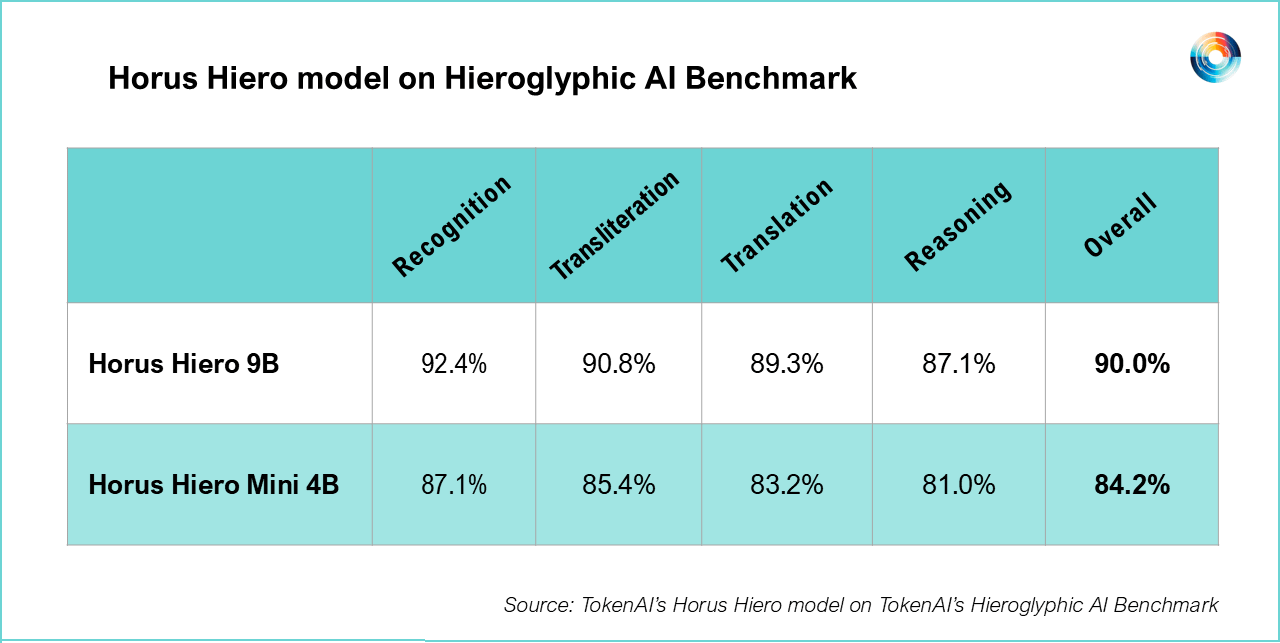
TokenAI has also announced its own Hieroglyphic AI Benchmark, covering recognition, transliteration, translation and contextual reasoning to better assess the Hieroglyphic capabilities of AI models. Horus Hiero scores 90% overall on this benchmark, with 92.4% on visual symbol recognition and 89.3 percent on grammatical translation.
Horus Hiero Mini scores 84.2% on the same benchmark and is designed to run on standard CPUs and mobile devices, making offline real-time hieroglyphic translation feasible on budget hardware.
Both Horus Hiero models have been built with massive context window length. The 128K token context window is long enough to process entire books or multiple papyrus documents in a single inference pass, and support over 100 languages with full Arabic dialect mapping across colloquial Egyptian, Levantine, Gulf and North African variants.
According to TokenAI’s internal evaluation, the two models score well on standard global benchmarks .The flagship Horus Hiero 9B scores 79.3% on MMLU-Pro, 78.1% on GPQA Diamond and 83.7% on HumanEval for Python coding, competitive figures for a model of its parameter size.
The compact Horus Hiero Mini 4B scores 74.2% on MMLU-Pro and 72.3% on GPQA Diamond, retaining strong general reasoning despite running under tight resource constraints.
Practical use cases for the models include real-time camera-based inscription translation for tourists and museum visitors, multi-dialect enterprise document search, academic Egyptology tools and high-fidelity OCR of historical archives.
Horus Hiero 9B and Horus Hiero Mini 4B are both available as open-weight models under a custom developer licence designed to protect intellectual property, while encouraging research use.
Founded by Egyptian entrepreneur Assem Sabry, TokenAI released Horus 1.0-4B in April 2026, which outperformed Llama 3.1-8B and Gemma-2-9B on the MMLU benchmark despite having fewer parameters. The company is currently developing a third, more powerful AI model to be announced in the near future.
Hieroglyphic AI Benchmark
In tandem with the development of the Horus Hiero models TokenAI created its own proprietary Hieroglyphic AI Benchmark to better assess the performance of the model suite on ancient texts, The framework covers four key dimensions of hieroglyphic processing: Recognition (OCR), Transliteration, Translation, and Contextual Reasoning.
Recognition - This measures the model’s ability to identify and segment each individual hieroglyphic symbol within an image, and classify it correctly according to Gardiner’s Sign List.
Transliteration - This measures how the model converts symbols identified into a standardised phonetic or vocal representation that reflects the pronunciation of words in the Ancient Egyptian language, such as converting the vulture symbol into its corresponding phonetic letter.
Translation - This measures the linguistic and contextual accuracy of the model’s translation of hieroglyphic texts, after decoding their symbols, into modern languages such as English or Arabic.
Contextual Reasoning - This measures the understanding the religious, historical, and cultural connections between symbols. For example, inferring that a combination of symbols such as the Ankh (life), the Eye of Horus (protection), the Was-sceptre (power), and the Ma’at (justice and wisdom) expresses a sacred contextual meaning related to the safety of the individual and the pharaohs’ relationship with the gods, rather than just a sequence of separate words.
ZOOM OUT — Horus Hiero is TokenAI's most significant model release so far this year. In April, the Egyptian AI startup released Horus 1.0-4B, a 4 billion parameter open-source model published under an MIT licence. The model punched well above its weight, scoring 88 percent on the MMLU benchmark against 69 percent for Meta's Llama 3.1-8B and 71 percent for Google's Gemma-2-9B, both considerably larger models. On Arabic-specific tests it was similarly competitive, scoring 67 percent on ArabicBench against Llama's 40 percent. The model runs in seven variants, down to a 2.3GB compressed version that fits on a laptop, which matters in a region where many developers don't have access to GPU clusters. TokenAI also built Horus Lens 1.0 , an advanced text-to-image and image-to-image generation model. The developer plans to release a chat interface for Horus Hiero in the near future and is also working on a more powerful version of Horus Hiero.
[Written and edited with the assistance of AI]
Source: TokenAI
LINKS
Horus Hiero 9B (Hugging Face)
Horus Hiero 4B Mini (Hugging Face)
Horus Hiero 9B GGUF (Hugging Face)
Horus Hiero 4B Mini GGUF (Hugging Face)
Horus Hiero (GitHub)
Read more about TokenAI:
Egyptian open-source LLM Horus punches above its weight (Middle East AI News)