

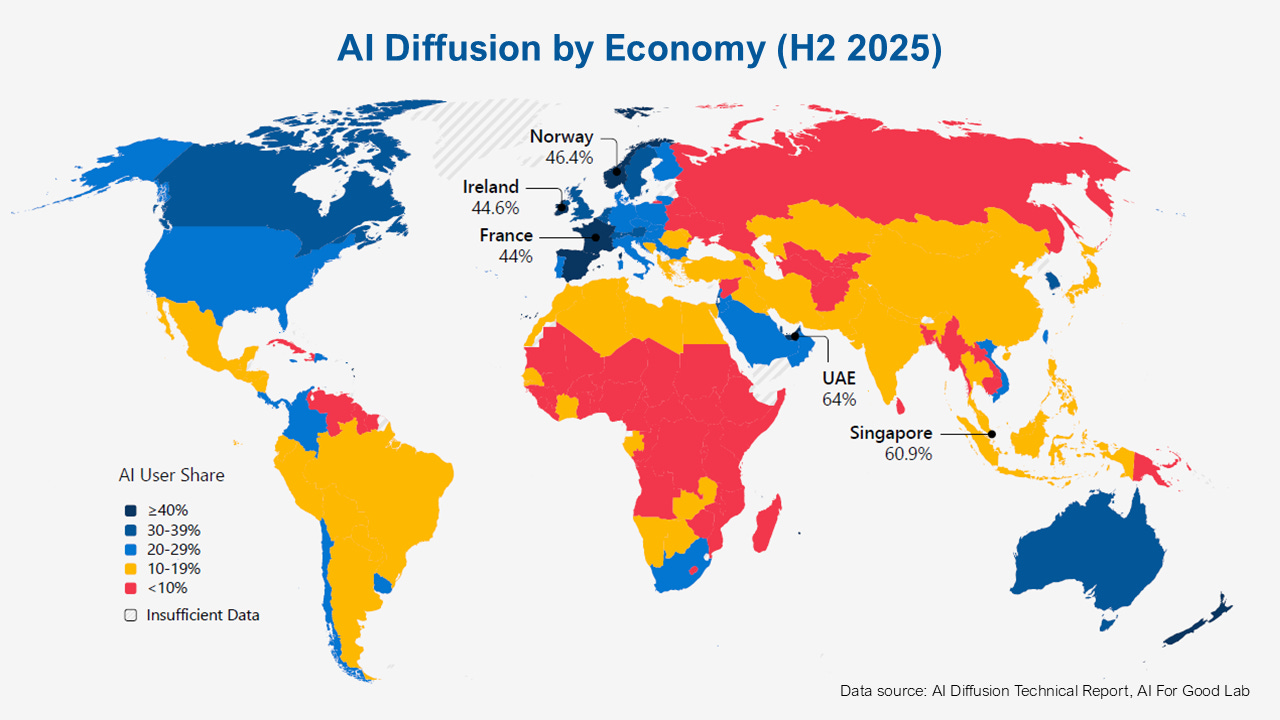
#UAE #digitaltransformation - The UAE has extended its position as the world’s leading nation for artificial intelligence adoption, with 64 percent of the working-age population now using generative AI tools by the end of 2025, according to new global data from Microsoft AI Economy Institute (AIEI). The research shows the UAE now has a lead of more than three percentage points over Singapore, which remains in second place with 60.9 percent adoption. The findings highlight how early government leadership, regulatory pragmatism and sustained investment in digital infrastructure, AI policy and skills development have translated into real-world adoption at scale.
SO WHAT? - The UAE’s achievement represents the culmination of strategic decisions made years before the generative AI wave began. In October 2017, five years before ChatGPT launched, the UAE appointed the world’s first Minister of State for Artificial Intelligence and established a national AI strategy covering nine priority sectors. Alongside government policy ,programmes and investment, the UAE has also developed a wide variety of AI education and training programmes, including the UAE AI Summer Camp which has been running for seven years. This early foundation-building created familiarity and trust that enabled rapid adoption when consumer AI tools arrived, with UAE AI trust levels reaching approximately 67% compared to just 32% in the United States.
Here are some key points regarding the new Microsoft report:
The UAE’s 64 percent AI adoption rate amongst working-age adults represents an increase from 59.4 percent earlier in 2025, according to the latest AI Diffusion Report released by Microsoft AI Economy Institute (AIEI). The new data signals continued momentum in the country’s digital transformation journey and widening the gap over regional and global competitors.
Singapore holds second place globally with 60.9 percent adoption, followed by Norway, Ireland, France and Spain, showing that strong infrastructure, policy coordination and digital readiness can drive rapid adoption without requiring frontier-level model development or massive datacentre capacity.
The UAE’s early AI leadership began in October 2017 with the appointment of His Excellency Omar Sultan AlOlama as the world’s first Minister of State for Artificial Intelligence, five years before ChatGPT captured global attention.
Meanwhile, the 2025 Edelman Trust Barometer shows UAE AI trust at approximately 67 percent, a 35 percentage point gap over the United States and Western European nations which average just 32 percent, representing one of the starkest cross-national differentials in technology attitudes.
Regulatory pragmatism including sandbox environments for controlled experimentation, special visa programmes to attract AI talent and principles-based guidelines provided clear direction without creating compliance paralysis, generating trust through demonstrated outcomes in daily transactions.
Microsoft’s data highlights a widening global digital divide, with AI adoption growing much faster in advanced economies than in the Global South, though the report notes rapid rise in usage of DeepSeek tools in markets historically underserved by traditional providers.
DeepSeek tools have shown strongest adoption across China, Russia, Iran, Cuba, Belarus and much of Africa, underscoring how global AI diffusion is influenced by accessibility factors and that the next wave of users may come from communities with historically limited access to technological progress.
Regional competitors remain far behind the UAE’s adoption levels, with Qatar at 38.3%, Saudi Arabia at 26.2%, Oman at 24.2%, Kuwait at 19.1% and Egypt at 13.4%, according to Microsoft’s H2 2025 global AI diffusion data. However, all these percentages have grown since H1 2025.
[Written and edited with the assistance of AI]
DOWNLOAD
Read about previous Microsoft AI Diffusion reports:
UAE leads world in AI adoption rates (Middle East AI News)