

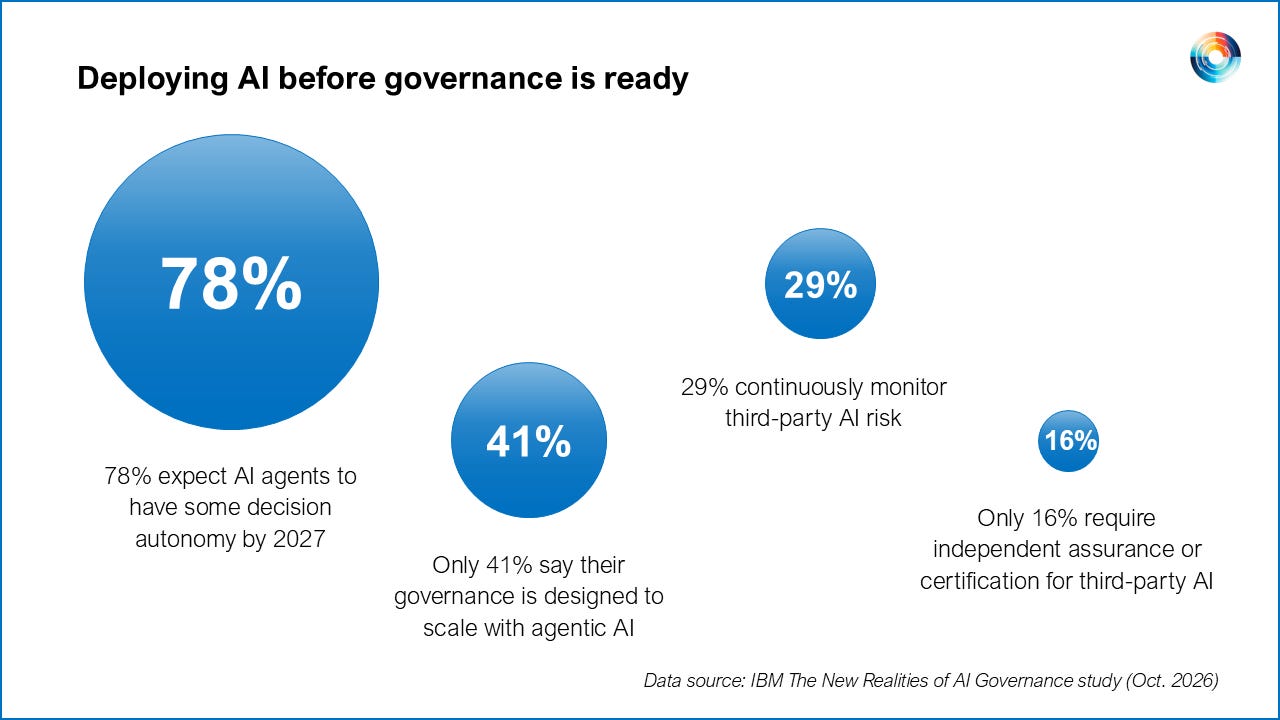
#UAE #governance - Three out of four UAE executives say an AI-related incident was escalated to their board or C-suite during the past 12 months, according to new research from IBM. The study found that 78 percent of organisations expect AI agents to have some autonomy over decisions by 2027, but only 41 percent say their governance is designed to scale with agentic AI. Even when deployment outpaces governance, 60 percent continue to deploy within agreed risk limits. The UAE findings draw on a survey of 206 executives (a subset of a survey of 3,221 respondents across eight countries).
SO WHAT? - UAE enterprises are choosing accelerated AI deployment over delay, and so AI incidents are a predictable risk. The study found that 75% of those surveyed have escalated an AI incident to leadership, but responsibility can be unclear. Often no role clearly owns the outcomes of autonomous agents, and views on legal liability are split. Only 39 percent of those surveyed have board-reviewed estimates of the financial risk from governance gaps. The pattern is consistent with other recent UAE surveys: policy exists, and enforcement lags.
KEY POINTS:
IBM released the UAE findings of its Censuswide study on 15 October 2026. The study surveyed 206 UAE executives, within a sample of 3,221 at organisations with 1,000 or more employees, for eight countries across Europe and the Middle East.
75% of UAE executives say an AI-related incident was escalated for board or C-suite attention over the past year. Incidents included agent failures, data exposure, AI-driven decision errors and AI security breaches.
Among those executives reporting an escalated incident, 49% changed their AI governance policy or framework as a result, while 40% changed AI investment or deployment plans.
38% of those surveyed say agentic AI is already in production in one or more functions, including 13% that have embedded it across enterprise operations. 78% expect AI agents to have some decision autonomy by 2027.
41% say their governance is designed to scale with agentic AI, and 35% say current frameworks can cope but need strengthening. When deployment outpaces governance, 60% continue within agreed risk limits and 30% delay.
Ownership of agent outcomes is unclear. The Chief Risk Officer or Chief Compliance Officer is most often named (21%), then shared C-suite responsibility (17%) and the CIO or CTO (15%). Views on liability are divided.
By 2027, executives expect to need contractual frameworks on AI vendor liability (37%), cross-jurisdictional governance structures (36%) and the ability to halt agent activity enterprise-wide (36%).
39% have a formal, board-reviewed estimate of the financial risk from governance gaps. 49% see gaps in how governance covers vendors’ AI, only 29% continuously monitor third-party AI risk, and 59% cite national AI strategy as a primary driver of governance spending.
ZOOM OUT - IBM's full study surveyed of 3,221 senior executives across eight European and Middle East countries, identifying the gap between AI adoption and oversight. Some 80 percent overall say an AI-related incident reached their board or C-suite in the past year, yet only 40 percent of those changed their governance policy as a result. The study found that 35 percent run agentic AI in production, and 75 percent expect agents to have some decision autonomy by 2027. However, only 37 percent say their governance is designed to scale. Ownership is also unclear, with just 17 percent naming the CIO or CTO as responsible for agent failures. Meanwhile, only 21 percent continuously monitor third-party AI risk.
[Written and edited with the assistance of AI]
Source: IBM
DOWNLOAD
Read more about UAE AI governance and adoption:
98% of UAE firms report AI accessing data beyond its task (Middle East AI News)
UAE, Saudi lead world on AI agent use (Middle East AI News)
UAE firms run AI agents at massive scale (Middle East AI News)
Saudi Arabia, UAE AI spend surges, execution lags behind (Middle East AI News)
IBM: Middle East’s average data breach cost reaches $8M (Middle East AI News)
UAE firms locked into AI vendors, IBM finds (Middle East AI News)