

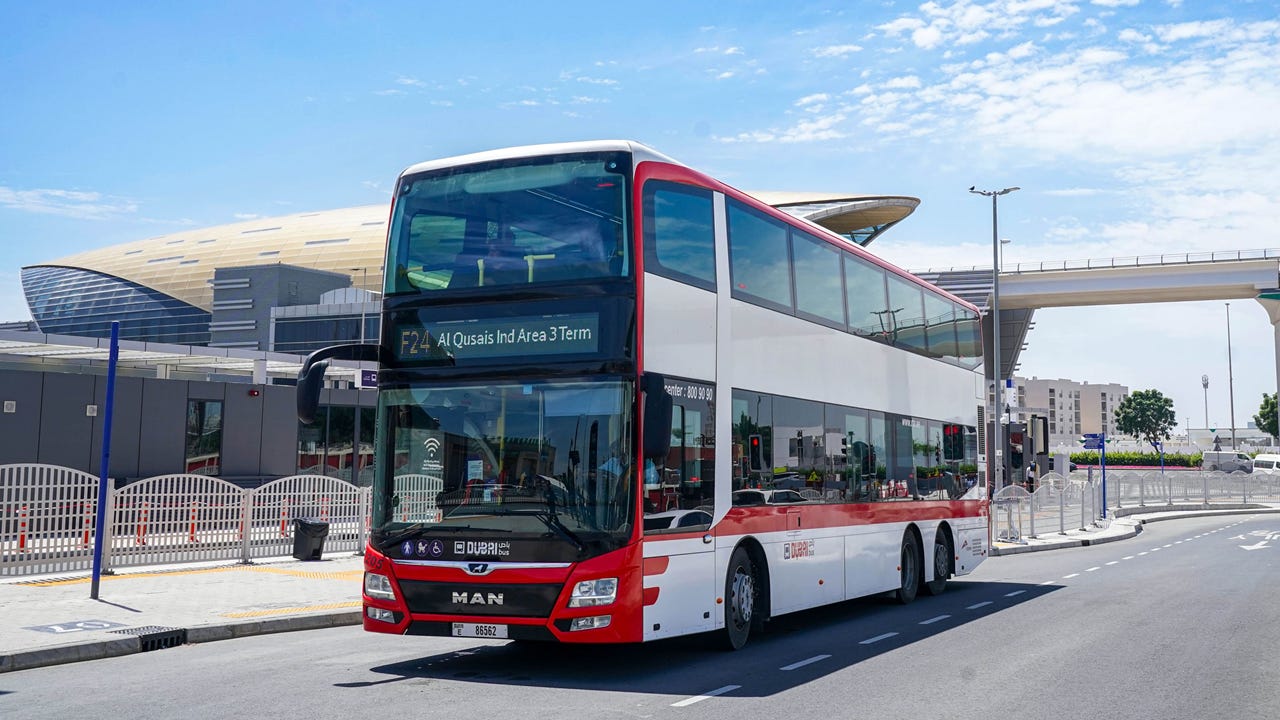
#UAE #smartcities – Dubai’s Roads and Transport Authority (RTA) has deployed AI-powered smart dashboards at its Bus Operations Control Centre, cutting early bus departures by more than 68 percent and reducing CO₂ emissions by over 13,000 tonnes. Developed with RTA’s in-house Artificial Intelligence Centre and built on the Dataiku platform, the system embeds predictive analytics and real-time operational tools directly into daily bus network management across Dubai.
SO WHAT? – As part of the authority’s ongoing digital transformation under is AI Strategy 2030, the RTA has fully embedded AI into live bus operations at scale, delivering measurable results across punctuality, emissions and disruption response. For other cities watching the transformation of Dubai’s transport system, the deployment sets a new benchmark for AI in driving real improvements and efficiencies across busy public transport networks.
KEY POINTS:
Dubai’s Roads and Transport Authority’s has deployed AI-powered smart dashboards built on the Dataiku platform in its Bus Operations Control Centre, developed jointly by the authority’s Public Transport Agency and Artificial Intelligence Centre. The system is now fully integrated into daily control room workflows across Dubai’s bus network.
Early bus departures have fallen by more than 68% since the dashboards went live. This is one of the clearest indicators of improved schedule discipline and a direct gain for passengers relying on consistent service timing.
The system includes predictive analysis for potential trip cancellations, allowing operators to anticipate service gaps before they occur. The new AI platform transforms the control centre from a reactive to a proactive operating model.
The new platform also boasts rapid-response tools which can automatically deploy buses when metro disruptions occur. Rather than waiting for manual intervention, the system triggers immediate resource reallocation, reducing the knock-on impact on passengers during unplanned metro outages.
Sustainability dashboards have helped cut over 13,000 tonnes of CO₂ emissions by reducing engine idling and improving bus parking management. These are concrete environmental gains, not projections, achieved as a by-product of smarter operations.
The platform also optimises short-turning operations allowing buses to reverse direction mid-route during disruptions or demand shifts, improving network resilience without adding vehicles.
Automated alert systems have improved customer communication, reducing the burden on staff while ensuring passengers receive faster, more accurate service updates during disruptions or schedule changes.
RTA describes the deployment as part of a broader Enterprise AI strategy, positioning Dataiku as a scalable foundation for AI development across its operations — suggesting further AI applications are in development beyond bus management.
ZOOM OUT – The RTA launched its Artificial Intelligence Strategy 2030 last year, setting out 81 projects and initiatives built around six pillars: people happiness, smart mobility, intelligent traffic, cognitive licensing, future-readiness and asset excellence. The authority’s strategy aims for a 30 percent reduction in travel times, a 40 percent rise in employee productivity and a 20 percent cut in operational costs. It builds on more than 40 AI use cases deployed since 2017 — from predictive bus maintenance to passenger sentiment analysis — with 45 more in development. RTA's Big Data Platform now manages 670 terabytes of data across 49 integrated systems.
[Written and edited with the assistance of AI]
Source: RTA, MEAIN
Read more about Dubai RTA:
Dubai’s RTA hits AED 5.3 billion in Digital Revenue (Middle East AI News)
Dubai RTA launches AI traffic analysis platform (Middle East AI News)
Dubai RTA actively explores Quantum transport solutions (Middle East AI News)
Pony.ai to start robotaxi trials with Dubai RTA this year (Middle East AI News)
Dubai RTA’s AI strategy to reduce travel times by 30% (Middle East AI News)