


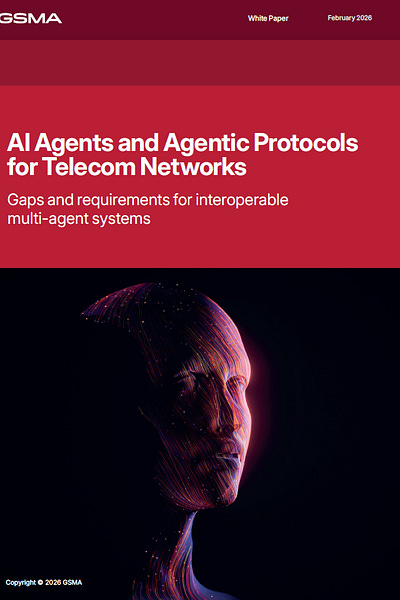
#UAE #telecom – A new whitepaper from global telecom association GSMA and Khalifa University’s Digital Future Institute (DFI) asserts that agentic protocols must be treated as a critical foundational building block for future 6G networks. The AI Agents and Agentic Protocols for Telecom Networks whitepaper identifies key gaps in existing agentic frameworks and defines requirements for telecom-ready multi-agent systems. The work insists that agentic AI can not be considered as simply add-on to existing architectures and calls for coordinated standardisation efforts across the global telecommunications industry to enable scalable, trustworthy and interoperable agentic AI deployment at 6G scale. The paper was developed with contributions from Deutsche Telekom, BT Group, Vodafone, Huawei, IBM and Nokia.
SO WHAT? – The telecom industry is approaching an inflection point as AI and telecom technologies begin to merge. As networks evolve toward the 6G era, the question is no longer whether AI agents can be deployed in telecom environments, but how they can be deployed safely, interoperably and at scale. Telecom systems are society-critical, highly regulated and technically demanding in ways that general-purpose AI frameworks have so far not been designed to address. Furthermore, decisions made about agentic AI now could shape 6G network design for decades. The whitepaper aims to move the industry conversation from aspiration to architecture, whilst providing a concrete set of requirements and clear direction for standardisation.
Here are some key points about this whitepaper:
The global telecom association GSMA and Khalifa University’s Digital Future Institute (DFI) have released AI Agents and Agentic Protocols for Telecom Networks whitepaper, identifying key gaps in existing agentic frameworks and defines requirements for telecom-ready multi-agent systems.
The whitepaper asserts that agentic protocols are a critical building block for 6G networks, calling for a shift from ad-hoc agent communication toward telecom-aware agentic protocols that support consistent coordination and interoperability at scale across the global telecom ecosystem.
The whitepaper was developed with contributions from a high-profile group of industry partners including Deutsche Telekom, BT Group, Vodafone, Huawei, IBM and Nokia., reflecting broad industry alignment behind the need for telecom-specific agentic AI frameworks and standardisation.
Existing general-purpose agentic frameworks fall short of telecom requirements in critical areas including coordination at scale, real-time operation, semantic consistency, reliability and interoperability across vendors and network domains.
Telecom AI agents differ fundamentally from general-purpose agents, interacting directly with physical network infrastructure, operating under strict timing and safety constraints, and required to comply with regulations and standards.
The whitepaper defines a comprehensive set of requirements for telecom-ready agentic systems, covering multi-agent operation, quality-of-service-aware communication, service continuity, intent-based interaction, governance, security, extensibility and interoperability across vendors and network domains.
Multi-agent coordination is identified as a central architectural challenge, with typical telecom use cases involving multiple specialised agents operating across terminals, networks and services simultaneously, making planning, communication and coordination between agents essential design considerations.
The paper identifies agentic protocols as an opportunity and a responsibility for the standardisation community. It also calls for coordinated efforts across standardisation bodies, industry players and research institutions to ensure that agentic systems remain interoperable, secure and trustworthy across the global telecom ecosystem.
The whitepaper concludes that autonomous networks enabled by telecom-aware agentic protocols can be not only technically advanced but also operationally viable and economically sustainable: a combination could prove to be essential for the 6G era to deliver on its potential.
ZOOM OUT – On 2 March 2026 at MWC Barcelona, GSMA formally launched Open Telco AI as a full global industry initiative, confirming that AI has moved to the centre of the association’s strategic priorities as 6G network development accelerates. In addition to the AI Agents and Agentic Protocols for Telecom Networks whitepaper, the Open Telco AI initiative introduced a new portal for telco open models, data, compute and tools designed to build the open foundations of telco-grade AI. Khalifa University’s Digital Future Institute joined ICT giants such as AT&T, AMD and TensorWave in launching the new initiative. DFI also leads the Network Management and Configuration Group within the Open Telco AI initiative.
DOWNLOAD
Read more about Khalifa University’s work on telecom AI:
Open Telco AI Leaderboard Release 3 launched (Middle East AI News)
Khalifa University unveils breakthrough RF AI model (Middle East AI News)
UAE University, KU release first open 6G AI benchmark (Middle East AI News)
GSMA, Khalifa University to update TelecomGPT (Middle East AI News)
Khalifa University announces telecom AI benchmarks (Middle East AI News)