

#UAE #SaudiArabia #cybersecurity - The digital recovery plans of UAE and Saudi organisations are not keeping pace with the increasing volume of cyberattacks, according to a report from California-based data security company Cohesity. The Cyber Resilience Report finds that 73 percent of organisations suffered a material attack in the past 12 months, up from 59 percent in 2025. Meanwhile, just 1 percent say that their plans are equipped for future frontier AI attacks, against 3 percent worldwide. Only 17 percent have tested a ‘minimum viable company’ to support a safe, faster recovery, while response and recovery take just 36 percent of resilience spending.
SO WHAT? - Cyberattacks in the Gulf are on the rise, but the ‘complete confidence’ of Saudi and UAE respondents in their resilience strategy fell from 44 percent to 35 percent since last year’s survey. The report finds that 87 percent say that resilience spending leans too far towards prevention. Cohesity advises that firms that test recovery before the next attack will be better placed.
KEY POINTS:
Cohesity commissioned independent research firm Vanson Bourne to survey 3,200 IT and security decision-makers at organisations with 1,000 or more employees across 12 countries in July 2026. The UAE and Saudi Arabia sample is 100 respondents.
73 percent of UAE and Saudi organisations experienced a material cyberattack in the past 12 months, up from 59 percent in 2025. Of those, 74 percent exceeded their recovery time objective, with recovery taking about 40 percent longer than planned.
Of UAE and Saudi organisations hit by a damaging cyberattack in the past year, 74 percent took longer to recover than planned (76 percent globally). Overruns averaged about 40 percent, against nearly 100 percent worldwide. 71 percent also found more systems affected than first thought (70 percent globally).
90 percent of UAE and Saudi organisations say their recovery plans rely, at least partly, on five common assumptions. These include containing the attack fully before recovery starts and mapping every dependency. Complete confidence in their cyber resilience strategy fell from 44 percent in 2025 to 35 percent.
90 percent of UAE and Saudi organisations say their recovery plans focus more on restoring IT systems than on keeping the business running and serving customers. Globally, it’s 78 percent. Among attacked firms, 78 percent put speed ahead of making sure restored systems are clean, against 72 percent globally.
Only 17 percent have a formally documented and tested ‘Minimum Viable Company’, the smallest version of the business that can keep operating during recovery, against 22 percent globally. A further 19 percent have documented one without testing it, and 30 percent are still developing one.
90 percent of attacked UAE and Saudi organisations say differences between IT and security teams can delay recovery decisions, against 84 percent globally. 93 percent expect plans to need workarounds or improvisation, versus 88 percent. And 70 percent don’t always test identity systems for lingering attacker access.
99 percent of UAE and Saudi respondents use AI systems, and 39 percent have plans that fully cover attacks on them. Both figures match the global rates. Among those firms, 90 percent are well prepared for unintended AI agent actions, against 21 percent with partial or minimal plans.
67 percent of UAE and Saudi respondents aren’t very confident they can verify the integrity of AI models and data after an attack, against 58 percent globally. 53 percent aren’t well prepared for unintended actions by AI agents or copilots, close to the global 56 percent.
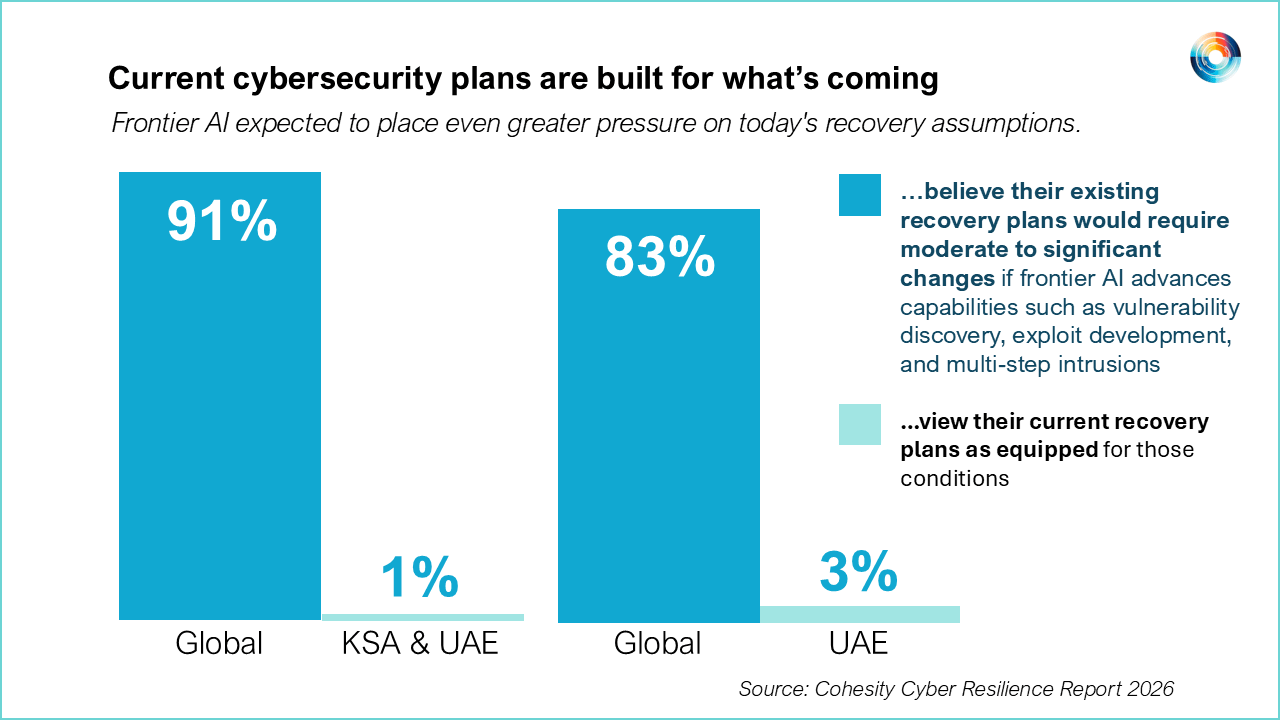
91 percent of UAE and Saudi respondents expect moderate to significant changes to recovery plans if frontier AI advances vulnerability discovery, exploit development and multi-step intrusions, against 83 percent globally. Only 1 percent say current plans are equipped, versus 3 percent worldwide.
ZOOM OUT - The UAE is now one of the most frequently targeted countries by cyberattacks in the world. Microsoft data for the first half of 2026 ranks the Emirates sixth globally for customers hit by cyber activity, and second in the Middle East and Africa. The exposure follows the nation’s push to adopt AI and increase economic competitiveness. Each new model, agent and data pipeline adds identities and access points to defend. Microsoft’s 2026 Digital Defence Report says identity remains the main way attackers get in, and that one compromised supplier can allow cyberattacks to hit many firms.
[Written and edited with the assistance of AI]
Source: Cohesity, UAE Cyber Security Council, Microsoft
DOWNLOAD
Read more about cybersecurity:
DFSA maps four cyber risks from AI agents (Middle East AI News)
98% of UAE firms report AI accessing data beyond its task (Middle East AI News)
UAE taps Microsoft, Core42 for AI cyber defence (Middle East AI News)
TokenAI releases Horus Cyber Nano 1.0 (Middle East AI News)
IBM: Middle East’s average data breach cost reaches $8M (Middle East AI News)