

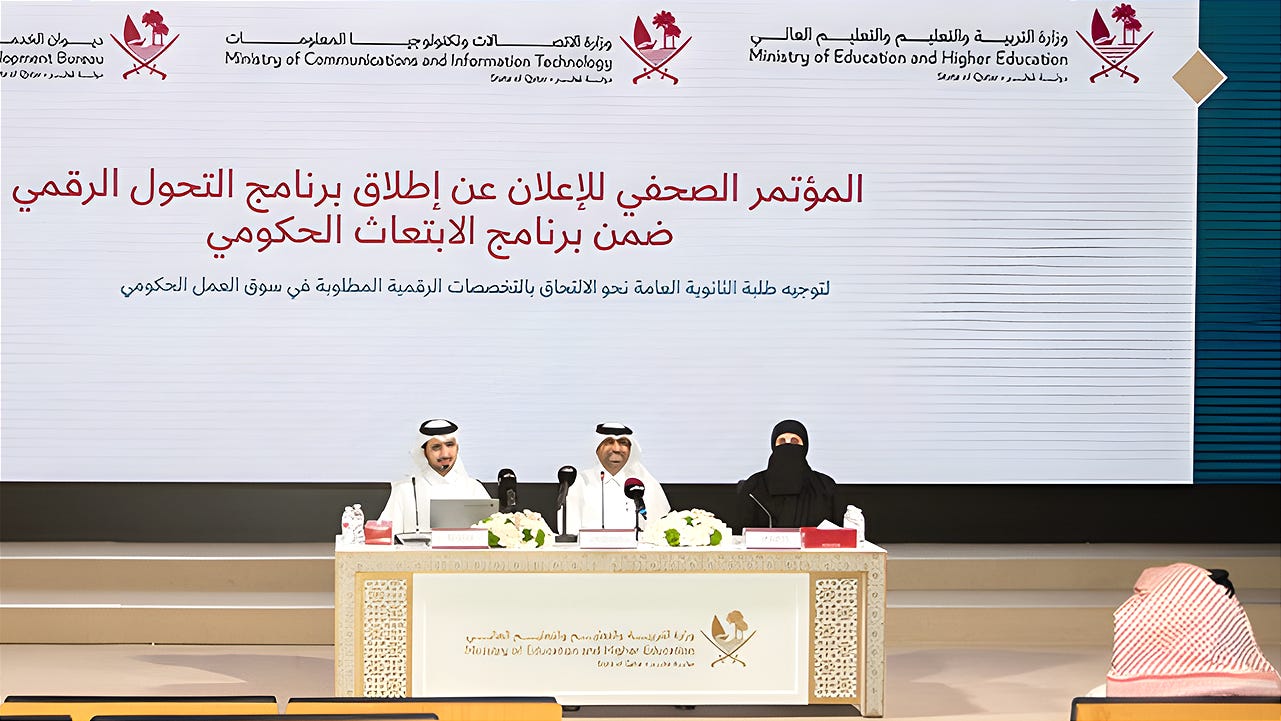
#Qatar #talent — Qatar has more than doubled the ‘Work Nature Allowance’ for engineering jobs following amendments to the Human Resources Law last year, increasing the allowance for computer engineering roles from 35 percent to 75 percent of a worker’s basic salary. The news was announced during the the launch of Qatar Ministry of Education and Higher Education (MOEHE)’s Digital Transformation Programme as part of the Government Scholarship Plan for the 2026/2027 academic year.
The new scholarship scheme introduces monthly stipends of up to QAR 20,000 ($5,500) for students at top overseas universities and guarantees employment for graduates in engineering, science and technology tracks. The scheme is run in coordination with the Ministry of Communications and Information Technology (MCIT) and the Civil Service and Government Development Bureau,
SO WHAT? — Qatar has ambitious goals for creating a digital talent pipeline and under the National AI Strategy the government aims to both build a national workforce and become an attractive destination for global talent. The new Digital Transformation Programme aims to boost the number of young Qataris entering the technology sector. It provides incentives for students entering computer science studies and guaranteees them high-paying jobs when they graduate. The programme purposefully supports a young students journey to join the workforce, from entering tertiary education, to internships, technical training and mentorship, through to full-time employment.
KEY POINTS:
Qatar’s Ministry of Education and Higher Education (MOEHE), working with the Ministry of Communications and Information Technology (MCIT) and the Civil Service and Government Development Bureau, has launched the Digital Transformation Program as part of the 2026/27 Government Scholarship Plan, aimed at building a national workforce for digital transformation.
By coordinating with other ministries, the scholarship programme ensures that the government supports Qatari nationals entering computer science fields from applying for tertiary education, through to full-time employment in high-paying digital roles.
Computer engineering specialists will see their Work Nature Allowance rise from 35 percent to 75 percent of their basic salary, under amendments made to Qatar’s Human Resources Law last year. The Work Nature Allowance is typically given to those working in particularly arduous jobs, or roles that have been made a top national priority. Cybersecurity specialists were also identified to receive additional benefits.
Students studying abroad at designated premier universities will get monthly stipends of up to QAR 20,000 ($5,500), two annual business-class flights, pre-departure allowances of up to QAR 40,000 ($11,000), and academic excellence rewards.
Students on the engineering, science and technology track at approved universities will receive monthly allowances of up to QAR 14,000 ($3,800), annual flights, pre-departure support of up to QAR 25,000 ($6,850), and guaranteed employment after graduation.
Domestic scholarship students will also receive monthly stipends and tuition coverage at Qatar institutions, including Education City universities and other local universities running digital transformation and technology programmes.
The Digital Transformation Programme includes a practical training component built with MCIT, giving students internships at technology organisations throughout their studies, plus access to local and international tech events and mentorship.
Priority subjects for the programme include artificial intelligence, cybersecurity, digital analytics and cloud computing, with the list of specialisations reviewed regularly against labour market needs.
More than 40 academic programmes in digital transformation are now available at Qatar’s higher education institutions, according to MOEHE’s Assistant Undersecretary for Higher Education Affairs Dr Hareb Mohammed Al Jabri.
Applicants need a minimum secondary school average of 80 percent for science and technology tracks; humanities students can join via an academic bridging programme.
Registration for overseas scholarships, Education City and private local universities runs from 1 July to 15 August 2026; domestic scholarships for government universities open from 15 November to 30 December 2026 via the Government Scholarship Platform.
ZOOM OUT — The Digital Transformation Program fits a strategy Qatar has been building since 2019, when the Qatar Ministry of Transport and Communications adopted a blueprint the country's National AI Strategy. Talent was the first of six pillars in that strategy, built on the premise that AI skills are scarce globally and that demand for data scientists and engineers was already pushing up salaries and competition between employers. The plan called for AI education to run through the school system from primary level onwards, for universities to build apprenticeship pathways into degree courses, and for Qatar to compete internationally for AI specialists alongside growing its own. The new scholarship programme, and the pay rise for computer engineers, are a continuation of that talent strategy.
[Written and edited with the assistance of AI]
Source: QNA, various
Read more about Qatar’s technology initiatives;
Qatar Foundation launches $30m fund to back DeepTech (Middle East AI News)
Qatar’s Shura Council mulls future AI legislation (Middle East AI News)
Qatar’s national AI platform’s powerful upgrade explained (Middle East AI News)
Qatar launches AI research grant for key sectors (Middle East AI News)
Qatar University launches AI-powered research ecosystem (Middle East AI News)