

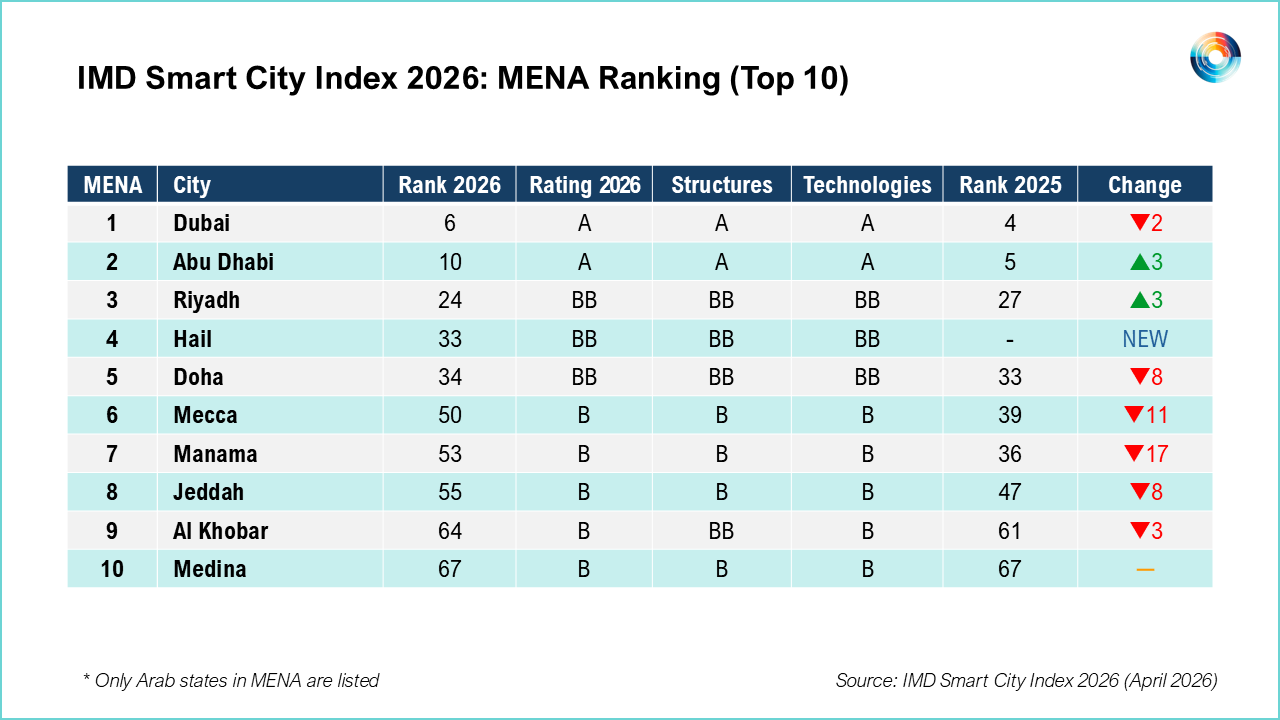
#MENA #SmartCities – Dubai and Abu Dhabi have secured the top two positions among Arab cities in the IMD Smart City Index 2026, ranking sixth and tenth globally respectively out of 148 cities worldwide. The index, published by Swiss business school IMD, measures how residents experience urban technology, infrastructure, and governance. While the UAE leads the regional table, Saudi Arabia dominates in breadth, with six cities in the MENA top ten, including two first-time entries. The results reflect accelerating urban investment across the Gulf as Saudi Arabia marks 2026 as its Year of Artificial Intelligence.
SO WHAT? – The IMD index is not simply a technology scorecard. Its central finding this year is that strong institutions and public trust predict smart city performance more reliably than technology investment alone. The Gulf’s showing high scores for technology and public trust suggests that state-directed digital investment, when paired with high-quality service delivery, can genuinely translate into citizen confidence. Much of the Gulf’s government AI spending over the past few years has focused on improving the delivery of AI-powered public digital services, and this seems to be validated by the new index.
Here are some key points from the new Smart City Index:
Swiss business school IMD has published its annual Smart City Index 2026, ranking 148 cities worldwide according to how residents experience urban technology, infrastructure, and governance.
Dubai ranked sixth globally with an A rating across both the Structures and Technology pillars — the highest score awarded by the index. Abu Dhabi placed tenth, also rated A across both pillars, making the UAE the only country in the MENA region with two cities in the global top ten.
Both UAE cities scored above 0.76 on the technology pillar, with public trust in online government services reaching 95.7% in Dubai and 89% in Abu Dhabi. The IMD report singles out the Gulf model of state-directed digital investment as a global reference point when paired with high service quality.
Saudi Arabia saw six cities placed in the Arab top ten this year, more than any other country in the region. Riyadh advanced three places to 24th globally. Hail made its index debut at 33rd (the highest first-time entry in the region) while Hafar Al Batin also entered the index for the first time, placing 100th.
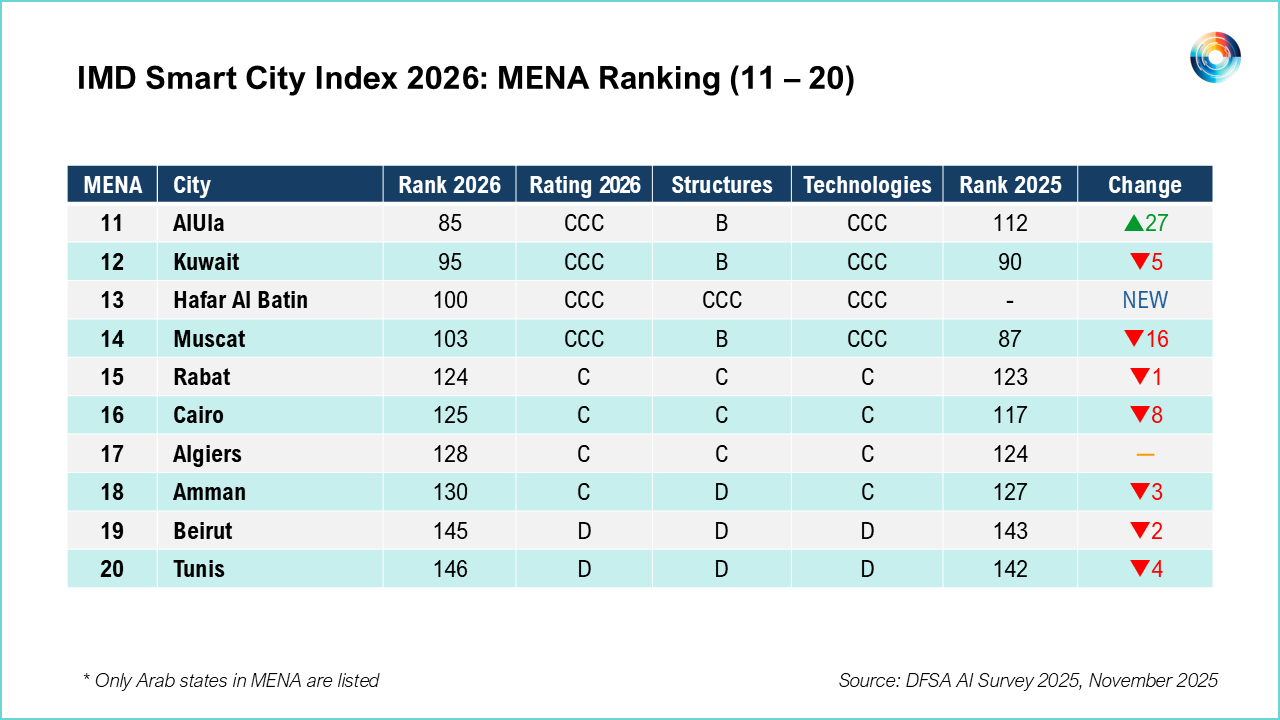
AlUla recorded the biggest regional climb, rising 27 places from 112th to 85th globally. The jump reflects the rapid pace of development and tourism infrastructure investment the city has attracted under Saudi Vision 2030.
Doha ranked fifth in the Arab region at 34th globally, down eight places from 33rd in 2025. Manama placed seventh regionally at 53rd globally, but has slipped 17 places in this years index: the sharpest drop among Gulf cities.
Outside the Gulf, Arab city performance remains weak. Rabat ranked 124th, Cairo 125th, Algiers 128th, Amman 130th, Beirut 145th, and Tunis 146th (all rated C or D). Most slipped compared to 2025, pointing to a widening gap between Gulf and non-Gulf Arab cities.
The IMD index assesses 148 cities globally across five pillars: health and safety, mobility, urban activities, opportunities, and governance. The index combines quantitative data with resident perception surveys. Its central finding this year is that Structures scores are a stronger predictor of overall smart city performance than Technology scores alone.
ZOOM OUT – The GCC’s Smart City Index results reflect years of sustained investment in smart cities and digital public services. The UAE has built one of the world's most advanced digital government ecosystems, anchored by UAE PASS, a national digital identity platform integrating thousands of services across government and private sector providers. Abu Dhabi's AI-powered TAMM superapp, serves 3.6 million users across more than 1,100 services, while Dubai's DubaiNow, covers some 280 services from 44 public sector entities. In Saudi Arabia, the Tawakkalna superapp now serves 34 million users across 600 government services, and recently opened a regulated sandbox for private sector integration. The Gulf model is proving influential beyond the region. Morocco launched its Idarati X.0 superapp project in February 2026, signing eight cooperation agreements with public institutions and private partners to build an AI-powered citizen services platform on similar design principles A six-month development and testing timeline for Idarati X.0 is already underway.
[Written and edited with the assistance of AI]
DOWNLOAD
Also see our sister site Africa AI News:
Nine African cities ranked in IMD Smart City Index 2026 (Africa AI News)
Read more MENA smart city stories:
Dubai deploys AI robots and drones to keep beaches safe (Middle East AI News)
Morocco launches Idarati X.0 digital government platform (Middle East AI News)
Smart city initiative deploys UAVs across Dubai parks (Middle East AI News)
WeRide expands into Ras Al Khaimah (Middle East AI News)
Pony AI deploys robotaxis on Qatar public roads (Middle East AI News)