

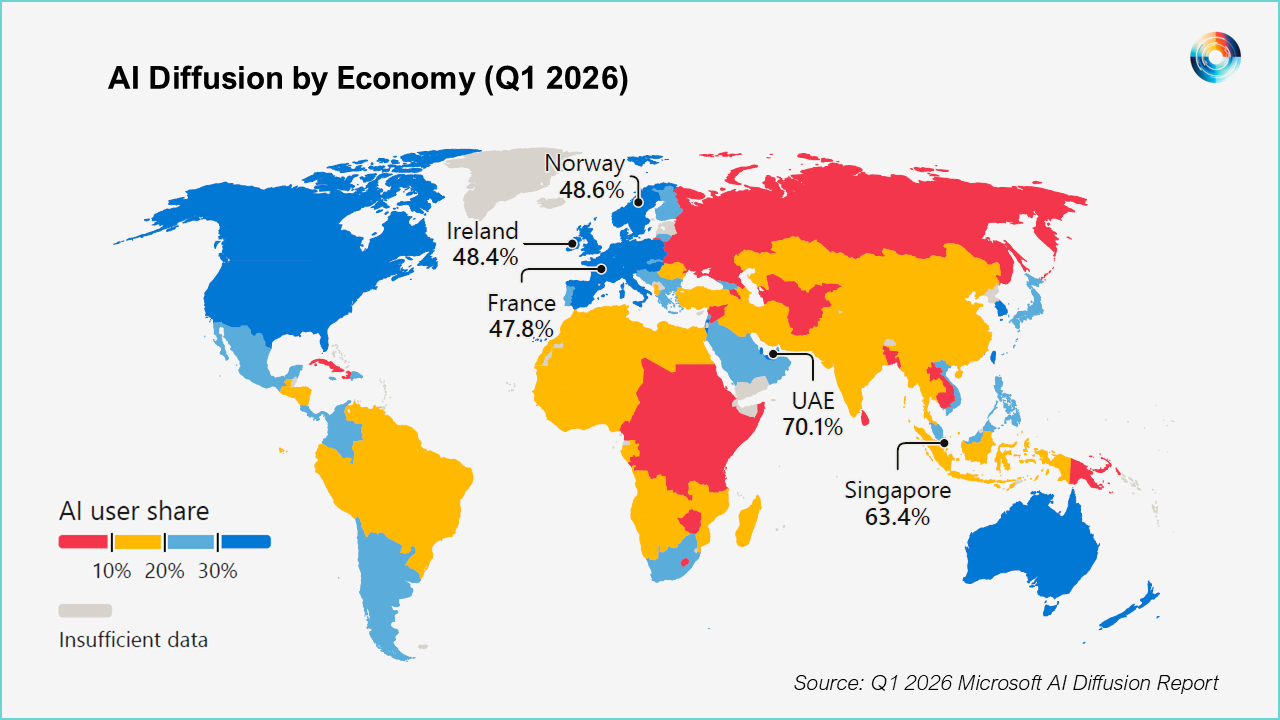
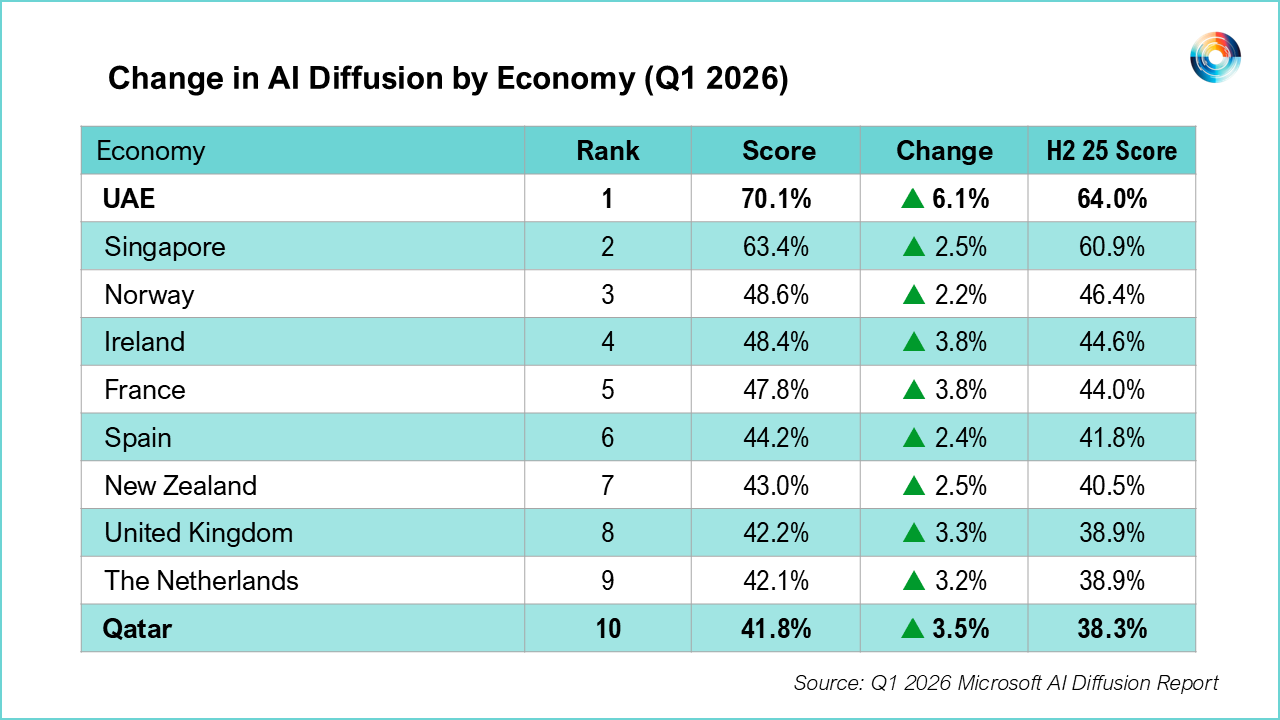
#UAE #AIAdoption – The UAE has retained its position as the world’s leading nation for AI adoption, with 70.1 percent of the working-age population using generative AI tools by the end of Q1 2026, according to the Microsoft AI Economy Institute (AIEI). The result shows a 6.1 percentage point increase from the UAE’s 64 percent score in the H2 2025 report, and extends its lead over second-placed Singapore from 3 percentage points to nearly seven. Qatar retained 10th place globally with a score of 41.8 percent, up 3.5 percentage points from 38.3 percent in H2 2025. Globally, AI usage among the working-age population rose from 16.3 percent to 17.8 percent during the quarter.
SO WHAT? – UAE retains a strong lead in the new report with a 70.1 percent generative AI adoption rate among working-age people. The UAE’s position at the top of Microsoft’s AI Diffusion report’s global rankings reflects years of deliberate policy choices: early government leadership, regulatory pragmatism and sustained investment in digital infrastructure and AI skills. As global adoption accelerates, the UAE is not merely keeping pace, it is pulling further ahead and has put in place a wide range of AI policies to ensure that it continues to do so.
KEY POINTS:
The UAE leads the world in generative AI adoption with 70.1% of its working-age population using AI tools in Q1 2026, according to the Microsoft AI Economy Institute (AIEI). The result is up 6.1 percentage points from 64% in H2 2025 and extends the UAE’s lead over second-placed Singapore to nearly 7 percentage points.
Qatar retained 10th place globally in Microsoft’s National AI Leaderboard, with an adoption rate of 41.8%, up 3.5 percentage points from 38.3% in H2 2025. The result confirms the Gulf region’s position as one of the world’s most concentrated clusters of high AI adoption.
The UAE’s sustained leadership reflects deliberate policy choices, such as early government commitment, regulatory pragmatism and consistent investment in digital infrastructure, AI policy and skills development. Microsoft’s report frames these as the primary drivers behind real-world adoption at scale.
Global AI adoption rose from 16.3% to 17.8% of the working-age population in Q1 2026, with 26 economies now exceeding 30% adoption. The United States moved from 24th to 21st place with a 31.3% usage rate (still less than half the UAE’s adoption level).
The report shows that the gap between the Global North and Global South continued to widen. Adoption in the Global North reached 27.5%, up 2.8 percentage points, while the Global South reached 15.4%, up just 1.3 percentage points. Limited access to electricity, connectivity and digital skills remains the primary constraint on adoption across the South.
Asia emerged as a significant growth engine during the quarter, with South Korea, Thailand and Japan recording the greatest movement. Microsoft attributes much of the acceleration to improving AI capabilities in Asian languages.
The quarter saw a dramatic acceleration in AI-assisted software development. Git pushes (through which developers publish coding changes) increased 78% year on year globally, driven by advances in AI coding tools including Anthropic’s Claude Code, OpenAI’s Codex and Microsoft’s GitHub Copilot.
Contrary to fears of AI-driven job displacement in software development, US developer employment reached a record 2.2 million in 2025, up 8.5% year on year. Early 2026 data shows developer employment in March running approximately 4% above March 2025 levels, suggesting that AI coding tools are currently expanding demand rather than reducing it.
ZOOM OUT – The UAE's high adoption rate is one of the outcomes of a policy journey that began in 2017, when the UAE became the first country in the world to appoint a Minister of State for Artificial Intelligence. Since then, the government has systematically embedded AI across performance, planning and legislation. The UAE operates the world's first AI-powered Proactive Government Performance System tracking over 150 million data points monthly. In April 2026, the UAE Cabinet announced a world-first framework to deploy agentic AI across 50 percent of government sectors, services and operations within two years. No other government has moved at this speed or this scale.
[Written and edited with the assistance of AI]
DOWNLOAD

Read about previous Microsoft AI Diffusion reports:
UAE extends global lead in AI adoption (Middle East AI News)
UAE leads world in AI adoption rates (Middle East AI News)