

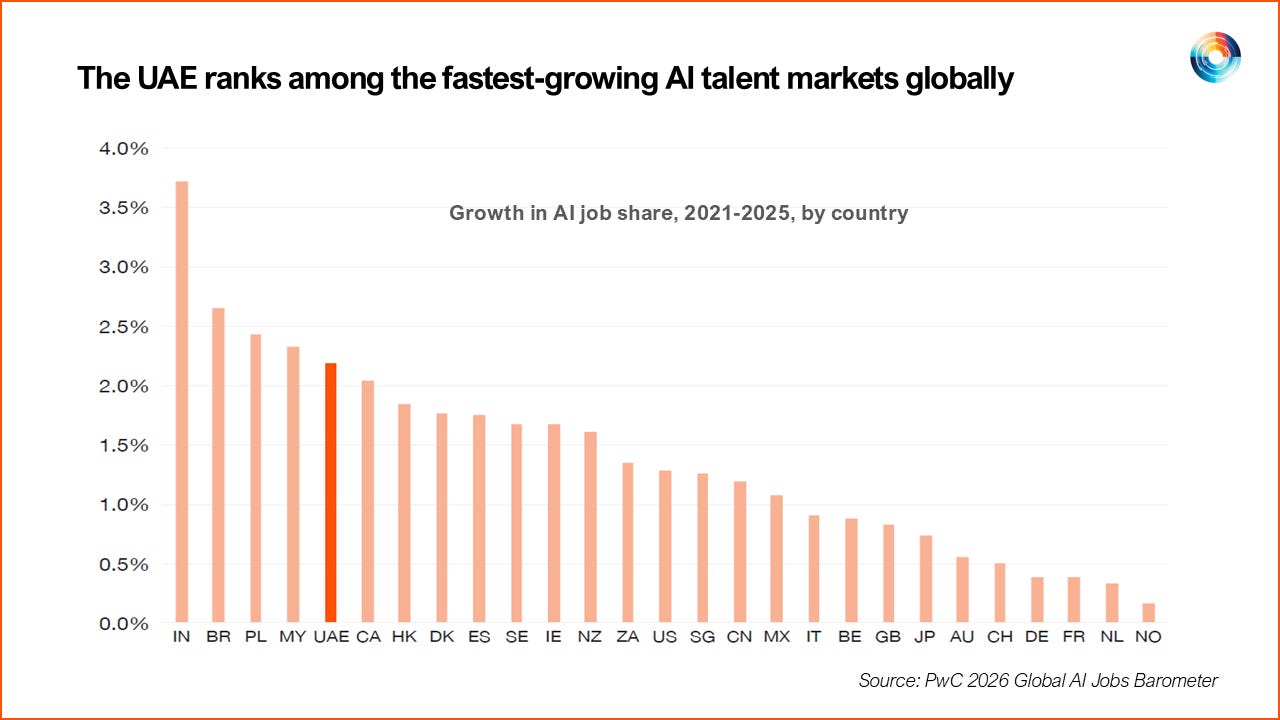
#UAE #AIjobs – The UAE ranks among the fastest-growing AI talent markets globally, according PwC’s latest AI Jobs Barometer report. PwC reports that AI hiring intensity is rising across all UAE sectors, led by technology, media and telecoms, with financial services recording the highest wage premium for AI skills. Globally, companies most exposed to AI have tripled their productivity growth lead over least-exposed peers since 2022. Furthermore, those early adopters appear to be growing headcount 52 percent faster, challenging the narrative that AI primarily displaces workers. The study draws on more than one billion job advertisements across 27 countries to examine how AI is reshaping hiring, skills, wages and productivity.
SO WHAT? – This year’s AI Jobs Barometer makes an important distinction: AI is not simply replacing jobs, it is splitting the labour market into two tracks. First, jobs that AI professionalises (raising the expertise required) are growing, paying more and attracting investment. Second, jobs that AI democratises (lowering the expertise bar) are falling behind on wages and growth. For the UAE, understanding which track each role sits on is now strategic for workforce planning.
KEY POINTS:
The UAE ranks among the fastest-growing AI talent markets globally, according to PwC’s 2026 AI Jobs Barometer, which analyses more than one billion job postings across 27 countries. AI hiring has risen steadily in recent years across all UAE sectors, with the most AI-exposed occupations accounting for the largest share of job postings.
AI hiring intensity is led by technology, media and telecoms in the UAE, with energy and professional services accounting for the largest overall shares of hiring across the labour market. AI job demand in the UAE is dominated by AI user roles, though strong growth is recorded across both user and developer categories.
Financial services records the highest AI wage premium in the UAE, with sectors more exposed to AI generally commanding higher wages than less exposed peers. The wage premium for AI skills is positive across the majority of nations in the study, and the UAE is no exception.
Globally, companies most exposed to AI have tripled their productivity growth lead over least-exposed companies since 2022, when AI use accelerated sharply. The most AI-exposed firms are also growing headcount 52% faster than the least exposed, and recording higher wage growth — 24% versus 17%.
The study identifies a two-track labour market emerging globally and in the UAE.
Jobs professionalised by AI: where AI handles basic tasks, leaving more expert work for people .These account for 22% of advertised roles and are thriving, with 42% higher wage growth since 2021.
Jobs democratised by AI: where AI takes on complex tasks. These account for 52% of roles and are falling behind on both wages and growth.
Skills required for the most AI-exposed jobs are changing twice as fast as those for least-exposed roles, a gap that has widened by 75% since last year’s study. In the UAE, the most AI-exposed occupations show the largest skill shifts and the greatest expansion in the average number of new skills required per occupation.
AI-exposed entry-level roles are being fundamentally redesigned. Junior positions in the most AI-exposed categories are seven times more likely than least-exposed junior roles to demand traditionally senior skills such as leadership and strategic thinking. These seniorised entry-level roles have grown 35% since 2019, while other entry-level roles have declined.
The most AI-exposed jobs are adding human-intensive skills 2.5 times faster than least-exposed roles — with empathy, judgement and creativity emerging as the capabilities AI cannot replicate and that employers are actively seeking to complement AI performance. This signals a structural shift in what human workers are being asked to contribute alongside AI systems.
ZOOM OUT – The global picture is both more optimistic and more unequal than most labour market forecasts have suggested. PwC's 2026 Global AI Jobs Barometer finds that jobs requiring specific AI skills are growing almost eight times faster than the overall jobs market, with the average wage premium for AI skills hitting 62 percent, up from 57 percent last year. The most striking finding is the superstar company effect: the top 20 percent of the most AI-exposed companies achieved average labour productivity growth of 163 percent relative to 2018: nearly five times higher than the most AI-exposed companies overall. Headcount at the most AI-exposed companies is also growing faster, at 52 percent versus 36 percent, directly challenging the assumption that AI adoption leads to workforce reduction.
[Written and edited with the assistance of AI]
Source: PwC
DOWNLOAD
Read more stories about jobs and the workplace:
AI failure could put 79% of UAE CEO jobs on the line (Middle East AI News)
UAE leads in AI adoption with 70% workplace usage (Middle East AI News)
UAE, KSA leadership highlighted in Stanford AI Index (Middle East AI News)
UAE AI usage jumps to 80% among professionals - LinkedIn (Middle East AI News)
Saudi Arabia, UAE enter global AI talent top 20 (Middle East AI News)