

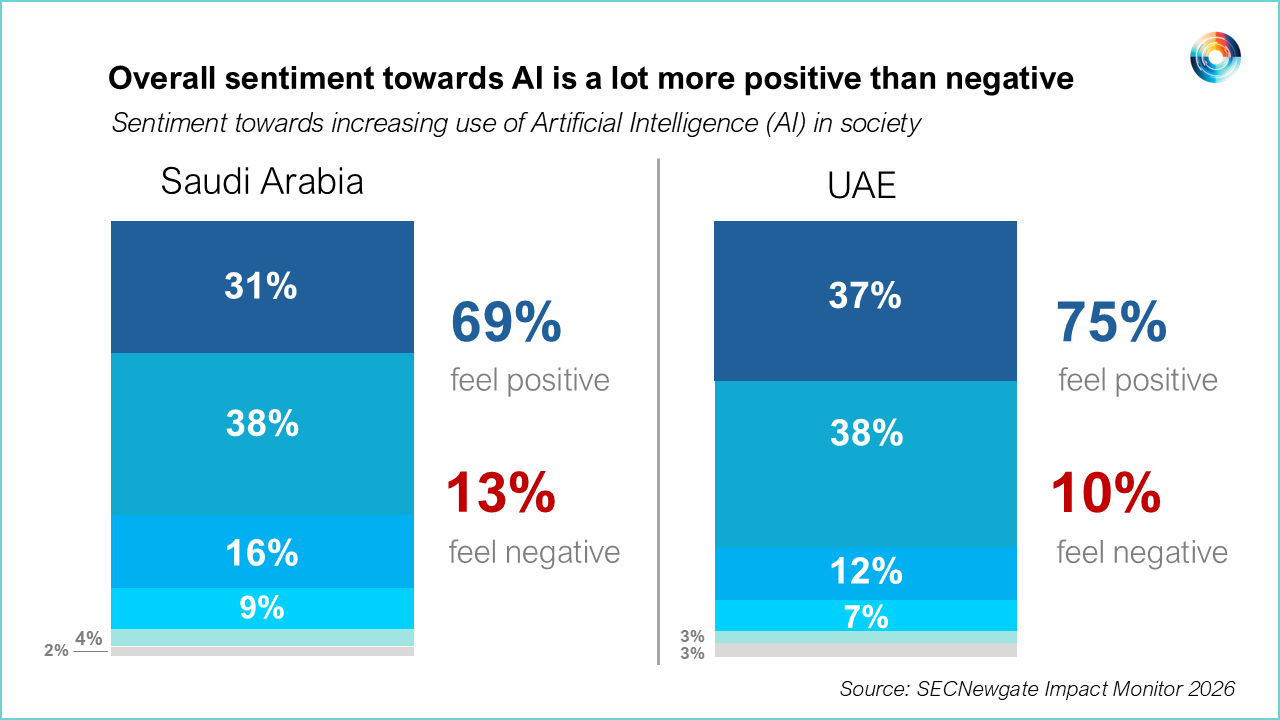
#UAE #SaudiArabia #AI - Residents of the UAE and Saudi Arabia welcome AI, and most want governments and AI developers to help regulate it. In the UAE, 75 percent view AI’s growing use as positive for society, third highest among 20 markets, against 69 percent in Saudi Arabia. The figures come from the sixth Impact Monitor by Milan-based communications group SEC Newgate, which also has offices in Dubai and Riyadh. Some 80 percent of UAE respondents expect AI to make daily life easier, against 60 percent globally.
SO WHAT? - The new study finds that Gulf optimism about AI remains high, but also that the public isn’t blind to AI risks. About six in ten people in both Saudi Arabia and the UAE see risks to privacy and personal data, and the same share expect fewer jobs as a result of AI. According to the research, the public in both countries back several regulators at once, although UAE respondents put national governments first and Saudi respondents put AI developers first.
KEY POINTS:
Milan-based communications group SEC Newgate has released Impact Monitor editions for Saudi Arabia and the UAE, tracking community expectations regarding environmental, social and governance issues.
75% of UAE respondents feel positive about AI’s growing use in society, and 10 percent feel negative. In Saudi Arabia, 69% feel positive and 13 percent negative. The UAE ranks third among the 20 markets surveyed.
80% of UAE respondents and 76% of Saudi respondents believe AI will make everyday life easier and more convenient, against 60% globally.
75% in the UAE expect AI to improve productivity and economic growth, and 75% expect better outcomes in education. In Saudi Arabia the figures are 73% and 71%. Healthcare expectations are 70% in the UAE and 66% in Saudi Arabia.
Meanwhile, 61% of UAE respondents agree AI increases risks around privacy and personal data, and 60% believe that the rise of AI will reduce job opportunities. Saudi respondents give 63% on privacy and 60 percent on jobs.
58% of UAE respondents and 64% of Saudi respondents say AI will make false or misleading news easier to spread.
In the UAE, 80% want national governments to play a key role in regulating AI, 78% want AI developers to play a key role and 66% want bodies such as the UN or OECD. In contrast, Saudi Arabia’s responses were developers 79%, governments 75% and international bodies 60%.
47% of UAE respondents and 49% of Saudi respondents think AI will eventually become smarter than humans and impossible to control, and 44 percent in both countries expect a negative impact on the natural environment
Globally, a 23-point credibility gap separates the 80% who say large businesses should act responsibly from the 56 percent who rate their performance highly. In the UAE, the figures are 90% and 86%, a gap of 3 points, down from 7 in 2025.
99% of UAE respondents say the country is heading in the right direction, against a global average of 49%. The press release says this is the highest among the markets asked, up from 98% in 2025.
SEC Newgate surveyed 20,473 people in 20 countries and territories between 26 August and 17 September 2026. Results were weighted by age and gender, and the global figures give each country equal weight.
[Written and edited with the assistance of AI]
Source: SEC Newgate
DOWNLOAD
Read about more AI research studies:
UAE AI officers see value, but lack authority (Middle East AI News)
Saudi AI business registrations jump 31% (Middle East AI News)
Just 1% of Gulf firms ready for frontier AI cyberattacks (Middle East AI News)
Only 10% of GCC firms scale governed agentic AI - study (Middle East AI News)
MENA firms plan 9.3% of revenue on digital transformation (Middle East AI News)