


#UAE #telecom — Abu Dhabi-based Khalifa University’s Digital Future Institute has built the Telecom World Model (TWM), a new AI architecture designed to give telecommunications networks the ability to anticipate failures, congestion and disruption before they occur. TWM moves beyond existing AI approaches, including large language models and digital twins, by learning how networks evolve over time and simulating the consequences of control actions before they are applied to live systems.
SO WHAT? — Most AI systems in telecoms today are reactive. They respond to problems after they emerge. As networks grow denser and more complex, particularly with 6G on the horizon, that is increasingly insufficient. TWM represents a meaningful architectural shift: a system that models cause and effect across multiple network layers simultaneously. For network operators, that means fewer outages, smarter resource allocation, and decisions grounded in predicted outcomes rather than historical patterns.
Here are some key points about the new research:
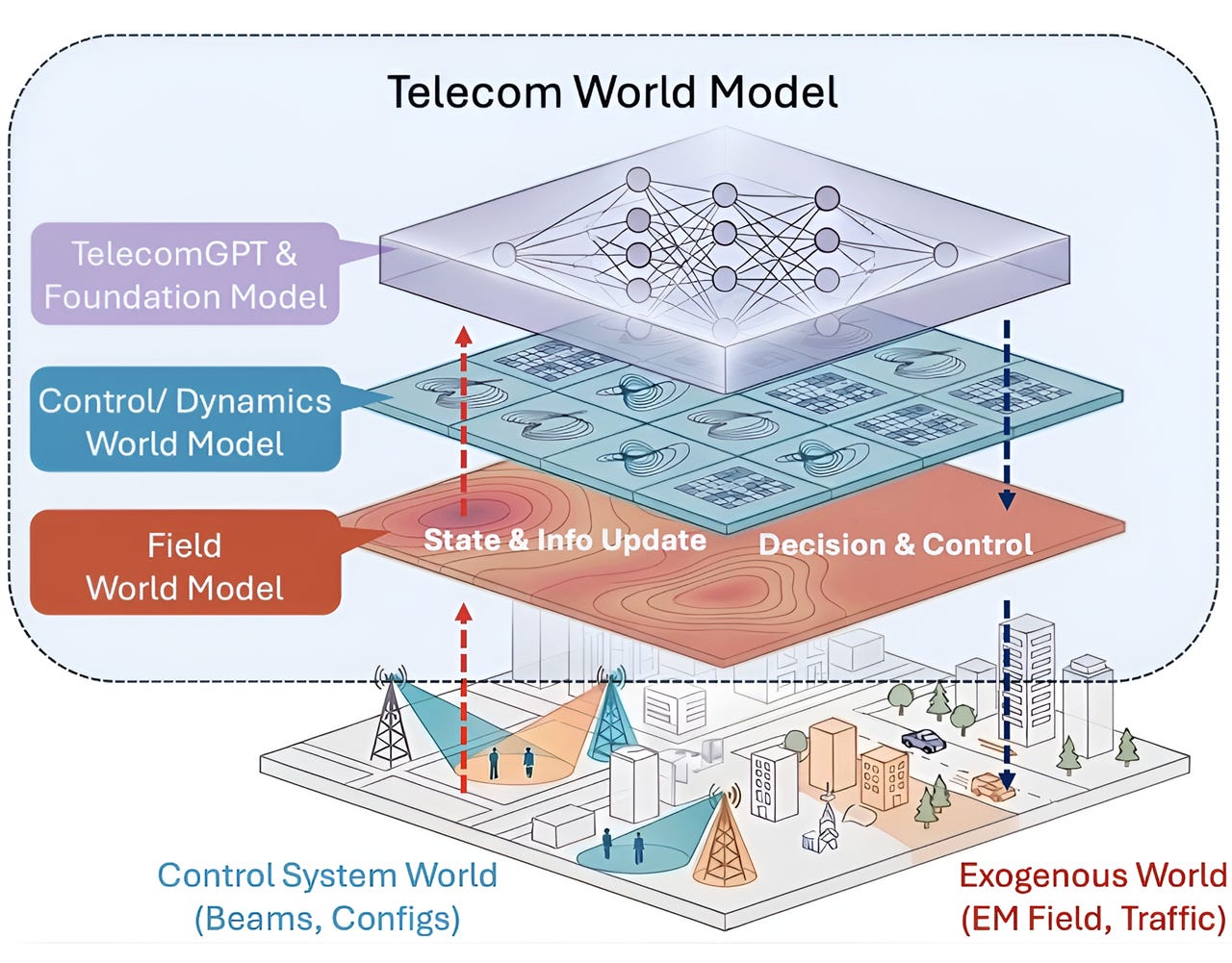
Khalifa University’s Digital Future Institute has developed a Telecom World Model (TWM), a three-layer AI architecture designed to predict how telecom networks will behave over time, rather than simply reacting to problems as they arise.
TWM addresses a gap that neither large language models nor digital twins currently fill. LLMs can interpret network logs and generate configurations, but cannot model how networks physically evolve. Digital twins simulate scenarios but rely on fixed assumptions and rarely support real-time decision-making under uncertainty.
The architecture separates network dynamics into three interacting layers: a Field World Model for spatial environment prediction, a Control and Dynamics World Model for forecasting key performance indicators based on control actions, and a Telecom Foundation Model layer for intent translation and orchestration.
TWM is built specifically with 6G in mind, where decisions must account for evolving network states, uncertainty, and the cascading effects of control actions across multiple layers simultaneously — a level of complexity that existing paradigms cannot reliably handle.
A proof-of-concept on multi-domain network slicing demonstrated that the full TWM pipeline outperforms single-paradigm baselines, achieving better SLA compliance while reducing cost compared to both standalone AI agents and digital twin-based approaches under similar resource constraints.
The system models both controllable and external network worlds. The controllable world covers operator-configurable settings, while the external world captures wireless propagation, user mobility, traffic patterns and potential failures: all modelled together in real time.
TWM is not designed to replace LLMs or digital twins, but to act as a predictive core that grounds higher-level reasoning in actual network dynamics, with LLMs and digital twins playing supporting roles within the broader framework.
Key open challenges remain before TWM reaches production, including integration with existing infrastructure such as O-RAN and OSS/BSS platforms, standardised benchmarking, and building regulatory and governance frameworks for autonomous network management decisions.
The Telecom World Model research team includes: Merouane Debbah, Hang ZOU, Yuzhi Yang, Lina Bariah, Yu Tian, PhD, Yuhuan Lu, Bohao Wang, Anis BARA, Brahim Mefgouda, Hao Liu, Yiwei Tao, Sergey Petrov, Salma Chèour, Nassim Sehad, Sumudu Samarakoon, Chongwen Huang, Samson Lasaulce, Mehdi Bennis
ZOOM OUT — The Telecom World Model is one piece of a much larger research programme at Khalifa University's Digital Future Institute which has been gaining momentum. In February 2026, the institute released RF-GPT, the first radio-frequency language model capable of reasoning over wireless signals, and co-developed 6G-Bench with UAE University, the first open benchmark for evaluating AI in 6G networks across 113,475 scenarios. In March, it joined AT&T, AMD and the GSMA to launch Open Telco AI at MWC Barcelona, leading the initiative's Network Management and Configuration Group. Khalifa University is quietly becoming one of the most productive 6G research institutions in the world.
[Written and edited with the assistance of AI]
LINK
Telecom World Models paper (arXiv)
Read more about other telecom AI research from Khalifa University:
GSMA & Khalifa University test AI telecom agents (Middle East AI News)
GSMA whitepaper sets out 6G role for agentic AI (Middle East AI News)
Open Telco AI Leaderboard Release 3 launched (Middle East AI News)
Khalifa University unveils breakthrough RF AI model (Middle East AI News)
UAE University, KU release first open 6G AI benchmark (Middle East AI News)