

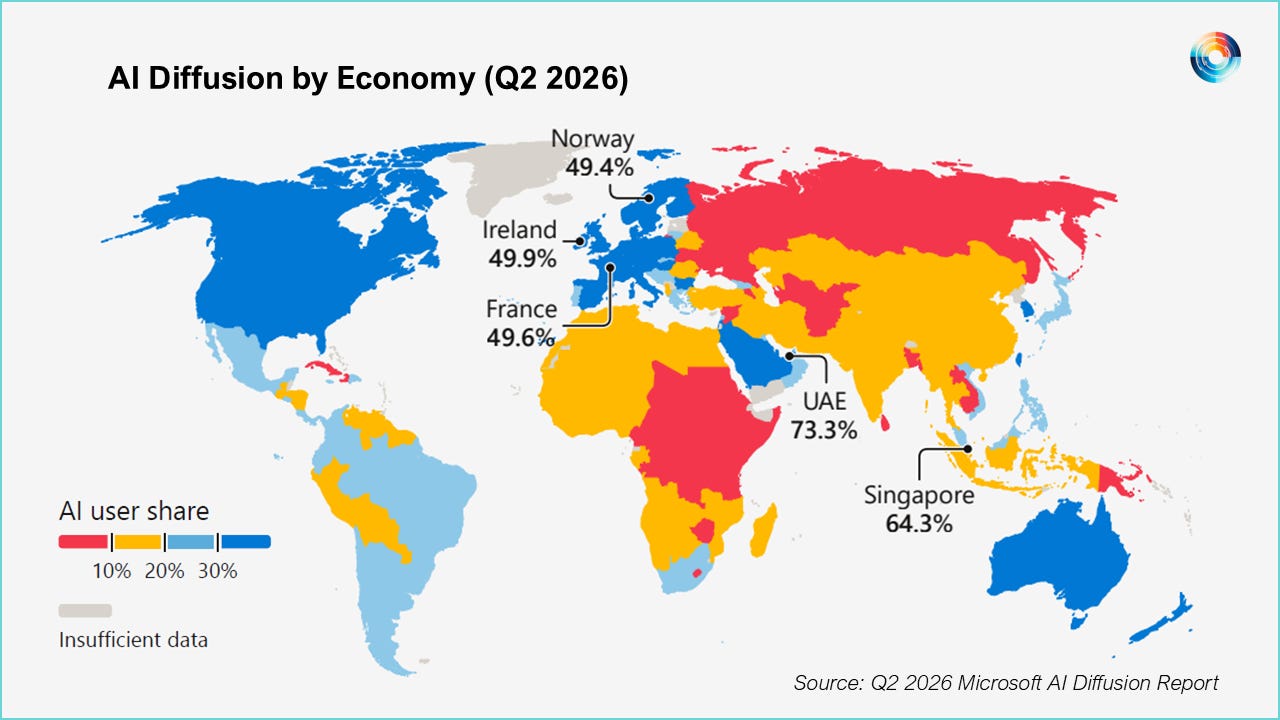
#GCC #AIAdoption - Microsoft AI Economy Institute (AIEI) has published its Global AI Diffusion Report for the second quarter of 2026, showing the UAE remains the world’s most AI-active economy, with 73.3 percent of its working-age population using generative AI. Global AI usage climbed to 18.8 percent of the working-age population, up roughly one percentage point from Q1, with growth spread across nearly every economy tracked. Two other Middle East countries were ranked in the AI diffusion report: Saudi Arabia posted the biggest rank jump in the Middle East, climbing from 30th to 25th globally with usage reaching 31.4 percent; while Qatar retained 10th place with at 43.5 percent.
SO WHAT? - The UAE's lead isn't just holding, it's growing. This quarter's score is three percentage points up from the previous report, meaning the UAE isn't simply staying ahead of the pack, it's a little further forward. The UAE’s leading position reflects years of deliberate policy choices: early government leadership, regulatory pragmatism, and sustained investment in digital infrastructure and AI skills. As global adoption accelerates broadly, the UAE isn't just keeping pace with that acceleration, driving it.
KEY POINTS:
Global generative AI usage reached 18.8% of the world’s working-age population in June 2026, up about one percentage point from Q1 2026, with growth broad-based across almost every economy tracked.
The UAE leads the world at 73.3% AI diffusion, followed by Singapore at 64.3%, Ireland at 49.9% and France at 49.6%.
Qatar entered the global top ten for the first time at 43.5%, ranking alongside the Netherlands, while Israel ranked third in the Middle East at 38.7%.
Saudi Arabia recorded the largest rank climb of any economy in the report, moving from 30th to 25th place globally with usage reaching 31.4%, newly entering the top 25.
South Korea posted the largest quarterly gain worldwide at 3.5 percentage points, its third consecutive quarter as the biggest riser, adding nearly 15 percentage points to its AI user share over the past 12 months.
Only 31 of the 147 economies tracked have AI diffusion above 30%, described in the report as an “elite cohort” of adopters.
The gap between the Global North (28.8% usage) and Global South (16.2% usage) widened from 12.1 to 12.6 percentage points during the quarter, driven by unequal access to electricity, connectivity and digital skills.
Open-weight AI models are closing the gap with closed frontier models faster than before: GLM-5.3 scored 44.9 on the Artificial Analysis Intelligence Index by September 2026, edging past levels set by earlier closed models including Claude Opus 4.8 in May.
Developer activity around AI applications has surged, with public Hugging Face Spaces reaching 1.46 million by September 2026, an 83% increase from October 2025.
ZOOM OUT – The UAE’s high adoption rate is one of the outcomes of a policy journey that began in 2017, when the UAE became the first country in the world to appoint a Minister of State for Artificial Intelligence. Since then, the government has systematically embedded AI across performance, planning and legislation. The UAE operates the world’s first AI-powered Proactive Government Performance System tracking over 150 million data points monthly. In April 2026, the UAE Cabinet announced a world-first framework to deploy agentic AI across 50 percent of government sectors, services and operations within two years. No other government has moved at this speed or this scale.
[Written and edited with the assistance of AI]
DOWNLOAD

Read about previous Microsoft AI Diffusion reports:
UAE leads the world in AI adoption (Middle East AI News)
UAE extends global lead in AI adoption (Middle East AI News)
UAE leads world in AI adoption rates (Middle East AI News)