

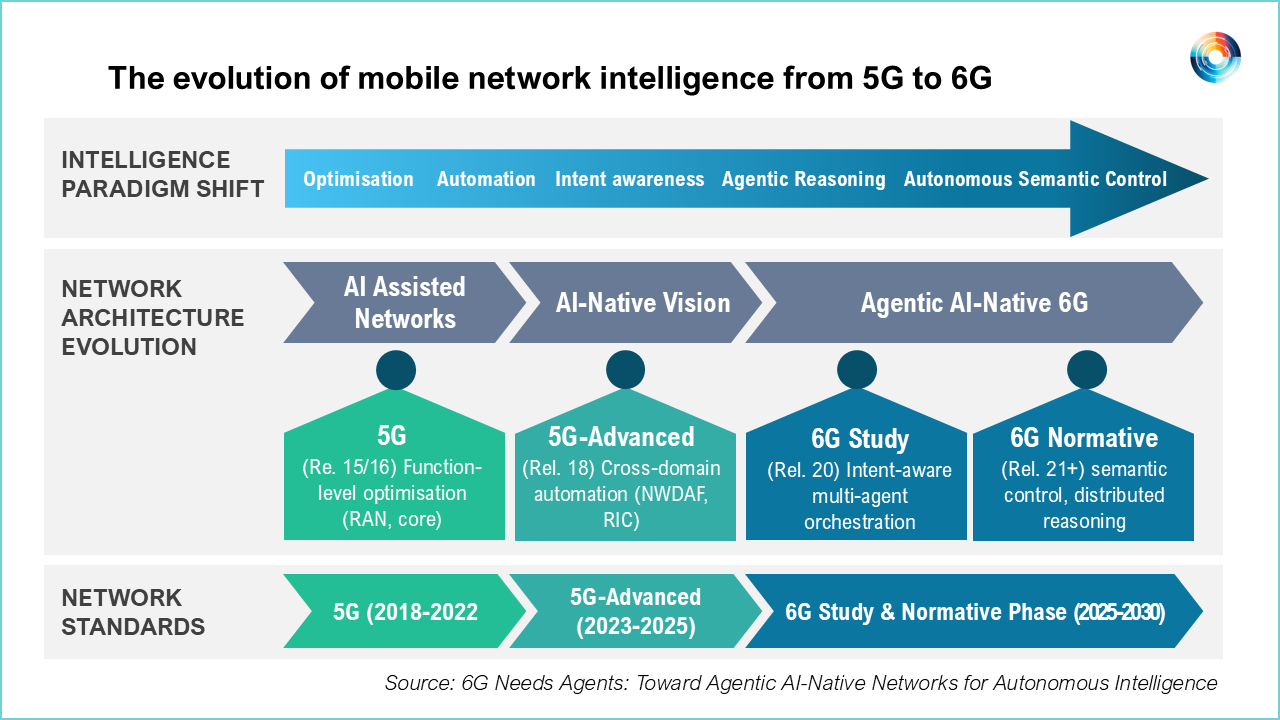
#UAE #telecom – The Department of Computer and Network Engineering at UAE University in collaboration with the Digital Future Institute at Abu Dhabi-based Khalifa University, have have published a paper arguing that 6G networks must move beyond optimisation-based AI toward fully agentic, reasoning-capable systems. The research paper proposes a four-layer architecture in which large language model-based agents operate as policy-governed reasoning entities within a dedicated semantic control layer sitting above standard 3GPP network infrastructure. The researchers also developed 6G-Bench, a domain-specific benchmark to evaluate LLM agent performance under realistic 6G deployment constraints.
SO WHAT? – Most current AI in telecoms is narrow and reactive. It typically optimises specific functions but cannot reason, adapt intent, or coordinate autonomously across a network. This paper argues that the window to fix this is closing fast. With 6G standardisation moving from study phase to normative specifications between now and 2027, architectural decisions made in the next two years will define how intelligent 6G networks actually are. UAE researchers are making a direct case for embedding agentic AI at the architectural level before those decisions are locked in.
KEY POINTS:
The Department of Computer and Network Engineering at UAE University (UAEU) in collaboration with the Digital Future Institute at Abu Dhabi-based Khalifa University, have have published a research paper 6G Needs Agents: Toward Agentic AI-Native Networks for Autonomous Intelligence, arguing for a fundamental rethink of how intelligence is built into 6G networks.
The paper proposes a four-layer agentic architecture spanning deterministic network infrastructure, semantic abstraction, hierarchical reasoning, and a distributed multi-agent fabric running across device, edge, and core network domains.
At the core of the proposal is a semantic control plane, in which LLM-based agents handle intent-aware, context-driven, and trust-aware decision-making — sitting above, but working in concert with, standard 3GPP telecom infrastructure.
The researchers recently built and tested 6G-Bench, a domain-specific benchmark designed to evaluate LLM agent performance under realistic 6G constraints, measuring tradeoffs between reasoning accuracy, inference latency, throughput, and memory efficiency.
A key finding is that no single AI model can satisfy all 6G performance requirements simultaneously. High-capability models deliver stronger reasoning but at higher latency and memory cost, while compact quantised models run efficiently but with reduced reasoning accuracy.
The results point to heterogeneous agent deployment as the practical path forward, with different LLM agents placed at different points across the device-edge-core continuum depending on the performance tradeoffs required at each layer.
The researchers also asserts that quantisation (compressing AI models to run on constrained hardware) affects different models in different ways, meaning system-level optimisation is needed rather than blanket model compression. This has direct implications for how 6G network operators will need to design and manage AI deployments.
The new research aligns with active standardisation efforts across 3GPP Release 20 and 21, the ITU IMT-2030 framework, IETF AI agent drafts, and ETSI’s zero-touch service management initiatives (all of which are moving toward intent-driven, AI-native network architectures).
The 6G research team includes Mohamed Amine Ferrag (UAE University), Abderrahmane Lakas (UAE University), Merouane Debbah (Khalifa University).
ZOOM OUT – The new research paper follows the joint released of 6G-Bench by the two universities in February: the first open benchmark designed to assess how well foundation models handle semantic communication and network-level reasoning in AI-native 6G networks. 6G-Bench has been used to test 27 AI models across 30 decision-making tasks, drawing on 10,000 multiple-choice questions derived from more than 113,000 scenarios. Researchers found that accuracy rates across models tested ranged from 22.8 percent to 82.9 percent (with mid-scale models offering the strongest balance between accuracy and deployability). Meanwhile, by open-sourcing the full benchmark infrastructure, the team gave network operators, equipment manufacturers, and researchers an independent, reproducible way to evaluate whether today’s AI models are ready for deployment on 6G networks.
[Written and edited with the assistance of AI]
Sources: Khalifa University, UAEU, MEAIN
LINKS
6G Needs Agents research paper (arXiv)
Agentic 6G code (GitHub)
DOWNLOAD
Read more about the UAE’s 6G research:
Khalifa University builds AI brain for 6G networks (Middle East AI News)
GSMA & Khalifa University test AI telecom agents (Middle East AI News)
GSMA whitepaper sets out 6G role for agentic AI (Middle East AI News)
Khalifa University unveils breakthrough RF AI model (Middle East AI News)
UAE University, KU release first open 6G AI benchmark (Middle East AI News)